

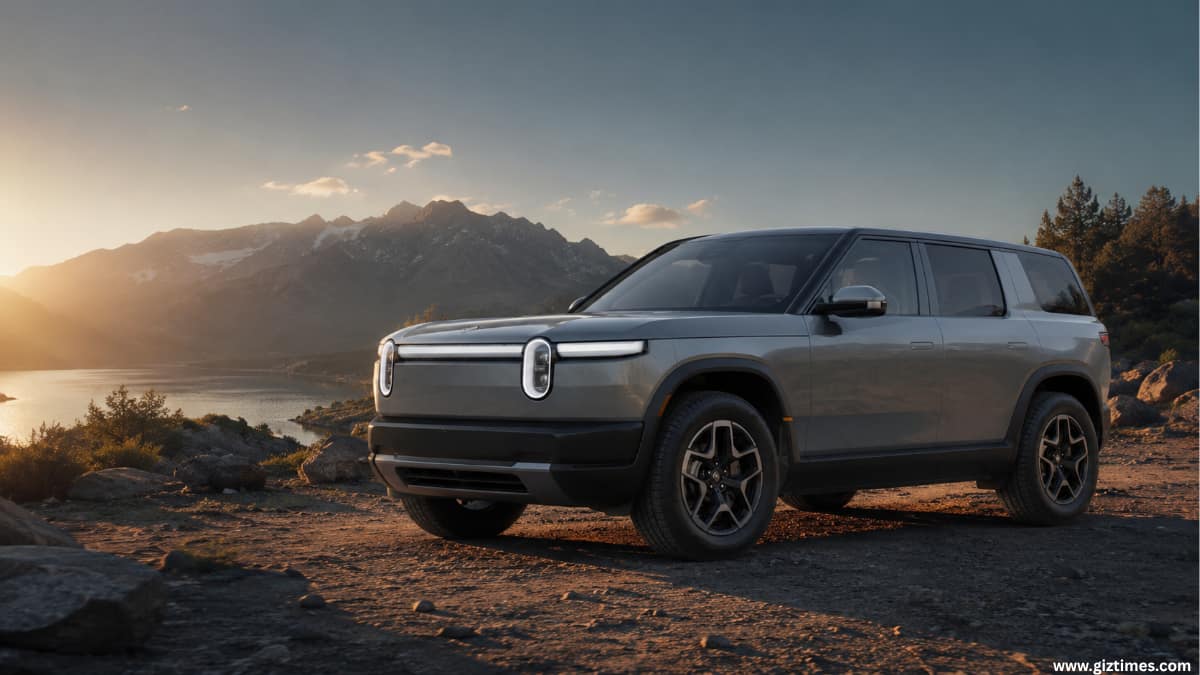
HYDERABAD, India (GizTimes) —The Rivian R2 is more than a smaller version of the company’s existing SUVs. It represents Rivian’s attempt to move from a premium electric vehicle manufacturer into the center of the EV market. Scheduled for production in the first half of 2026 with a starting price of approximately $45,000, the R2 brings Rivian’s design language, software focus, and adventure-oriented identity to a significantly broader audience.
That creates an important question. Can Rivian preserve the characteristics that defined the R1S and R1T while lowering costs enough to compete in one of the industry’s most competitive segments?
Why This Vehicle Exists
The R2 exists because Rivian’s future growth depends on volume rather than exclusivity.
The R1 lineup established the brand’s reputation, but premium pricing naturally limits the number of customers who can enter the ecosystem. The R2 addresses that constraint by targeting the midsize EV SUV segment, where buyers generally evaluate practicality, charging convenience, value, and daily usability alongside performance.
The vehicle’s specifications reflect this balancing act. Rivian will offer single-motor, dual-motor, and tri-motor configurations, allowing buyers to prioritize either affordability or performance. The tri-motor version is expected to reach 0-60 mph in under three seconds, while range is estimated at more than 300 miles depending on configuration and battery selection.
The design also reveals a shift in priorities. Compact dimensions improve urban usability, while folding front and rear seats, a powered rear glass window, dual gloveboxes, and multiple storage compartments maintain the utility-focused character that has become part of Rivian’s identity.
A less apparent insight emerges when these features are viewed together. Rivian is not simply reducing the size of the R1S. It is selectively preserving the brand-defining experiences, adventure capability, cargo flexibility, software integration, and performance while redesigning the underlying vehicle to lower production costs. That disparity is critical because mainstream buyers rarely pay for complexity they cannot see.
Framework Integration
The R2’s strategy becomes clearer when its technology and engineering architecture are analyzed together.
On the software side, Rivian is introducing a redesigned platform with over-the-air updates, advanced driver-assistance technology, and hardware designed to support future driver-assistance progress. This means the vehicle is intended to evolve throughout ownership rather than remain fixed at launch.
At the same time, Rivian has reworked the vehicle’s underlying systems to reduce manufacturing complexity. The company states that major vehicle systems have been redesigned, electrical architecture has been simplified, component counts have been reduced, and more functions have been integrated into fewer assemblies.
These two decisions reinforce each other. A software-defined vehicle becomes more valuable when the hardware architecture is simplified and integrated. Fewer components can reduce production costs while creating a cleaner foundation for future software updates and feature deployment.
The result is not merely a cheaper Rivian. It is a vehicle designed around scalability. That matters because the success of a mass-market EV increasingly depends on manufacturing efficiency as much as battery technology or acceleration figures.
Comparison
The Rivian R2 and Ford Mustang Mach-E approach the electric SUV market from different directions. Ford emphasizes performance heritage and driving concentration through the Mustang brand, while Rivian combines performance with utility, adventure-focused functionality, and a software-centric ownership experience.
| Category | Rivian R2 | Ford Mustang Mach-E |
|---|---|---|
| Starting Price | Approximately $45,000 | Not provided |
| Production Start | First half of 2026 | Currently on sale |
| Powertrain Options | Single-motor, dual-motor AWD, tri-motor | RWD and dual-motor AWD configurations |
| Performance Highlight | 0-60 mph in under 3 seconds (tri-motor) | GT and Rally variants deliver sports-car-like acceleration |
| Estimated Range | More than 300 miles depending on configuration | Not provided |
| Software Updates | Over-the-air updates | Software updates through SYNC system |
| Driver Assistance Hardware | Enhanced autonomous driving hardware with multiple cameras and sensors | Advanced connectivity and driver-focused technology |
| Charging Standard | Native NACS compatibility | Access to Tesla Supercharger network through NACS |
| Utility Features | Folding front and rear seats, powered rear glass, multiple storage compartments | Spacious flat-floor EV interior |
| Brand Positioning | Adventure, utility, technology, performance | Performance-focused electric crossover |
Public Reaction Analysis
The public discussion around the R2 reveals that many consumers view the vehicle through a lens larger than the product itself.
One recurring theme is the comparison to Tesla’s Model 3 era. Some observers see the R2 as Rivian’s equivalent of a moment of transition from a niche manufacturer to a volume producer. The focus is not solely on specifications but on whether Rivian can successfully scale manufacturing while maintaining product quality. In this view, the vehicle has become a test of Rivian’s long-term viability rather than just another model launch.
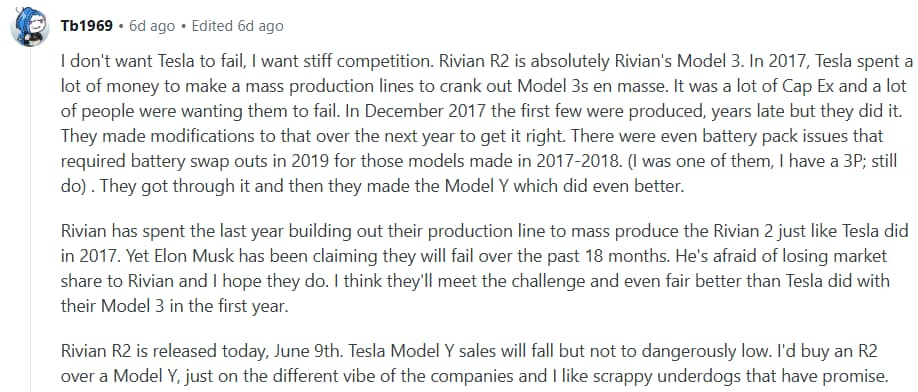
Another pattern involves future-proofing. While enthusiasm for the vehicle remains strong, some prospective buyers are already examining technical decisions such as the 400V architecture. The concern is less about present-day performance and more about how competitive the platform will remain over several years of ownership.
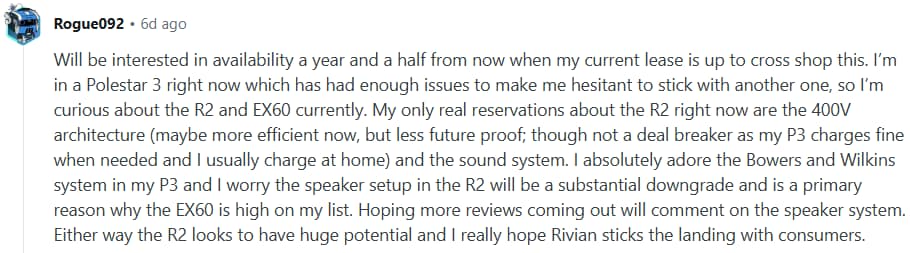
Interestingly, concerns about the sound system appear alongside discussions of charging architecture and software capability. This suggests that mainstream EV buyers increasingly evaluate vehicles as complete technology products rather than transportation devices. Performance alone is no longer enough. Consumers expect excellence across software, charging, comfort, and digital experiences.
Why It Matters
The R2 arrives at a critical moment for the EV industry.
As electric vehicles become more common, success is shifting away from simply offering an EV and toward delivering a complete ownership ecosystem. Buyers increasingly compare charging access, software functionality, practicality, and long-term value alongside traditional measures such as range and acceleration.
The R2 directly addresses these preferences. Native access to the North American Charging Standard ecosystem improves charging convenience. Over-the-air updates support continuous advancement. Manufacturing simplification targets affordability. Flexible interior packaging increases everyday usefulness.
For Rivian, the stakes are especially high. The R1T and R1S established brand credibility. The R2 is the vehicle that will determine whether that credibility can translate into mainstream scale.
Final Takeaways
One notable aspect of the R2 is that its most important innovation may not be visible to customers. The redesign of manufacturing processes, electrical systems, and component integration could have a greater impact on Rivian’s future than any single performance specification.
Another observation is that Rivian is entering the market without abandoning its identity. Many manufacturers move downmarket by removing distinguishing features. The R2 instead attempts to preserve the experiences that made the brand recognizable while reducing production complexity behind the scenes.
Much of the discussion now centers on Rivian’s ability to scale manufacturing efficiently, which could define its conversion from a niche EV brand into a major automotive manufacturer.
