

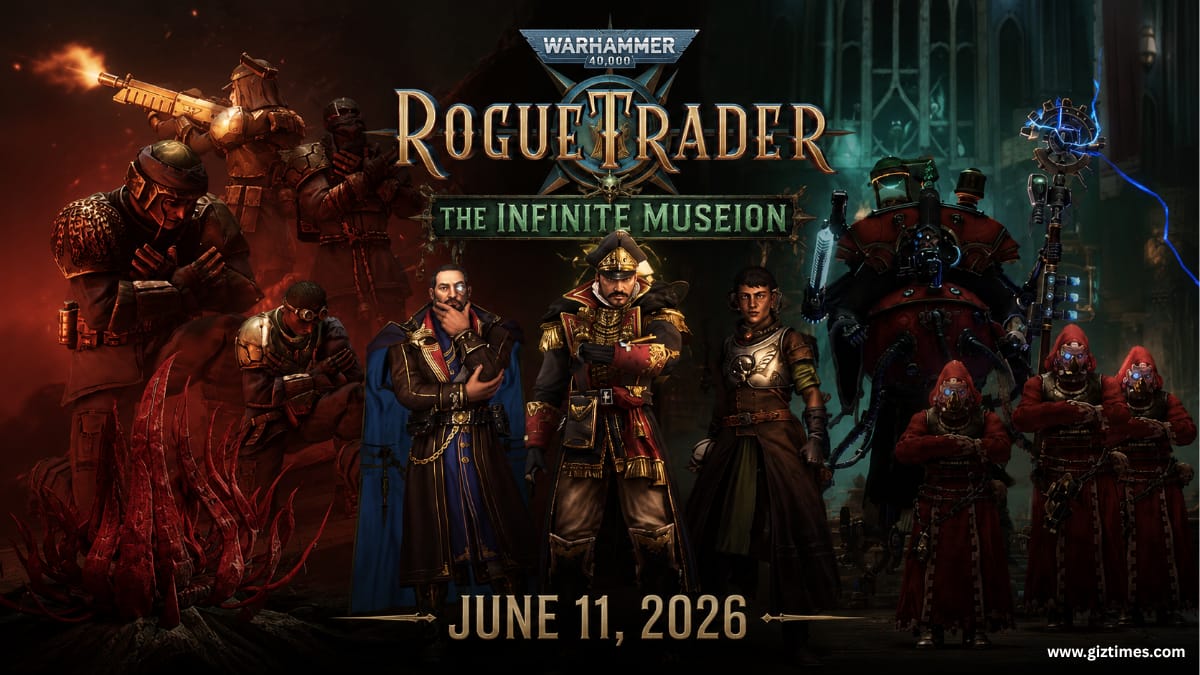
HYDERABAD, India (GizTimes) — Owlcat Games has expanded Warhammer 40,000: Rogue Trader once again with The Infinite Museion, a major story DLC released on June 11, 2026. Built around the legendary Necron collector Trazyn the Infinite, the expansion introduces a multi-act narrative campaign, a new companion, extensive cybernetic augmentation mechanics, additional exploration content, and deeper role-playing opportunities tied to the von Valancius dynasty.
The expansion arrives at an important moment for Rogue Trader’s post-launch lifecycle. Following the law-focused Lex Imperialis expansion released in 2025, Owlcat is now shifting toward one of Warhammer 40K’s most recognizable lore figures. The question is not whether the DLC adds content, it clearly does but whether its new systems and narrative focus strengthen Rogue Trader’s position in an increasingly competitive CRPG market.
Why This Matters in Gameplay
The most significant addition is not Trazyn himself but the cybernetic augmentation system. With more than 100 augmentation options reportedly available, players can fundamentally reshape character progression through implants, bionic limbs, and mechanical enhancements that alter combat effectiveness and survivability.
What makes the system noteworthy is its built-in trade-off structure. Augmentations provide power but introduce vulnerabilities such as susceptibility to EMP-based attacks. This design prevents cybernetics from becoming a straightforward upgrade path and preserves build diversity. Instead of replacing existing progression systems, augmentations create a second layer of strategic decision-making.
The addition of Eogunn Februs further supports this design philosophy. As a Tech-Priest Manipulus focused on technological support and battlefield utility, he naturally complements augmentation-heavy builds while also introducing narrative uncertainty through his questionable loyalties.
From a gameplay perspective, the DLC appears focused on expanding player expression rather than simply increasing enemy counts or quest volume. That distinction matters because long-term RPG engagement often depends on replayability and build experimentation more than raw content quantity.
Framework Integration
Performance Analysis and Unresolved Questions
On the technical side, The Infinite Museion maintains accessibility across platforms. The DLC launches on Windows, macOS, PlayStation 5, and Xbox Series X|S, while retaining controller support for Xbox, DualShock, and DualSense devices.
The PC requirements remain relatively modest for a modern CRPG. Minimum specifications require an Intel Core i5-4590T, 8GB RAM, and integrated graphics solutions such as Intel HD Graphics 630 or Radeon RX Vega 6. Recommended requirements move to an Intel Core i5-6400, 16GB RAM, and a GTX 1050 Ti or RX 570-class GPU.
The larger concern is not hardware performance but content execution. Community discussion shows uncertainty about how much meaningful late-game content the expansion contributes, particularly in Act V. Some players have criticized the base game’s final act for becoming too easy once character power reaches its peak. The augmentation system may deepen progression, but it also risks increasing player power further if encounter difficulty does not scale appropriately.
A second unresolved issue comes from early community comparisons with previous expansions. While critics have praised the DLC’s lore integration and customization systems, some players already question whether its narrative quality can surpass earlier releases.
This creates an interesting tension. Owlcat’s strongest innovation appears mechanical, while community expectations remain heavily focused on story quality.
A Non-Obvious Market Insight
An important pattern emerges when comparing Owlcat’s recent expansions. Lex Imperialis expanded Rogue Trader through political investigations, Imperial law, and faction-based role-playing. The Infinite Museion shifts toward character customization, artifact hunting, and Necron lore.
This suggests Owlcat is deliberately diversifying expansion themes instead of repeatedly targeting the same audience segment. Rather than creating multiple versions of the same DLC formula, the studio appears to be building distinct entry points for different Warhammer fan communities. That approach potentially broadens Rogue Trader’s market appeal without fragmenting the core game.
Comparison
While both expansions build upon the Koronus Expanse, they target different aspects of the Rogue Trader experience. Lex Imperialis focused on authority, investigations, and Imperial politics, while The Infinite Museion prioritizes customization, exploration, and Necron-focused storytelling.
| Category | The Infinite Museion | Lex Imperialis |
|---|---|---|
| Release Date | June 11, 2026 | June 24, 2025 |
| Main Focus | Trazyn the Infinite and Necron lore | Adeptus Arbites and Imperial law |
| New Companion | Eogunn Februs | Solomorne Anthar |
| Major Gameplay Feature | Cybernetic Augmentation System | Familiars and Cyber-Mastiff |
| Story Structure | Multi-act campaign beginning in Act 2 | Investigation-focused campaign |
| Character Progression | 100+ augmentation options | Companion and familiar progression |
| Core Theme | Discovery, artifacts, ancestry, manipulation | Justice, authority, loyalty |
| Exploration Focus | Infinite Museion vault and artifact hunts | Legal investigations and faction conflicts |
| Platforms | PC, macOS, PS5, Xbox Series X | S |
Public Reaction Analysis
The community response reveals cautious optimism rather than outright excitement.
One recurring pattern is comparison fatigue. Some players immediately measured the DLC against previous expansions, questioning whether its story can match or exceed earlier releases. This indicates that Owlcat’s biggest competitor may no longer be other CRPGs but its own content library.

Another reaction highlights anticipation mixed with caution. Players appear enthusiastic about downloading and experiencing the expansion but remain hesitant until they see how the content performs in practice. That reflects growing expectations around post-launch RPG content, where consumers increasingly evaluate expansions based on depth rather than marketing promises.

The most revealing feedback concerns Act V difficulty. Rather than asking for more story alone, players specifically want encounters that challenge fully developed characters. This suggests a portion of the community views endgame balance as a larger issue than content quantity. If accurate, future updates may need to focus as much on encounter design as narrative expansion.

Why It Matters
The Infinite Museion strengthens Rogue Trader’s position within the CRPG market by targeting three areas that traditionally drive long-term engagement: narrative choice, character customization, and franchise lore.
Trazyn the Infinite provides immediate recognition among Warhammer fans, while the augmentation system offers mechanical depth that extends beyond a single playthrough. Together, they create a DLC capable of attracting both lore enthusiasts and optimization-focused RPG players.
The expansion also reinforces Owlcat’s broader post-launch strategy. Rather than delivering small cosmetic packs, the studio continues producing large narrative additions that significantly alter how players approach the game. In a live-service era where many games prioritize seasonal content cycles, Rogue Trader’s expansion model remains closer to traditional RPG growth.
Extra Takeaways
The addition of cybernetic customization aligns naturally with Warhammer 40K’s transhuman themes, making the progression system feel lore-driven rather than mechanically isolated.
Eogunn Februs may ultimately prove as important as Trazyn from a gameplay perspective because support-oriented companions often have wider impact on party composition than narrative antagonists.
The emphasis on Heretic-aligned choices suggests Owlcat is continuing to invest in alternative playthroughs, which directly increases replay value without requiring entirely separate campaigns.
If successful, The Infinite Museion could become the expansion that transforms Rogue Trader’s customization depth and long-term replayability, but uncertainty around narrative comparisons and late-game challenge remains a meaningful risk.
