

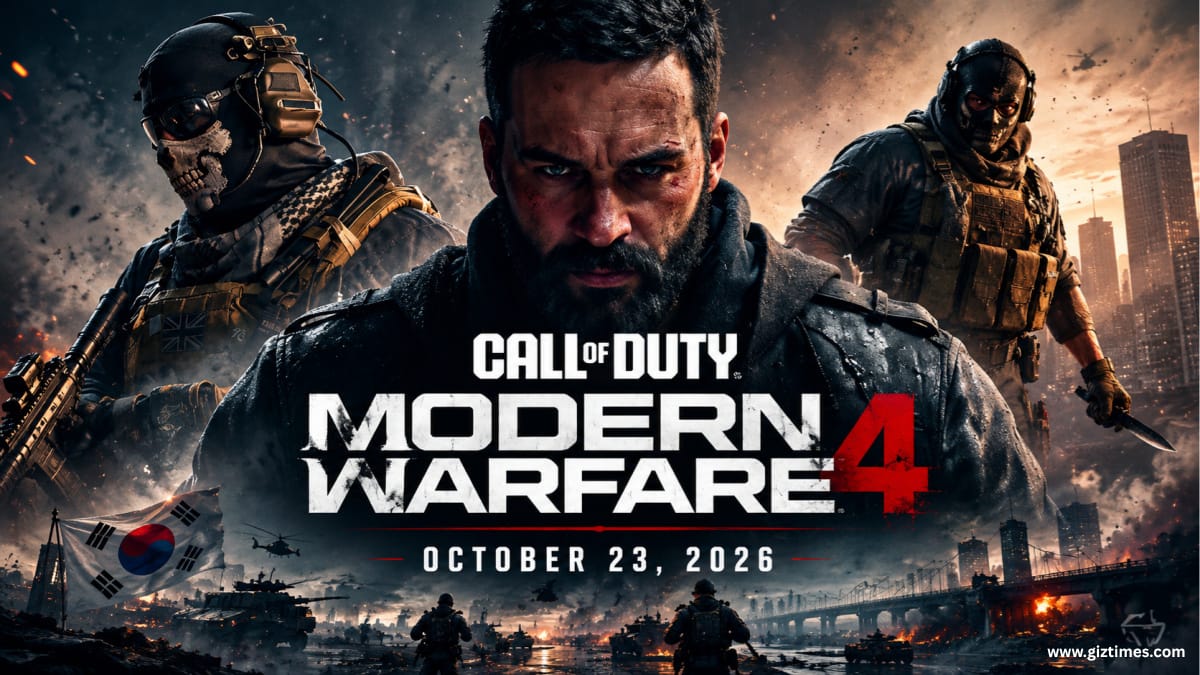
HYDERABAD, India (GizTimes) — Activision and Infinity Ward have officially revealed Call of Duty: Modern Warfare 4, with a worldwide launch scheduled for October 23, 2026 on PlayStation 5, Xbox Series X|S, PC, and Nintendo Switch 2. Unlike its predecessor, the game abandons PlayStation 4 and Xbox One support entirely, signaling a major technological shift for the franchise. The reveal trailer places players in the middle of a large-scale war on the Korean Peninsula, where North Korea launches a full-scale invasion of South Korea while Captain Price pursues a separate revenge-driven mission operating in the shadows.
The announcement positions Modern Warfare 4 as Infinity Ward’s most ambitious post-reboot entry. The trailer emphasizes larger battles, higher visual fidelity, expanded environments, and a more serious military tone. At the same time, comparisons with Call of Duty: Modern Warfare III are unavoidable because the previous game generated mixed reactions regarding its campaign quality despite offering substantial multiplayer and Zombies content.
Why This Matters in Gameplay
The most significant change is not the setting but the hardware strategy behind it. Modern Warfare III was designed across two console generations, supporting PlayStation 4, PlayStation 5, Xbox One, Xbox Series X|S, and PC. Modern Warfare 4 removes those older platforms completely, allowing Infinity Ward to build around current-generation hardware without legacy limitations.
That decision directly impacts gameplay possibilities. Infinity Ward is promising larger-scale military engagements, more detailed environments, and more ambitious campaign set pieces. The Korean Peninsula setting appears designed to support this vision, combining urban warfare, frontline combat, covert operations, intelligence missions, and political intrigue within a single narrative structure.
The multiplayer changes also suggest a shift toward competitive consistency. Infinity Ward has highlighted reduced shooting randomness, improved recoil behavior, refined weapon handling, better aiming mechanics, and faster movement responsiveness. Rather than introducing entirely new systems, the studio appears focused on tightening core gunplay fundamentals.
DMZ’s return further expands the game’s scope. Instead of Modern Warfare III’s focus on open-world Zombies as its major cooperative experience, Modern Warfare 4 places extraction gameplay at the center of its long-term strategy. Dynamic weather, roaming AI threats, evolving mission structures, and persistent deployment progression are intended to make each deployment less predictable.
A less obvious takeaway from the reveal is that Infinity Ward appears to be separating itself from Modern Warfare III’s experimental design philosophy. MWIII expanded player freedom through Open Combat Missions and introduced large-scale open-world Zombies. Modern Warfare 4 instead seems focused on refining established systems rather than introducing radically different ones. That suggests the studio may be prioritizing consistency and immersion over experimentation.
Performance Analysis and Key Issues
The technical direction represents one of the strongest arguments in Modern Warfare 4’s favor. By dropping previous-generation support, Infinity Ward can devote resources toward larger battles, improved world detail, enhanced visual fidelity, and more complex environmental effects.
The simultaneous release on Nintendo Switch 2 is equally notable. This makes Modern Warfare 4 one of the first major Call of Duty releases to launch across all current-generation platforms at the same time. From a market-positioning standpoint, Activision is attempting to maximize platform reach without compromising its current-generation focus.
Yet several unresolved concerns remain.
The first issue is campaign confidence. Community reactions reveal lingering skepticism following Modern Warfare III’s campaign reception. Players are intrigued by the Korean conflict storyline, but many remain cautious about whether Infinity Ward can deliver a satisfying narrative after criticism directed at MWIII’s story structure.
The second issue involves long-term multiplayer identity. While the reveal trailer presents a grounded military atmosphere, some players worry that post-launch cosmetic strategies could eventually undermine that tone. This reflects a broader tension between immersive military storytelling and live-service monetization.
The third issue concerns expectations versus execution. Infinity Ward’s promises regarding improved gunplay, skill-based engagements, and more realistic combat flow sound appealing, but players have become increasingly hesitant to judge Call of Duty entries based solely on reveal trailers.
Comparison
Modern Warfare 4 and Modern Warfare III represent two different visions for the franchise. While MWIII focused heavily on nostalgia, cross-generation accessibility, and experimental modes, MW4 appears focused on technological advancement, military scale, and refined core gameplay.
| Category | Modern Warfare 4 | Modern Warfare III |
|---|---|---|
| Developer | Infinity Ward | Sledgehammer Games |
| Release Date | October 23, 2026 | November 2023 |
| Platform Strategy | Current generation only | Cross-generation release |
| Campaign Focus | Korean Peninsula invasion and global conflict | Task Force 141 vs Makarov |
| Narrative Structure | Multi-perspective military war story | Traditional campaign with Open Combat Missions |
| Major Gameplay Focus | Refined gunplay and expanded DMZ | Open Combat Missions and Open-World Zombies |
| Cooperative Mode | Expanded DMZ Extraction Experience | Large-Scale Open-World Zombies |
| Technical Direction | Larger battles, higher fidelity, expanded detail | Call of Duty HQ integration and cross-gen support |
| Nintendo Platform | Nintendo Switch 2 launch | No Nintendo release |
| Multiplayer Goal | Realistic combat flow and skill-based engagements | Classic MW2 maps with modern mechanics |
The comparison highlights a broader strategic shift. Modern Warfare III attempted to celebrate Call of Duty’s past through classic map returns and nostalgia-driven content. Modern Warfare 4 appears designed to push the franchise forward technologically while building a more serious military narrative around contemporary geopolitical conflict.
Public Reaction Analysis
Community reaction to the reveal trailer has been cautiously positive rather than overwhelmingly enthusiastic.

The strongest praise centers on the Korean Peninsula setting. Multiple players highlighted the Korean conflict as a refreshing direction for the series, suggesting that the campaign’s geopolitical focus immediately stands out from recent Call of Duty storylines. The trailer’s darker tone also received positive feedback, with some viewers describing it as stronger than recent franchise marketing efforts.
Visual presentation generated enthusiasm as well. Several reactions specifically praised the graphical quality shown in the trailer, reinforcing Infinity Ward’s emphasis on current-generation hardware capabilities.

At the same time, skepticism remains a major theme. Comments repeatedly reference disappointment with Modern Warfare III’s campaign, indicating that trust has not been fully restored. Players appear interested in the premise but are withholding judgment until gameplay demonstrations and reviews arrive.
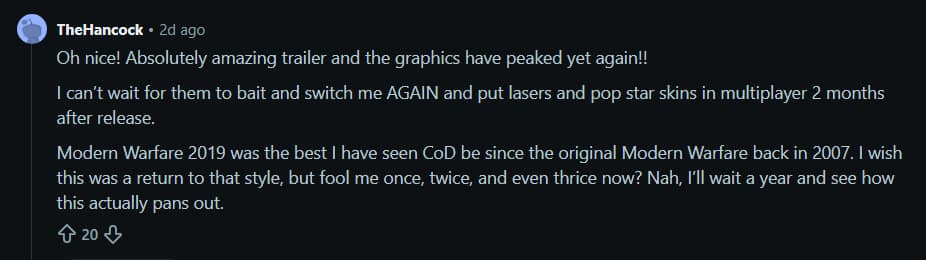
Another notable pattern is concern about post-launch identity. Some fans praised the grounded military atmosphere while simultaneously expressing concern that future cosmetic additions could clash with the serious tone established by the reveal. This contradiction reflects a wider challenge facing modern live-service shooters: maintaining thematic consistency while pursuing ongoing monetization.
Why It Matters
Modern Warfare 4 arrives at a critical moment for Call of Duty. The franchise no longer competes solely on sales but on long-term engagement, platform reach, and live-service retention.
The move to current-generation-only hardware aligns with broader industry trends as major publishers gradually leave behind PlayStation 4 and Xbox One. At the same time, the Nintendo Switch 2 launch expands the franchise’s potential audience significantly.
The return and expansion of DMZ is equally important. Extraction shooters have become an increasingly competitive segment, and Activision appears determined to establish DMZ as a long-term pillar alongside Campaign and Multiplayer rather than a side mode.
Success will depend on whether Infinity Ward can convert trailer excitement into meaningful gameplay improvements. Players are no longer evaluating Call of Duty solely on graphics or marketing. They are judging consistency, post-launch support, gameplay depth, and whether promises survive beyond launch month.
Extra Takeaways
The decision not to launch on Xbox Game Pass despite Microsoft’s ownership of Activision suggests that Call of Duty remains valuable enough as a premium release to maintain traditional sales strategies.
The Korean Peninsula setting also creates a unique narrative opportunity. Unlike many previous Modern Warfare conflicts that centered primarily on Western military perspectives, this campaign places South Korean soldiers at the forefront of major story events, offering a different viewpoint within the franchise’s modern warfare framework.
If successful, Call of Duty: Modern Warfare 4 could redefine the modern era of the franchise through current-generation technology and a more ambitious global conflict, but lingering concerns about campaign quality and long-term live-service direction remain significant risks.
