

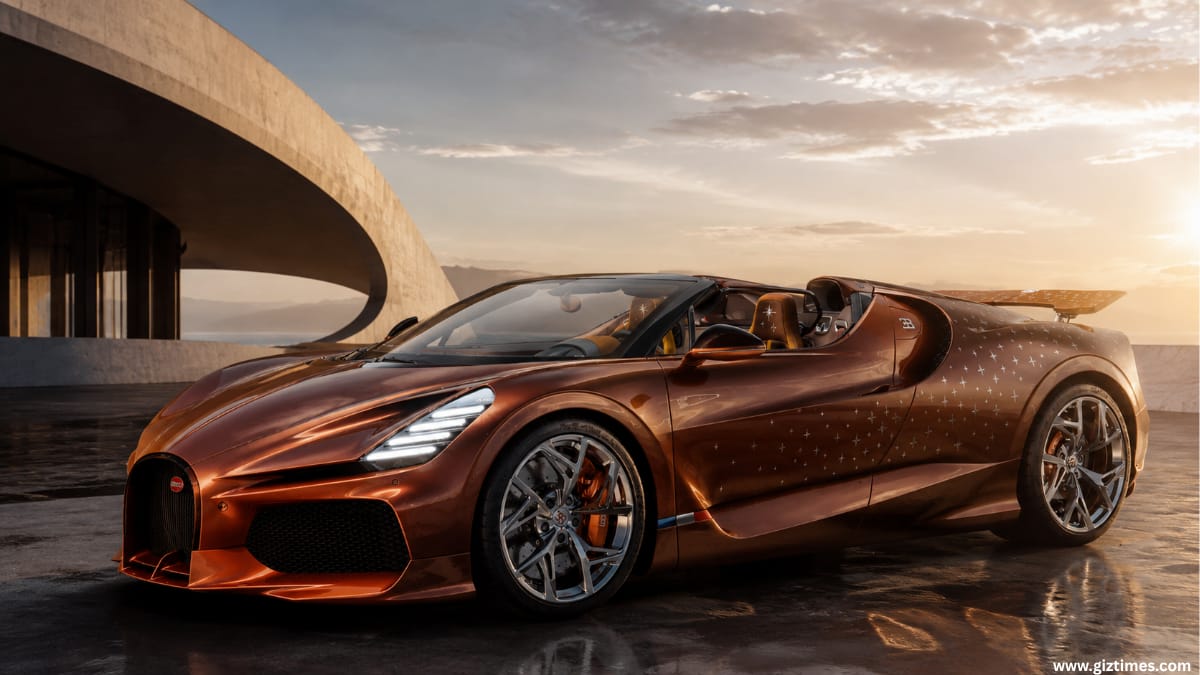
HYDERABAD, India (GizTimes) —The Bugatti W16 Mistral is not simply another limited-production hypercar. It represents the final roadgoing Bugatti powered by the company’s legendary quad-turbocharged 8.0-liter W16 engine, closing a chapter that began with the Veyron in 2005. Limited to 99 units and priced at approximately €5 million before customization, the Mistral combines extreme top-speed engineering with open-air grand touring.
What makes the car significant is not only its 1,578-horsepower output or its record-setting 453.91 km/h top speed, but also its place as the fastest roadster ever built. The deeper story is that Bugatti chose to end the W16 era with a fully open-top machine at a time when the hypercar industry is rapidly moving toward hybridization, electrification, and software-heavy performance systems.
The tension surrounding the W16 Mistral comes from that contradiction. It is both technologically advanced and mechanically old-school. It is engineered for future-level speed while serving as a farewell to excess pure combustion.
Why This Vehicle Exists
The W16 Mistral exists because Bugatti needed a final statement for the engine architecture that defined the brand for nearly two decades. The W16 powertrain became more than a specification sheet achievement after the Veyron. It evolved into Bugatti’s identity itself.
Rather than quietly retiring the engine, Bugatti transformed its final appearance into a celebration of mechanical engineering. The Mistral uses the highest-output roadgoing version of the W16 ever installed in a convertible, producing 1,578 hp and 1,600 Nm through all-wheel drive and a seven-speed dual-clutch transmission.
That approach reveals Bugatti’s larger strategy. Most modern hypercars increasingly focus on lightweight hybrid systems, software-managed torque delivery, or track-focused agility. The W16 Mistral instead prioritizes high-speed stability, long-distance capability, and sensory drama. It is engineered for sustained speed rather than short bursts of acceleration.
There is also a symbolic engineering decision hidden in the car’s configuration. Bugatti did not reuse existing Chiron body panels for the Mistral. The company developed a completely redesigned body and reworked airflow systems specifically for an open-top layout. That matters because it shows the Mistral was treated as a final flagship project rather than a low-volume derivative.
The car’s existence also reflects a changing hypercar economy. Every unit sold out almost immediately despite its multimillion-euro price, showing that collectors increasingly value historical significance as much as raw performance. Buyers were not simply purchasing speed. They were securing the last production Bugatti powered solely by the W16.
Framework Integration
The W16 Mistral demonstrates how Bugatti merges traditional mechanical engineering with modern aerodynamic and structural technology.
At the center of the experience is the quad-turbocharged 8.0-liter W16 engine derived from the Chiron Super Sport 300+. On paper, the numbers are already extreme. What becomes more interesting is how Bugatti engineered the surrounding systems to support those figures in a convertible platform capable of exceeding 420 km/h.
Open-top hypercars usually suffer from reduced chassis rigidity because removing a fixed roof weakens structural integrity. Bugatti responded by redesigning the monocoque and reinforcing the chassis to maintain near-coupe-level stiffness. That decision is central to the Mistral’s identity because stability at 400 km/h depends as much on structural behavior as engine output.
The aerodynamic package also reflects a systems-engineering mindset rather than pure styling. The dual roof-mounted air intakes behind the seats are not decorative elements. They simultaneously feed the massive W16 engine, improve airflow management, and contribute to rollover protection. Bugatti’s claim that the system was partly inspired by aviation engineering becomes reasonable when examining the layout. Fighter aircraft use controlled airflow pathways to stabilize performance under extreme conditions. The Mistral applies a similar philosophy to high-speed road-car aerodynamics.
Its active aerodynamics continue this integration. The rear active wing serves as both a stability system and an air brake, while the extended rear deck manages airflow separation at extreme speeds. Combined with adaptive suspension and carbon-ceramic brakes, the Mistral behaves less like a traditional convertible and more like a high-speed aerodynamic platform wrapped in luxury materials.
One non-obvious insight emerges from these engineering choices. Most open-top hypercars are designed around emotional driving experiences first, with performance adjusted afterward to compensate for their lack of rigidity. The W16 Mistral reverses that formula. Bugatti engineered the convertible structure around the demands of top-speed stability itself. That makes the roofless configuration part of the performance concept rather than a compromise.
Inside the cabin, Bugatti intentionally balances digital instrumentation with handcrafted physical components. The aluminum switchgear and the gear selector, featuring the amber-embedded “Dancing Elephant” sculpture, create a contrast rarely seen in modern performance cars. The interior is not trying to feel futuristic through minimalism. Instead, it treats mechanical craftsmanship as a form of luxury technology.
Comparison
The Bugatti W16 Mistral and Koenigsegg CC850 represent two very different responses to the future of hypercars. Both reject full electrification, yet their engineering philosophies move in opposite directions.
Bugatti focuses on top-speed stability, luxury grand touring, and the final evolution of an iconic combustion engine. Koenigsegg prioritizes driver engagement through lightweight engineering and its mechanical “Engage Shift System,” which blends manual driving feel with modern transmission technology.
| Specification | Bugatti W16 Mistral | Koenigsegg CC850 |
|---|---|---|
| Engine | 8.0-liter quad-turbocharged W16 | 5.0-liter twin-turbocharged V8 |
| Power Output | 1,578 hp | Up to 1,385 hp on E85 |
| Torque | 1,600 Nm | 1,385 Nm |
| Drivetrain | All-wheel drive | Rear-wheel drive |
| Transmission | 7-speed dual-clutch automatic | Engage Shift System with gated manual capability |
| Top Speed | 453.91 km/h record achieved | Not specified in provided data |
| Chassis | Carbon-fiber monocoque | Carbon-fiber monocoque |
| Key Engineering Focus | High-speed stability and aerodynamic integration | Driver engagement and transmission innovation |
| Production Volume | 99 units | 70 units |
| Starting Price | Approximately €5 million | Estimated above $3.5 million |
| Driving Philosophy | High-speed luxury touring | Mechanical driver involvement |
The comparison reveals an important aspect of the current hypercar market. Bugatti treats combustion engineering as a final large-scale monument, while Koenigsegg treats it as an interactive experience to preserve emotional connection. Both approaches are reactions against the industry’s shift toward hybrid systems, but they express that resistance differently.
Public Reaction Analysis
Public reactions to the W16 Mistral show that the car is being perceived less as a means of transportation and more as automotive art.
Comments describing the car as “absolute perfection” and “moonlight poetry” emphasize craftsmanship and emotional presence over technical specifications. That pattern is important because it suggests Bugatti has successfully moved beyond the traditional hypercar conversation dominated by acceleration numbers.

Another reaction, comparing Mistral’s design language to Ferrari Luce’s futuristic elegance, introduces a subtle shift in consumer expectations. Enthusiasts are no longer judging hypercars purely by mechanical performance. They are increasingly evaluating them through visual identity, digital aesthetics, and even the possibility of AI-assisted design evolution.
The mention of AI blending design principles is particularly revealing. It suggests that audiences now expect future hypercars to combine engineering heritage with computational creativity. In that context, the W16 Mistral feels intentionally analog. Its appeal comes partly from resisting the fully digital future.

There is also a broader emotional pattern underneath the reactions. Many responses celebrate the car with unusually nostalgic language despite it being a newly launched model. That nostalgia is tied directly to the W16 engine itself. Enthusiasts understand that the Mistral represents the end of a combustion era unlikely to return.
Why It Matters
The W16 Mistral matters because it represents a transition point in the automotive industry.
For nearly twenty years, Bugatti’s W16 engine symbolized the outer limit of combustion-engine engineering. The Mistral demonstrates how far that architecture could evolve before emissions regulations, electrification pressures, and hybrid performance systems reshape the hypercar market.
Its record-setting speed also proves that combustion-powered engineering still has room for advancement even in its final years. Achieving 453.91 km/h in an open-top car required aerodynamic precision, structural reinforcement, and thermal management at an extreme level.
At the same time, the Mistral shows how hypercars are changing the economy. Collector value now depends increasingly on historical significance and engineering uniqueness rather than simple performance superiority. The fact that every unit sold out immediately confirms that scarcity and legacy are becoming core market drivers.
The car also highlights a growing split within the hypercar industry. Some brands are moving toward lightweight electrified systems and software-defined performance. Others, like Bugatti with the Mistral and Koenigsegg with the CC850, are attempting to preserve mechanical theater before the industry fully transitions into hybrid or electric platforms.
Final Takeaways
The aviation-inspired roof intake design quietly shows how hypercar engineering increasingly borrows from aerospace airflow management rather than traditional automotive approaches.
The Mistral’s open-top configuration also changes how drivers experience speed. At over 400 km/h, airflow, sound, and vibration become part of the sensory performance package, creating a driving experience that closed-roof hypercars cannot fully replicate.
The inclusion of the “Dancing Elephant” sculpture inside the gear selector reveals another layer of Bugatti’s strategy. Even in a car engineered for record speeds, the brand still prioritizes historical continuity and handcrafted symbolism.
Much of the discussion now centers on how long pure combustion engineering can remain emotionally relevant, a question that could define the hypercar era’s final identity.
