

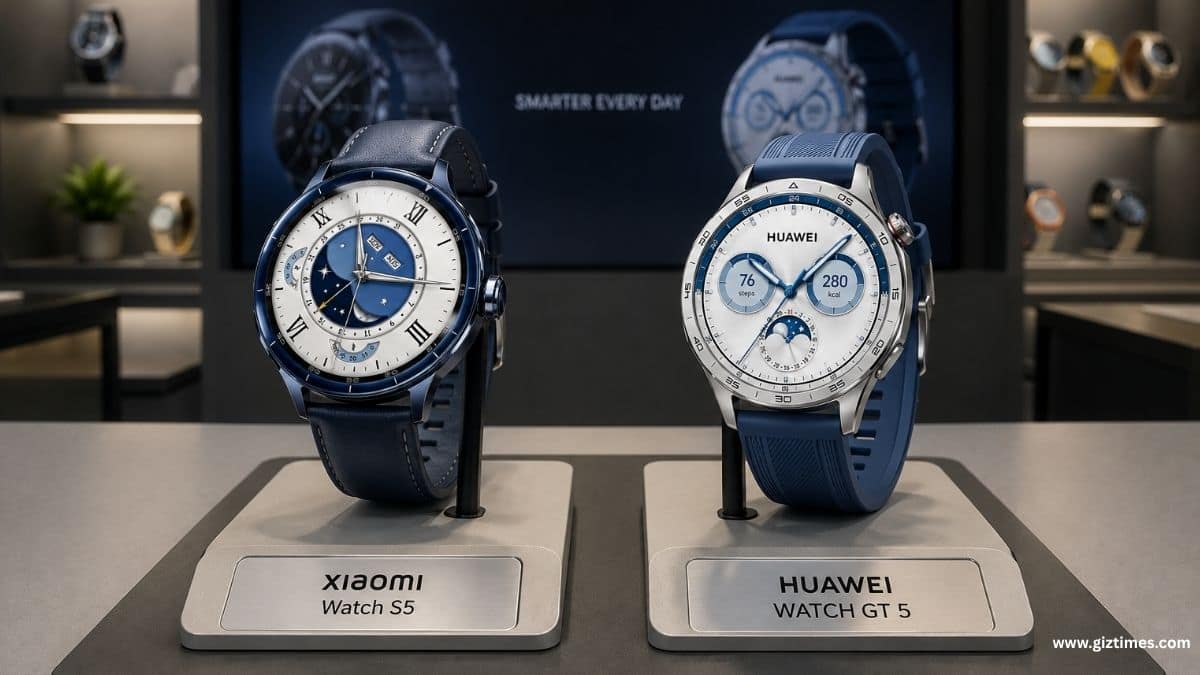
HYDERABAD, India (GizTimes) —The smartwatch market has quietly split into two completely different philosophies. One side is trying to build a miniature smartphone for the wrist. The other is building a long-lasting fitness instrument that disappears into daily life until you need it. The Xiaomi Watch S5 and Huawei Watch GT 5 represent those two directions almost perfectly.
Xiaomi is betting that consumers now care more about ecosystem convenience than isolated smartwatch intelligence. Huawei, meanwhile, continues refining a sports-focused wearable that prioritizes durability, battery endurance, and tracking precision over app-heavy flexibility.
What makes this comparison interesting is that both watches reject the traditional Wear OS formula. Neither is trying to compete directly with an Apple Watch Series 10 or a full Google-powered smartwatch. Instead, both are optimizing around efficiency. The difference is where that efficiency gets spent.
Why These Products Exist
The Xiaomi Watch S5 exists because Xiaomi no longer sees the smartwatch as a standalone gadget. HyperOS 3 transforms the watch into a control surface for a wider device ecosystem. The watch can display live doorbell camera feeds, trigger smart home interactions, sync with Xiaomi vehicles, and even overlay biometric data onto smartphone-recorded workout videos.
That changes the role of the watch completely. Xiaomi is not trying to replace your phone. It is trying to reduce friction between all the devices you already own. The 21-day battery life reinforces this strategy because the watch becomes something that stays attached to your ecosystem continuously instead of demanding constant charging attention.
Huawei took the opposite route. The Watch GT 5 exists to optimize the physical experience of wearing and training with a smartwatch for long periods. The company invested heavily in environmental resilience, dual-band positioning accuracy, and the TruSense biometric framework.
The IP69K certification is a strong example of this philosophy. Most smartwatches stop at water resistance marketing. Huawei engineered the GT 5 to withstand high-pressure, hot-water exposure, alpine conditions, and extended outdoor use. That is not lifestyle branding. It is structural overengineering aimed directly at endurance users.
The deeper insight here is that Xiaomi treats the watch as a network node, while Huawei treats it as field equipment.
Hardware Versatility and Ecosystem Longevity
The Xiaomi Watch S5 has stronger long-term consumer flexibility if the buyer already lives inside Xiaomi’s ecosystem. HyperOS 3 allows the watch to participate in automotive alerts, smart home security feeds, camera controls, and synchronized AIoT interactions.
That matters because smartwatch usefulness usually declines when novelty disappears. Xiaomi is trying to prevent that decline by continuously attaching the watch to everyday routines beyond health tracking.
The fixed integrated bezel design also reveals Xiaomi’s new direction. The previous modular bezel-swapping approach was removed in favor of a slimmer unified stainless steel frame. Xiaomi clearly decided that users value premium thinness and refined aesthetics more than physical customization gimmicks.
Huawei’s hardware versatility is far more specialized. The GT 5 platform scales upward into serious sports instrumentation through the GT 5 Pro line with titanium alloy, sapphire glass, ECG telemetry, golf mapping, and free-diving support.
But Huawei’s ecosystem roadmap is narrower. HarmonyOS remains highly efficient, but the ecosystem is still relatively isolated. Third-party app support remains limited, and some advanced integrations behave inconsistently depending on the paired smartphone brand.
Ironically, Xiaomi’s smartwatch becomes more valuable as you buy more Xiaomi devices. Huawei’s watch becomes more valuable as your athletic demands become more serious.
That distinction matters more than raw specifications.
Performance and GPS Accuracy
Both watches focus heavily on positioning precision, but Huawei’s implementation feels more athlete-oriented.
Xiaomi’s Watch S5 uses dual-frequency L1+L5 GNSS support with five satellite systems and claims a 33% improvement in route plotting alongside 30% faster GPS locking. Offline color vector maps and track-back navigation also make it genuinely useful for hiking and outdoor movement.
The Huawei Watch GT 5 pushes further with its Sunflower Positioning System, which physically redesigns antenna placement around the watch body to reduce signal degradation during wrist movement. Huawei claims 40% better route accuracy and 20% better pace calculations. This is a subtle but important difference. Xiaomi improved GPS processing. Huawei redesigned the physical signal acquisition behavior itself.
For casual runners, walkers, and cyclists, both will feel highly accurate. But for serious outdoor athletes who care about pace consistency, terrain precision, and stable route telemetry during motion-heavy activities, Huawei’s engineering focus is more advanced.
Public reactions reinforce this divide. Users praise the GT 5’s running, cycling, and golf metrics alongside excellent battery life, but criticism appears when advanced sports expectations increase. Complaints about inaccurate heart-rate readings during slower movement, weak training effect analysis, and limited hiking map depth suggest Huawei still prioritizes broad efficiency over Garmin-level sports analytics. Those criticisms matter because Huawei positions itself close to performance-athlete territory.
Xiaomi avoids this problem by never pretending to be an elite sports watch in the first place.
Comparison
The real difference between these products is not hardware power. It is where each company spends engineering attention. Xiaomi optimizes interaction convenience across devices. Huawei optimizes reliability during physical activity and harsh usage conditions.
| Category | Xiaomi Watch S5 | Huawei Watch GT 5 |
|---|---|---|
| Operating System | HyperOS 3 | HarmonyOS 5.0 |
| Core Philosophy | Ecosystem control hub | Sports-focused endurance watch |
| Build Material | 316L stainless steel | Stainless steel / Titanium (Pro) |
| Thickness | 10.99 mm | 10.7 mm (46mm) |
| Battery Life | Up to 21 days | Up to 14 days |
| GPS System | Dual-frequency GNSS (L1+L5) | Dual-band GNSS with Sunflower Positioning |
| Brightness | Up to 2500 nits | Over 1200 nits (Pro) |
| Offline Maps | Yes | Yes |
| Smart Home Integration | Extensive HyperOS controls | Limited |
| Sports Metrics Depth | Strong general tracking | More advanced athletic analytics |
| Water Resistance | Swim-ready with wet-touch protection | IP69K + 5 ATM |
| Ecosystem Dependency | Best with Xiaomi devices | Works broadly but limited apps |
| Third-Party Apps | Very limited | Very limited |
| Premium Outdoor Features | Basic outdoor integration | Diving, ECG, Golf, biomechanics |
| Pricing | EUR 179.99–199.99 | ₹15,999–₹39,999 depending on model |
Public Reaction Analysis
Consumer reactions reveal a very clear pattern. Most users are surprisingly willing to forgive smartwatch software limitations if battery life is excellent. That explains why criticisms about missing messaging replies or music uploads do not dominate the discussion around Huawei devices. Users entering this category already understand the tradeoff. They are buying endurance first.
But reactions also expose a dangerous middle ground for Huawei. Casual users praise the metrics and reliability, while serious athletes begin noticing inconsistencies in heart-rate precision and advanced training analytics. That creates tension because Huawei visually positions the GT 5 Pro like a professional sports instrument.


 Xiaomi avoids this identity conflict more effectively. The Watch S5 never positions itself as a hardcore athlete device. Its value proposition is convenience density. Smart home control, vehicle alerts, camera synchronization, and wearable ecosystem continuity are easier promises to satisfy consistently.
The non-obvious insight here is that Xiaomi’s strategy is probably more scalable long term. Smart home ecosystems naturally gain value as more connected products enter the home. Sports tracking, meanwhile, becomes harder to improve because serious athletes eventually compare everything against specialized brands like Garmin.
The Bigger Shift in Smartwatch Priorities
The Xiaomi Watch S5 simplifies buying decisions for consumers already invested in Xiaomi hardware. If someone owns Xiaomi phones, smart home products, or eventually Xiaomi vehicles, the Watch S5 becomes a logical extension of daily life rather than just another wearable.
The Huawei Watch GT 5 serves a narrower but more demanding audience. It is for buyers who care about structural toughness, outdoor usage, battery reliability, and detailed athletic telemetry without entering the ultra-expensive Garmin or Apple Ultra pricing tier.
What this comparison ultimately reveals is that smartwatch value is shifting away from app counts. Consumers increasingly care about whether the watch integrates naturally into their specific lifestyle. That is a much harder category to dominate universally.
Other Keytakeaways
Xiaomi’s 2500-nit AMOLED panel is one of the more underrated upgrades here because smartwatch readability outdoors still affects daily usability more than most AI features.
Huawei’s use of only 32MB RAM is also surprisingly important. It demonstrates how aggressively the company optimized HarmonyOS efficiency instead of chasing smartphone-style computing power. That architectural restraint is the real reason the GT 5 achieves such long endurance. Both companies are quietly proving that the future of wearables may depend more on software discipline than processor horsepower.
The upcoming expansion of Xiaomi’s HyperOS ecosystem and Huawei’s next-generation TruSense platform will likely determine whether ecosystem-driven convenience or precision-first athletic specialization succeeds.
