

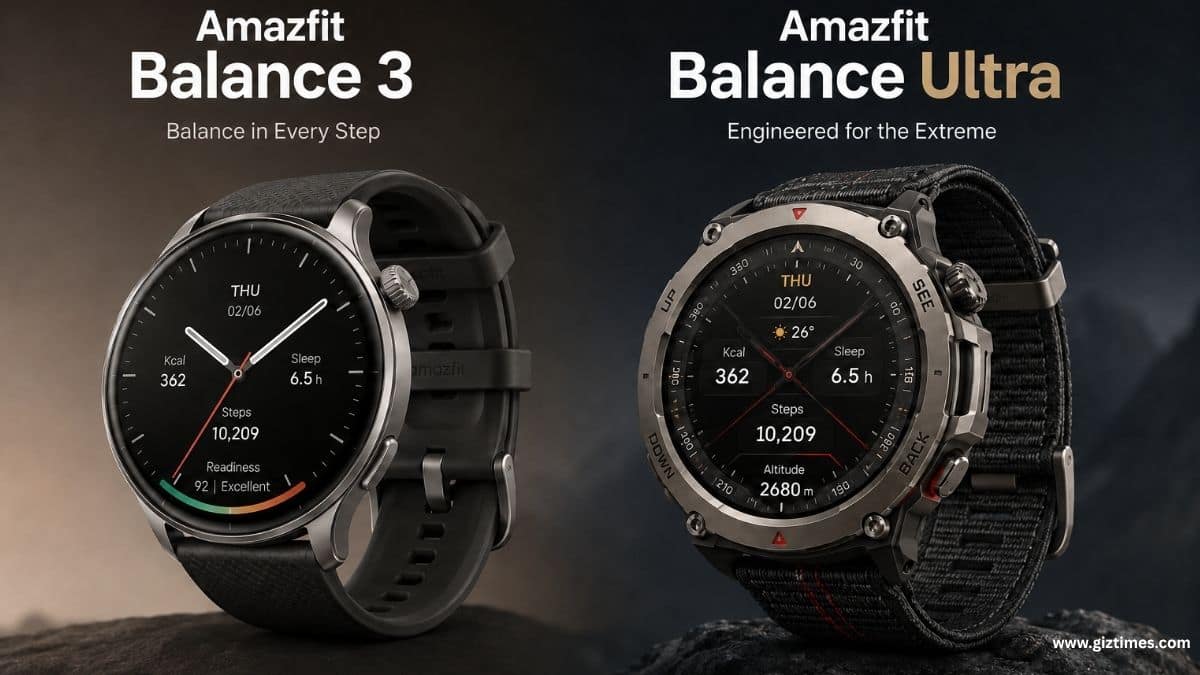
HYDERABAD, India (GizTimes) — Amazfit’s 2026 Balance lineup creates an unusual problem for buyers. The company has launched two watches that share the same core platform, software experience, upgraded processor, 3,000-nit display, and many of the same training tools. Yet one costs $369.99, while the other jumps to $599.99.
That immediately shifts the discussion away from features and toward value. The question is not which watch is better in absolute terms. The question is whether the Balance Ultra’s titanium construction and exceptional battery endurance justify a premium of roughly $230 over the standard Balance 3.
For most buyers, the answer appears surprisingly straightforward.
Why This Product Exists
The Balance 3 and Balance Ultra are not competing products. They are aimed at different types of athletes.
The Balance 3 is designed as a hybrid sports watch for people who move between office work, gym sessions, running, recovery tracking, and occasional endurance events. It combines a bright AMOLED display, advanced physiological analytics, HYROX integration, offline mapping, and long battery life at a price that remains within reach of mainstream fitness enthusiasts.
The Balance Ultra takes that same foundation and pushes durability and endurance to the extreme. Its full Grade 5 titanium construction, larger battery, additional physical button, and deeper outdoor positioning are targeted at athletes spending multiple days away from chargers or operating in harsh environments.
The interesting part is that Amazfit did not reserve major software features for the Ultra. Both watches receive the same modern platform experience. That changes the buying equation dramatically.
Processor Longevity: The Same Future-Proof Platform
The strongest argument for the Balance 3 is that it does not compromise on computing hardware.
Both watches use the newer ZPS3044S processor, which delivers map rendering that is 2.5 times faster and map refresh rates that are 12 times faster than the previous-generation chip. Both also include 64GB of storage and support advanced mapping functions.
From a longevity perspective, this is crucial. Buyers are not getting a slower chip or reduced storage by choosing the cheaper model. Navigation, offline maps, future Zepp OS features, and increasingly complex training analytics will run on the same hardware foundation.
That means the Balance 3 and Balance Ultra should age at a very similar pace from a performance standpoint. The Ultra’s higher price does not buy additional processing headroom. It is buying endurance and materials.
Hardware Versatility: Practical Control vs Extreme Durability
The Balance 3 makes several meaningful improvements over its predecessor by moving from two buttons to four physical controls. This improves usability during workouts when sweat, rain, or gloves make touchscreens less reliable.
The Ultra extends this philosophy further with five titanium buttons. For ultra-distance racers, open-water athletes, and expedition users, that extra physical control has real value.
Material choice creates the bigger distinction. The standard Balance 3 uses stainless steel with a plastic lower shell, while the Ultra adopts Grade 5 titanium across its external structure.
The practical implication is that most users will rarely push the Balance 3 beyond its durability limits. The Ultra’s titanium architecture matters most when repeated exposure to impacts, harsh environments, or multi-day outdoor adventures becomes routine in training.
A non-obvious insight emerges here: Amazfit appears to be treating hardware materials as the primary product differentiator rather than software features. Community reactions even suggest buyers are choosing based on aesthetics and design preference because functionality remains largely identical across the lineup. That is a rare strategy in the sports-watch market, where premium models often lock away major software capabilities.
Comparison
The comparison becomes surprisingly simple once feature overlap is accounted for. Both watches share the same display brightness, processor generation, storage capacity, HYROX ecosystem, Zepp OS 6 software foundation, and health platform. The Ultra’s advantages are concentrated in battery endurance, premium construction, and additional physical controls.
| Category | Amazfit Balance 3 | Amazfit Balance Ultra |
|---|---|---|
| Price | $369.99 | $599.99 |
| Processor | ZPS3044S | ZPS3044S |
| Storage | 64GB | 64GB |
| Display | 1.5-inch AMOLED, 3,000 nits | 1.5-inch AMOLED, 3,000 nits |
| Frame Material | Stainless Steel | Grade 5 Titanium |
| Bottom Casing | Plastic Shell | Grade 5 Titanium |
| Buttons | 4 | 5 |
| Weight | 62g (Stainless Steel model) | 57g |
| Battery Capacity | 658mAh | 780mAh |
| Typical Battery Life | Up to 21 days | Up to 30 days |
| Accurate GPS Runtime | Up to 41 hours | Up to 50 hours |
| Power Saving GPS Runtime | Up to 84 hours | Up to 97 hours |
| Water Resistance | 10 ATM | 10 ATM |
Public Reaction Analysis
The public discussion reveals an interesting pattern. The debate is not centered on missing features. Instead, it is centered on design and perceived value.
One group appreciates Amazfit’s willingness to offer multiple hardware choices without artificially restricting functionality. Users specifically note that they can choose based on appearance rather than losing major software capabilities. This suggests Amazfit’s strategy of maintaining feature parity is being recognized and appreciated.


 A second pattern involves aesthetics. Several reactions indicate a preference for the Balance 3’s softer, more rounded appearance. The Ultra’s design is repeatedly described as rigid, disjointed, or overly aggressive. Rather than seeing the Ultra as aspirational, some buyers view it as less wearable in daily life.
The most revealing sentiment is that people who prefer the Balance 3 are not necessarily rejecting premium hardware. They simply do not see enough additional utility to justify the price increase. That is a strong signal that the Balance 3 occupies the strongest value position in the lineup.
Why It Matters
The sports-watch market often relies on feature segmentation. Buyers are encouraged to spend more because premium models unlock capabilities unavailable elsewhere.
Amazfit has largely avoided that approach here. The Balance 3 delivers the same core performance experience, processor architecture, software ecosystem, and flagship display as the Ultra. The result is a watch that feels remarkably complete rather than intentionally limited.
For everyday hybrid athletes, that makes purchasing decisions easier. Spending $369.99 does not feel like settling for a lesser product. It feels like purchasing the most rational version of the platform.
The Ultra remains valuable, but its value proposition becomes highly specialized rather than universal.
Other Keytakeaways
One of the most interesting details is that the Ultra’s premium construction does not necessarily make it more wearable. Despite its titanium build, the watch remains physically large, measuring 51.8 mm and reaching 15.5 mm when the sensor housing is included. Even Amazfit’s own engineering analysis highlights concerns about bulk and comfort.
Meanwhile, the Balance 3 already delivers 41 hours of accurate GPS tracking and up to 21 days of typical battery life. For the overwhelming majority of runners, gym users, HYROX competitors, and outdoor enthusiasts, those numbers already exceed practical requirements.
The Ultra’s battery advantage is most meaningful for ultra-endurance athletes, multi-day adventurers, and racers who genuinely need every extra hour of GPS runtime.
The upcoming Zepp OS 6 update roadmap will likely determine whether Amazfit’s strategy of maintaining near-complete feature parity across price tiers succeeds or fails.
