

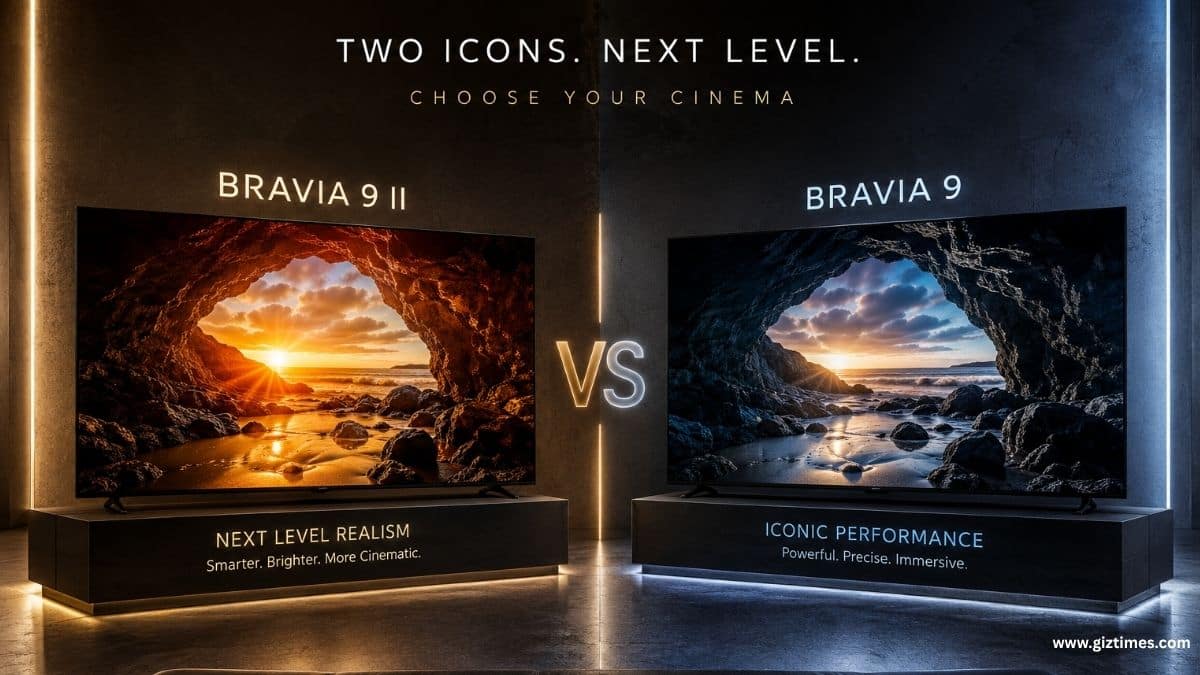
HYDERABAD, India (GizTimes) —Sony’s BRAVIA 9 II is not a normal yearly television upgrade. It is Sony attempting to rewrite how premium LCD televisions work altogether. Instead of refining the already aggressive Mini-LED formula from the original BRAVIA 9, Sony rebuilt the entire light-generation system around independently controlled red, green, and blue LEDs. The result is a television capable of nearly 4,000 nits of brightness, dramatically higher color volume, and blooming behavior that behaves more like optical lens flare than a traditional LCD artifact.
The problem is that the original BRAVIA 9 already solved most of the real-world issues consumers had with high-end Mini-LED TVs. Now that it sits in clearance territory with heavy discounts, the newer BRAVIA 9 II creates an uncomfortable question for Sony itself: how much visual perfection is actually worth paying for once you cross the ultra-premium threshold?
Why the BRAVIA 9 II Exists
The BRAVIA 9 II exists because OLED technology is starting to hit a physical wall in brightness. Hollywood mastering monitors are increasingly built around 4,000-nit HDR workflows, but consumer OLED panels still cannot sustain anywhere near that output without aggressive brightness limiting. Sony’s response was not to chase OLED harder. It was to abandon the traditional white LED backlight architecture entirely.
The new True RGB system changes the entire optical pipeline. Standard Mini-LED televisions rely on white or blue LEDs pushing light through color filters. Those filters absorb large amounts of light output to create red, green, and blue colors. Sony’s new system removes the filter dependency by generating pure red, green, and blue light directly from the backlight layer itself. That dramatically improves efficiency, brightness, and color purity at the same time.
In practical use, this creates a different kind of HDR presentation. The original BRAVIA 9 was already extremely bright at roughly 2,400 to 2,800 nits depending on mode. The BRAVIA 9 II pushes close to 4,000 nits while preserving richer color in highlights instead of washing them out into pale white tones. Explosions, sunlight reflections, neon signs, and specular lighting retain saturation instead of flattening under peak luminance pressure.
But Sony’s deeper goal is visible in another area: blooming control. The company clearly understands that traditional Mini-LED televisions still psychologically feel like LCDs because halos around bright objects remind viewers that the light source is shared across zones. The BRAVIA 9 II attacks this perception problem directly. When blooming occurs, the glow now matches the object color itself. A red neon sign produces faint red spill instead of gray haze. Human vision interprets this more naturally, making the artifact feel cinematic instead of electronic. That is probably the most important engineering trick in the entire television. Sony did not eliminate blooming physically. It changed how the brain perceives it.
The Hardware Longevity Advantage Is Bigger Than Brightness
The most overlooked part of the BRAVIA 9 II is not the brightness increase. It is the long-term stability advantage of the True RGB system itself.
Traditional OLED panels still operate with organic compounds that gradually wear over time, especially under sustained high-brightness workloads. Sony’s new architecture leans entirely into inorganic LED behavior. The independent RGB diodes are engineered for extreme luminance without relying on aggressive Automatic Brightness Limiter systems or long-term burn-in mitigation. That matters because HDR mastering standards are clearly moving toward higher peak brightness, not lower.
Ironically, though, the original BRAVIA 9 may still age more gracefully from a usability perspective because its processing demands are lower. The BRAVIA 9 II’s dual-step RGB modulation system is enormously computationally heavy, and the retained MediaTek Pentonic 1000 chipset already shows strain. Sony’s own testing revealed synchronization issues during difficult HDR scenes, including chromatic shifting and desync problems in Blade Runner 2049 text rendering.
That creates a subtle but important long-term concern. The BRAVIA 9 II is future-facing in display physics, but not entirely future-facing in silicon architecture. Sony pushed display engineering forward faster than the underlying processing platform evolved.
The update roadmap reflects this split personality, too. The newer set gains AI-heavy features like Voice Zoom 3 and deeper Google Gemini integration, improving dialogue separation and conversational TV interaction. The original BRAVIA 9 still receives firmware support and already possesses industry-leading image processing, but the II model is clearly built around more AI-driven refinement layers going forward.
Still, neither television solves Sony’s biggest flagship weakness: the HDMI architecture. Both rely on only two HDMI 2.1 ports, and one usually disappears into eARC audio duties. For televisions priced this high, especially in 2026, that limitation feels increasingly disconnected from how premium buyers actually use gaming hardware.
Sony Accidentally Reduced the Importance of Dimming Zone Numbers
The BRAVIA 9 II introduces one of the strangest premium TV regressions in recent years. The newer television actually reduces dimming zones compared to the original BRAVIA 9.
Normally, that would be a major concern. Yet Sony’s RGB architecture changes the rules enough that the reduction matters less than expected. The company effectively traded brute-force zone quantity for higher spectral precision. That is a major shift in how Mini-LED televisions are evolving.
The original BRAVIA 9 won through density and aggressive backlight precision. The BRAVIA 9 II wins through smarter light behavior itself. That may become the future direction of the premium LCD engineering industry-wide.
BRAVIA 9 II vs BRAVIA 9
| Category | BRAVIA 9 II | Original BRAVIA 9 |
|---|---|---|
| Backlight System | True RGB independent RGB LEDs | White Mini-LED with color filters |
| Peak Brightness | ~3,990 to 4,000 nits | ~2,400 to 2,800 nits |
| Color Volume | 2x higher than BRAVIA 9 | Baseline |
| Blooming Behavior | Color-matched natural glow | Traditional white/gray halos |
| Dimming Zones (75-inch) | 1,530 zones | ~1,920 zones |
| HDR Rendering | Native 4,000-nit mastering capability | Tone-mapped high brightness HDR |
| Processor | Cognitive Processor XR + upgraded RGB Master Drive Pro | Cognitive Processor XR + 22-bit XR Backlight Master Drive |
| HDMI 2.1 Ports | 2 ports | 2 ports |
| Maximum Refresh Rate | 4K 120Hz | 4K 120Hz |
| AI Features | Voice Zoom 3 + Google Gemini integration | Standard Voice Zoom processing |
| Acoustic Layout | Relocated mid-screen driver positioning | Bottom-edge driver positioning |
| Stand Design | Fixed-height Mirage Stand | Adjustable 4-way stand |
| Anti-Reflection | Immersive Black Screen Pro nanostructure | X-Anti Reflection coating |
| Launch Pricing | Higher premium positioning | Heavy clearance pricing |
Public Reaction Analysis
What stands out in user reactions is not excitement around brightness numbers. It is how often owners describe the original BRAVIA 9 as balanced.
One user compared it directly against LG’s C3 OLED and described Sony’s processing, shadow detail, and gradient handling as more satisfying despite the OLED’s strengths. Another highlighted how the BRAVIA 9 fixed the frustrating highlight dimming behavior present in older Samsung Mini-LED sets. A third user specifically preferred the BRAVIA 9 because it handled older movies dramatically better than Samsung’s gaming-focused OLED tuning.
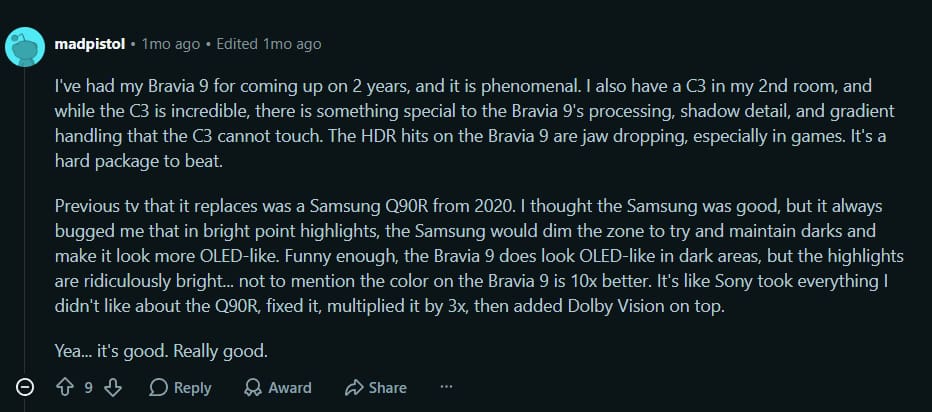

 There is a pattern here. Consumers are rewarding Sony less for extreme specs and more for restraint. The BRAVIA 9 became popular because it felt cinematic without constantly reminding viewers about the technology underneath. That matters because the BRAVIA 9 II pushes much harder technically, but also risks exposing more processing complexity in edge cases.
The non-obvious insight is that Sony may have already reached the point of diminishing returns for mainstream premium buyers with the original BRAVIA 9. The II model is technologically superior almost everywhere, yet the practical viewing experience gap may feel much smaller than the engineering leap suggests unless viewers specifically consume demanding HDR content in bright rooms.
Where the Original BRAVIA 9 Quietly Wins
The original BRAVIA 9 now occupies a very dangerous position for Sony’s own lineup. It is no longer the newest flagship, but it still delivers elite HDR brightness, outstanding processing, exceptional motion handling, and better stand flexibility while selling at heavily discounted clearance pricing in multiple regions.
For most luxury buyers, that changes the purchasing equation entirely.
The BRAVIA 9 II is the television for someone chasing display technology itself. It is for buyers who want the newest optical architecture regardless of diminishing returns. It is a statement product.
The original BRAVIA 9 is for someone who wants one of the best home theater experiences available without paying a massive premium for the final 10% leap in HDR and color science. That distinction matters because premium television pricing eventually stops scaling proportionally with real-world enjoyment.
The Bigger Market Problem Sony Created
The BRAVIA 9 II proves LCD technology still has room to evolve aggressively. That alone is a huge industry moment. Many expected OLED to permanently dominate flagship television perception. Sony just disrupted that narrative.
But it also complicates Sony’s own lineup strategy.
The company now has two televisions aimed at different interpretations of “premium.” One prioritizes absolute engineering advancement. The other prioritizes mature refinement and value efficiency. And because the original BRAVIA 9 remains so competent, the newer model unintentionally makes the older flagship look like the rational enthusiast purchase.
That is not a failure of the BRAVIA 9 II. It is evidence that Sony’s 2024 engineering was already ahead of where most consumers actually needed television technology to go.
Other Takeaways
The retention of the aging MediaTek Pentonic 1000 chipset across both generations quietly undermines Sony’s flagship positioning. Competitors increasingly treat gaming connectivity as a core premium feature, while Sony still behaves as though cinematic processing alone defines flagship status.
The fixed-height Mirage Stand on the BRAVIA 9 II also reflects Sony’s prioritization of industrial design aesthetics over setup flexibility. The original BRAVIA 9’s adjustable stand system remains more practical for mixed audio setups and varied furniture environments.
Sony’s increasing dependence on TCL fabrication infrastructure for massive screen sizes also signals where the television industry is heading: software and processing expertise may soon matter more than panel manufacturing ownership itself.
The upcoming firmware optimization cycle will likely determine whether Sony’s True RGB architecture becomes the new premium LCD standard or remains an expensive engineering showcase.
Read More:
