

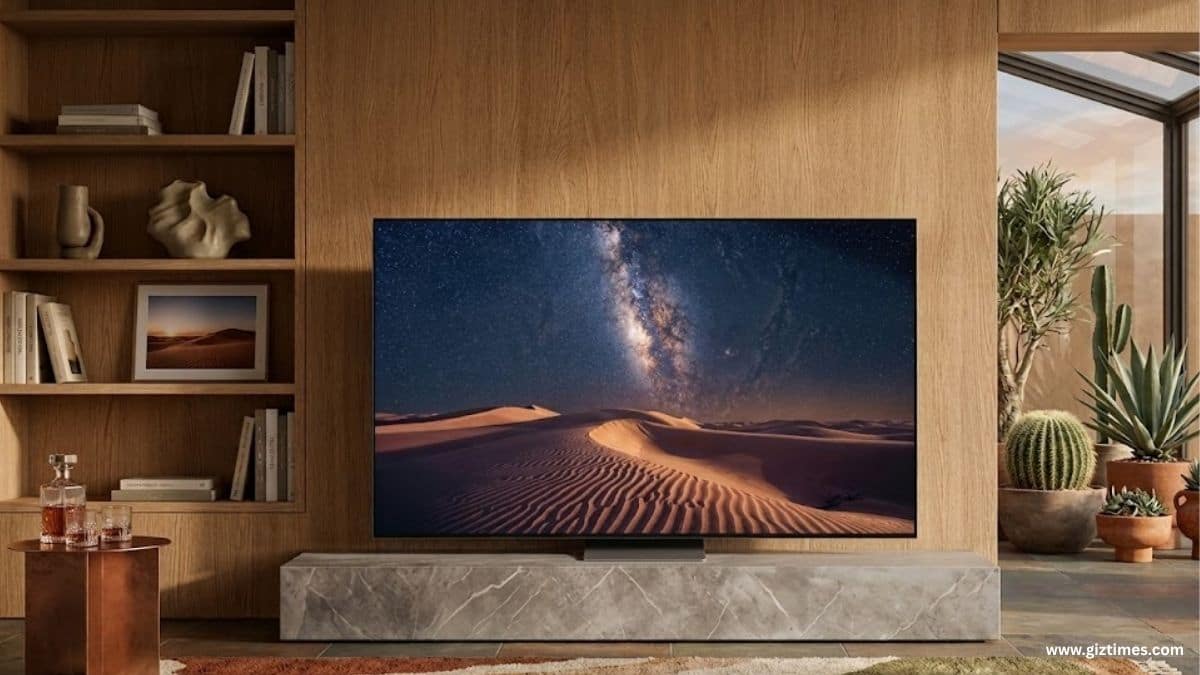
HYDERABAD, India (GizTimes) —The Samsung R85H, launching in 2026 at $1,599, isn’t just another step forward in TV tech; it signals a shift in what manufacturers are actually optimizing for. Instead of chasing brighter highlights or deeper contrast, the focus here is on precision that arguably goes beyond what most content and even human vision can fully take advantage of.
That changes how it compares to the Samsung S90F. This isn’t just a future vs. present value debate anymore. It raises a bigger question: what happens when display technology starts exceeding both the limits of available content and what our eyes can realistically perceive?
Why This Product Exists
The R85H exists because Samsung is aiming for a new kind of ceiling, one defined less by visible improvements and more by technical perfection.
With Micro RGB, each pixel produces its own red, green, and blue light independently. There’s no need for conversion layers like those used in QD-OLED, which allows for tighter color control and removes inefficiencies like filtering or quantum dot conversion.
On paper, that leads to 100% BT.2020 color coverage. Compared to the S90F’s roughly 89%, it sounds like a major leap. In practice, though, the difference is much harder to notice.
Moving from ~89% to 100% pushes into territory where most people won’t see a clear improvement, especially in typical viewing conditions. At that point, you’re dealing with diminishing returns. The R85H isn’t really fixing a visible issue; it’s solving for theoretical perfection, whether or not viewers or content can actually make use of it.
Update Roadmap + Display Longevity
Both the R85H and S90F benefit from Samsung’s commitment to seven years of OS updates, which helps stabilize their long-term software value.
The real difference shows up in how the hardware behaves over time. The S90F’s QD-OLED panel offers excellent contrast and responsiveness, but because it uses organic materials, there’s still some long-term variability, including potential burn-in under certain conditions.
Micro RGB avoids that entirely. It’s inorganic LEDs age more evenly, which changes the ownership experience in a subtle but meaningful way. You don’t really have to think about panel management.
The bigger limitation, though, comes from outside the TV itself: content. Most streaming media is still mastered in the DCI-P3 color space, not BT.2020. So, a lot of the R85H’s capabilities go unused. In a sense, the roles flip. The S90F is constrained by hardware but aligned with today’s content, while the R85H has the hardware headroom but lacks content that can fully utilize it.
Comparison
This comparison is less about superiority and more about alignment with human perception, content standards, and usage patterns.
| Aspect | R85H (Micro RGB) | S90F (QD-OLED) |
|---|---|---|
| Color Gamut | 100% BT.2020 | ~89% BT.2020 |
| Perceptual Impact | Marginal beyond threshold | Already near the human-visible limit |
| Contrast | High (self-emissive RGB LEDs) | Infinite contrast |
| Refresh Rate | 144Hz | 144Hz |
| Processor | Micro RGB AI Engine Pro (2026) | NQ4 AI Gen3 (128 neural networks) |
| Burn-in Risk | Minimal | Present |
| OS Updates | 7 years | 7 years |
| Market Position | Forward-looking entry point | Mature, optimized value |
The S90F is tuned for today’s reality. The R85H is engineered for a theoretical maximum.
Public Reaction Analysis
User reactions highlight a gap between technical progress and consumer understanding.
There’s a fair amount of confusion around what Micro RGB actually is; some people mix it up with Mini LED, while others compare it to high-end MicroLED. That lack of clarity makes the innovation feel less impactful than it might actually be.
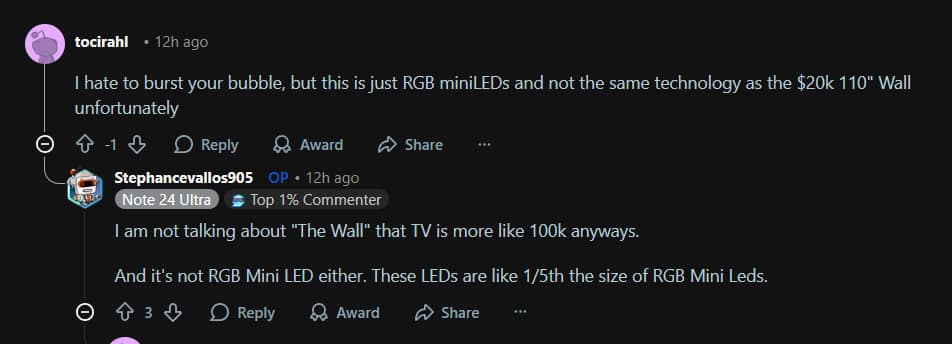
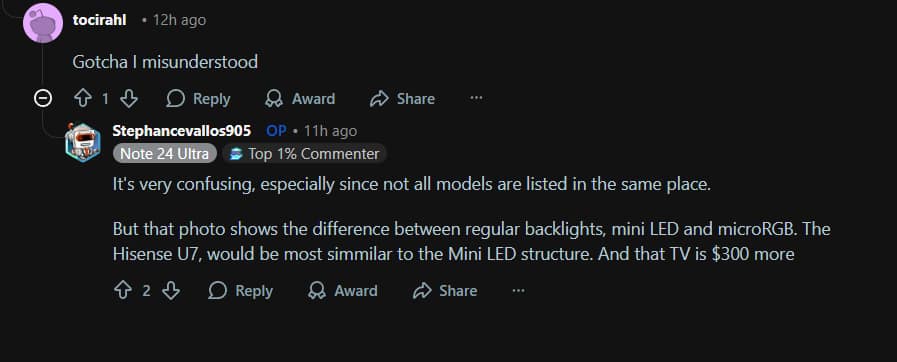
More notably, people question whether the added precision translates into a noticeably better experience. And that skepticism isn’t misplaced. Once improvements move beyond what’s easily visible, consumers tend to stop valuing them; they prioritize what they can clearly see over what specs suggest.
Why It Matters
The R85H introduces a different kind of buying decision.
It’s not just about picking between two TVs; it’s about choosing between two definitions of value. The S90F focuses on what matters right now: excellent contrast, color that already feels complete, and processing tuned for today’s content.
The R85H leans into what might matter later: near-perfect color accuracy and long-term panel consistency. That makes the decision less about immediate visual impact and more about how you expect the technology landscape to evolve, which is a harder thing to justify purely on price.
Other Takeaways
Display tech seems to be entering a phase where improvements are less obvious.
In the past, upgrades were easy to spot: higher resolution, brighter HDR, better contrast. Now, many of the advances are subtle unless you know exactly what to look for.
Micro RGB fits into that shift. It’s less about making images look dramatically different and more about eliminating edge-case issues like burn-in, color inaccuracies at extreme ranges, and long-term degradation.
At the same time, content hasn’t caught up. As long as most media sticks to DCI-P3, a chunk of what Micro RGB can do remains underutilized.
Ultimately, real-world reviews and the pace of change in content standards will determine whether Micro RGB’s push beyond perceptual limits becomes genuinely valuable—or remains an impressive but largely untapped capability.
