

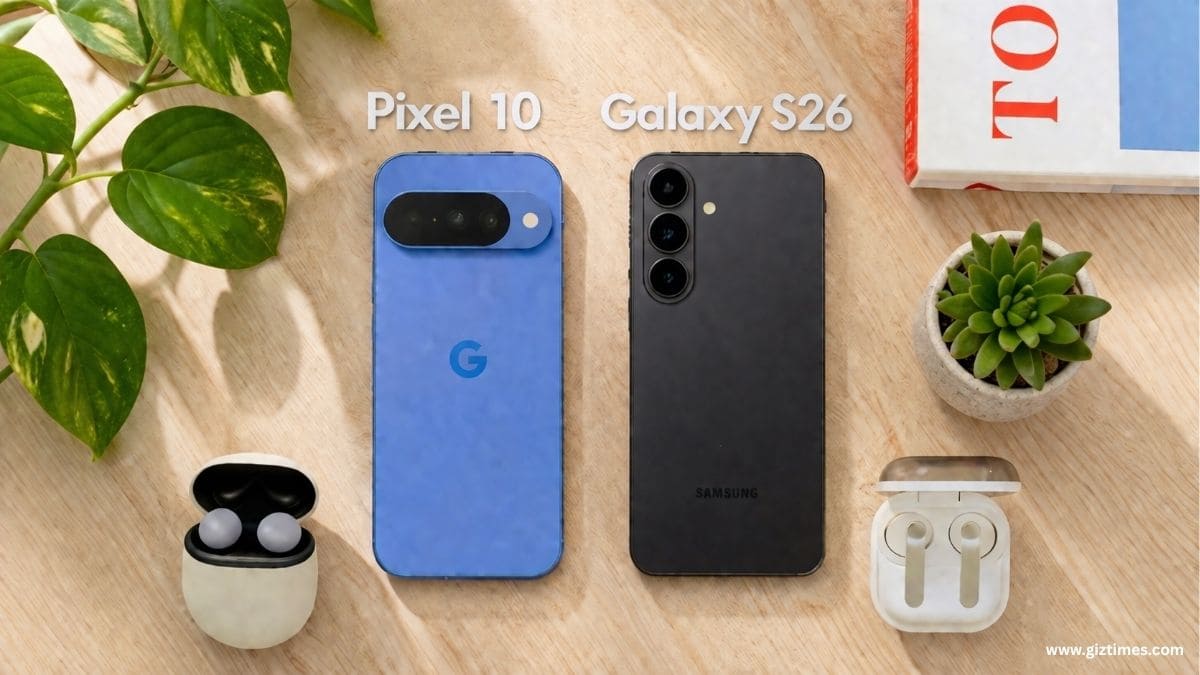
The Android flagship market is entering a more competitive phase as Samsung Galaxy S26 and Google Pixel 10 arrive with closer feature likeness than previous generations, narrowing the gap between hardware power and software intelligence. Both devices introduce meaningful upgrades. What makes this comparison interesting is that the choice no longer comes down to a clear winner, but rather to user priorities like performance, display behavior, and pricing flexibility.
The Pixel 10 undercuts Samsung at launch with a starting price of $799 for 128GB, while the Galaxy S26 begins at $899 and drops the lower storage level entirely, effectively aligning both phones at the 256GB price point. The physical design shows a clear difference: Samsung goes for a lighter 167g build focused on portability, while the Pixel 10 is heavier at 204g but includes built-in Qi2 magnets for accessories—a feature Samsung only offers through cases.
Display and performance further define the contrast. Google pushes ahead in peak brightness at 3,000 nits, improving outdoor usability, whereas Samsung’s LTPO panel scales from 1Hz to 120Hz for better power efficiency compared to the Pixel’s 60Hz–120Hz range. Under the hood, Samsung’s Snapdragon 8 Elite Gen 5 emphasizes raw performance and gaming, while Google’s Tensor G5 continues to prioritize AI-driven features and software integration. Both companies now promise seven years of OS and security updates, marking a shared commitment to long-term device support.
Camera systems show rare alignment in hardware, with both brands offering triple-lens setups including telephoto zoom. Samsung uses a 50MP main sensor with a 3x telephoto, while Google opts for a slightly lower-resolution main sensor but extends reach with a 4.5x zoom. Differences emerge in processing philosophy: Samsung favors vivid colors and supports 8K video recording, while Google leans into natural tones and computational photography tools, including AI-based editing features, with standard video restricted at 4K/60fps.
Battery and charging add another layer of distinction. The Pixel 10 carries a larger 4,970mAh battery compared to the Galaxy S26’s 4,300mAh, suggesting longer battery life. Charging speeds remain similar, but Google gains an advantage with built-in magnetic wireless charging support, positioning it closer to evolving accessory ecosystems.
This comparison matters because it reflects a broader shift in the Android ecosystem, where hardware alone is no longer the deciding factor. Consumers are now paying closer attention to things like ecosystem features, long-term software support, and everyday usability, whether that’s outdoor visibility or charging convenience. With prices also getting closer across similar storage options, brands are increasingly competing on overall experience rather than just specs.
A brief comparison with other flagship trends shows a broader industry pattern. Devices like Apple’s upcoming iPhone 17 are also expected to balance performance with ecosystem features, indicating that differentiation across platforms is becoming finer and less about headline specs.
Public reaction on the Reddit Thread remains mixed, reflecting three distinct user perspectives emerging from early discussions.
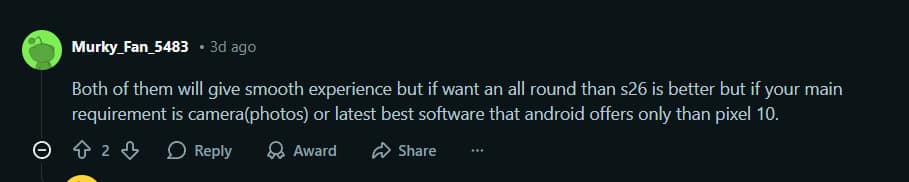
Some users frame the Galaxy S26 as the more balanced, all-around device, while positioning the Pixel 10 as the better choice for photography and pure Android software.
Others express frustration with Samsung’s software experience, particularly updates that change settings, with one user noting they switched after receiving a Pixel 10 through a carrier offer, signaling how promotions and software exhaustion can influence brand switching.

A third group leans toward Google’s offering or even considers alternatives. One user commented, definitely get the Pixel 10 for this price, you might as well get an iPhone 17, highlighting how overlapping prices are pushing buyers to look beyond Android. Together, these reactions suggest a market where brand loyalty is weakening, and decisions are increasingly driven by specific needs, deals, and ecosystem comparisons.

The upcoming long-term performance and software update cycle will likely determine whether this balance between hardware power and software intelligence succeeds or fails.
