

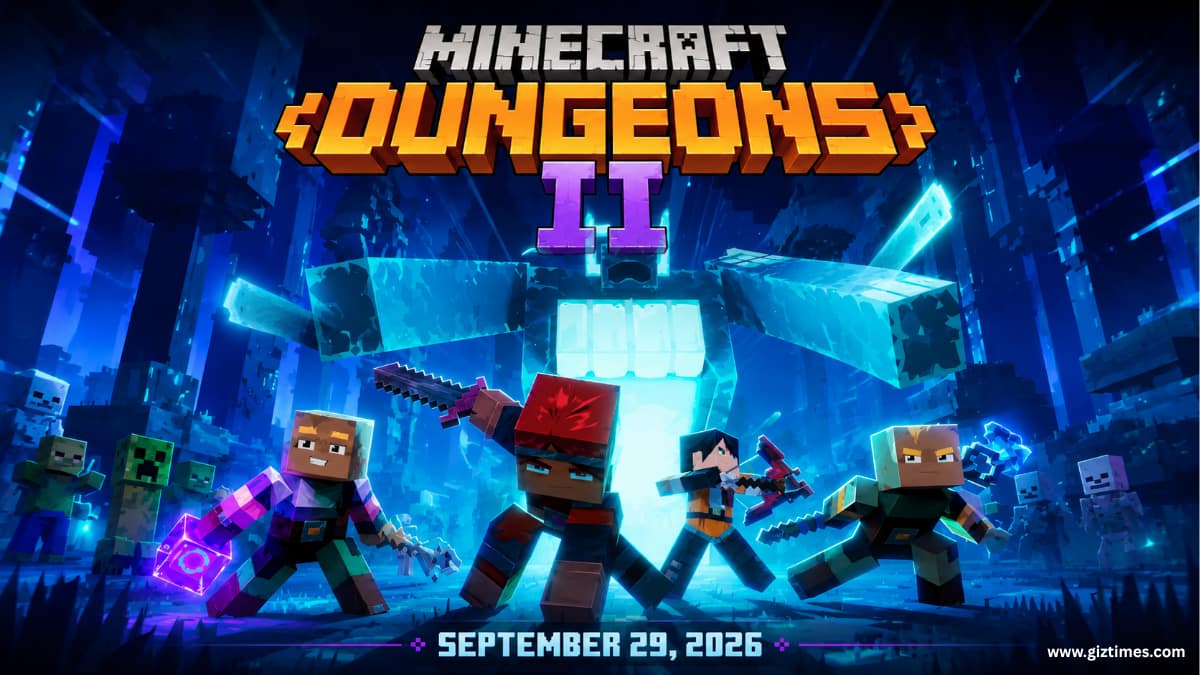
HYDERABAD, India (GizTimes) — Minecraft Dungeons II was officially revealed during Minecraft Live 2026, with its full gameplay showcase arriving on YouTube on June 7, 2026 ahead of its September 29, 2026 launch. Developed by Mojang Studios and Double Eleven and published by Xbox Game Studios, the sequel expands nearly every pillar of the original Minecraft Dungeons experience, from combat and loot systems to world design and cooperative play.
The challenge facing the sequel is not introducing players to the Minecraft action-RPG formula. The original Minecraft Dungeons already reached more than 25 million players and established itself as one of Mojang’s most successful spin-offs. Instead, Minecraft Dungeons II must convince that audience that larger worlds, deeper progression systems, and expanded co-op gameplay are enough to justify a full sequel rather than another content expansion.
Why This Matters in Gameplay
At its core, Minecraft Dungeons II remains committed to the same design philosophy that separated the original game from traditional Minecraft. Mining, crafting, and survival mechanics are absent. The focus remains on combat, loot collection, character progression, exploration, and dungeon crawling.
The gameplay reveal suggests that Mojang’s biggest priority is increasing combat intensity. Larger battlefields, more aggressive enemy encounters, lightning-based abilities, enhanced visual effects, and broader area-of-effect attacks point toward encounters that are designed around spectacle and crowd control rather than the smaller-scale engagements of the original game.
Character building also appears to be receiving a meaningful expansion. The addition of new weapons, armor, artifacts, talismans, and legendary gear increases the number of possible equipment combinations. Since build diversity was one of the strongest aspects of Minecraft Dungeons, expanding that system directly targets one of the franchise’s most successful gameplay loops.
The cooperative focus remains intact. Players can still tackle content alone or form four-player teams through online and couch co-op, while cross-platform multiplayer support removes platform barriers. For a game built around loot chasing and replayable content, maintaining a broad multiplayer ecosystem is critical to long-term engagement.
Framework Integration
From a performance perspective, Minecraft Dungeons II is taking a notably aggressive platform strategy. The game launches simultaneously on PC, PlayStation 5, Xbox Series X|S, Nintendo Switch, and Nintendo Switch 2 while supporting cross-platform multiplayer.
The PC requirements indicate that Mojang is still targeting accessibility rather than cutting-edge hardware. Minimum specifications requiring a GTX 1050 or RX 560 suggest that the studio wants to preserve the franchise’s broad reach despite the larger environments and upgraded visual effects shown during the reveal.
The market-positioning side is even more interesting.
The original Minecraft Dungeons succeeded because it occupied a unique space between family-friendly accessibility and loot-driven action RPG gameplay. Rather than chasing hardcore ARPG complexity, it offered an approachable alternative that appealed to younger audiences, casual players, and experienced dungeon-crawler fans alike.
Minecraft Dungeons II appears to be doubling down on that position. The deeper progression systems and larger-scale encounters target returning players, while the E10+ rating, familiar Minecraft identity, and straightforward cooperative structure preserve accessibility.
A non-obvious implication emerges from the announced Deluxe Edition. The inclusion of DLC 1 and DLC 2 before launch signals that Mojang is approaching the sequel as a long-term live-service-style content platform from day one. Unlike the original game, which expanded gradually through DLC and Seasonal Adventures, Minecraft Dungeons II appears to have its post-launch roadmap planned before release. That reduces uncertainty for players while signaling Microsoft’s confidence in the sequel’s longevity.
The primary unresolved question concerns gameplay depth. One of the biggest criticisms of the original game was that its RPG systems lacked the complexity of genre leaders. The reveal showcases more gear, abilities, and customization options, but it remains unclear whether those additions fundamentally deepen progression or simply provide more content within the existing framework.
Comparison
The reveal positions Minecraft Dungeons II as an expansion of the original formula rather than a complete redesign. Nearly every major feature builds upon systems that already worked in Minecraft Dungeons, suggesting Mojang views refinement and scale as the sequel’s central goals.
| Category | Minecraft Dungeons (2020) | Minecraft Dungeons II (2026) |
|---|---|---|
| Release Date | May 26, 2020 | September 29, 2026 |
| Developer | Mojang Studios, Double Eleven | Mojang Studios, Double Eleven |
| Publisher | Xbox Game Studios | Xbox Game Studios |
| Genre | Action RPG, Dungeon Crawler | Action RPG, Dungeon Crawler |
| Multiplayer | Up to 4 Players | Up to 4 Players |
| Cross-Platform Play | Supported | Supported |
| Story Focus | Arch-Illager and Orb of Dominance | New corruption threatening multiple regions |
| Character Progression | Gear, enchantments, artifacts | Expanded gear, artifacts, talismans, legendary equipment |
| World Design | Handcrafted and procedural missions | New biomes, settlements, wilderness zones, larger environments |
| Endgame Content | DLC expansions, Seasonal Adventures, The Tower | DLC roadmap confirmed before launch |
| Player Base | Over 25 million players | Upcoming release |
Public Reaction Analysis
Early community discussion shows a familiar pattern for established franchises: players are paying close attention to continuity rather than simply celebrating new features.

Some players are already debating movement mechanics, particularly whether the game will retain the original point-and-click style or adopt WASD controls depending on camera implementation. This indicates that mechanical familiarity remains an important concern among returning players. For many fans, preserving responsiveness and accessibility matters as much as introducing new content.

Lore-focused discussions are also emerging. Questions surrounding the return of enemies such as the Redstone Monstrosity suggest that part of the community is closely examining narrative consistency. This reflects an evolution in audience expectations. The original game was largely viewed as a straightforward dungeon crawler, but the sequel’s larger narrative ambitions are encouraging players to scrutinize world-building details more closely.

The common thread across these reactions is caution rather than skepticism. Players appear interested in seeing how Mojang evolves the formula without disrupting the identity that made the first game successful.
Why It Matters
Minecraft Dungeons II enters the market with a significant advantage: it does not need to create a new audience from scratch.
The original game’s 25-million-player milestone demonstrates proven demand for a Minecraft-themed action RPG. That audience provides a foundation many new franchises never achieve.
The broader gaming industry has increasingly favored long-term content ecosystems supported through expansions, seasonal updates, and cooperative engagement. The announced DLC roadmap, cross-platform support, and emphasis on replayable progression systems align directly with those trends.
Success will depend on whether the sequel can deepen player retention without sacrificing accessibility. If it can achieve both, Minecraft Dungeons II could strengthen Microsoft’s position in the family-friendly action-RPG market while extending the Minecraft brand into another long-term ecosystem.
Extra Takeaways
One overlooked aspect of the reveal is platform coverage. Simultaneous releases across PlayStation, Xbox, Nintendo Switch, Nintendo Switch 2, and PC indicate that Mojang is prioritizing franchise growth over ecosystem exclusivity.
The support for 17 languages and extensive multiplayer features also suggests that Minecraft Dungeons II is being positioned as a global cooperative experience rather than a niche action-RPG release.
The pre-order rewards and Deluxe Edition strategy further indicate that Mojang expects strong engagement beyond launch rather than relying solely on initial sales.
If successful, Minecraft Dungeons II could become the definitive family-friendly action RPG on the market, but uncertainty surrounding the depth of its expanded progression systems remains its biggest risk.
