

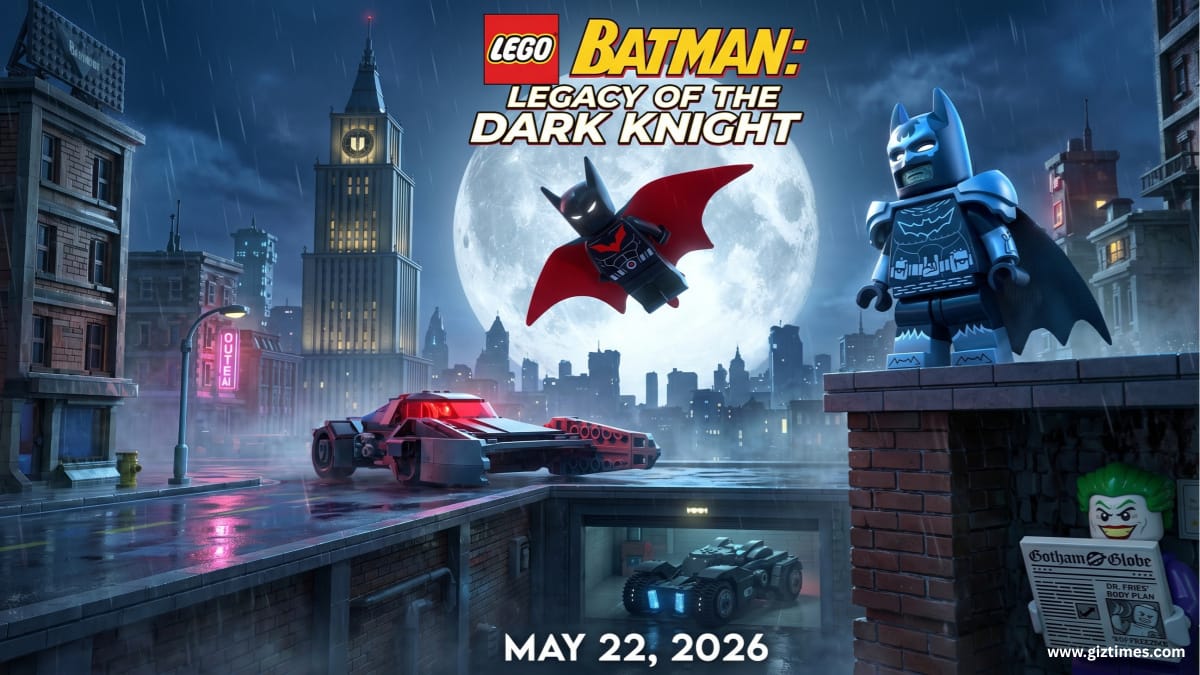
HYDERABAD, India (GizTimes) — TT Games is taking a noticeably different approach with LEGO Batman: Legacy of the Dark Knight. Instead of building another wide DC crossover packed with hundreds of playable heroes, the studio is narrowing its focus around Gotham City, Batman’s origin story, and deeper action mechanics. The reveal trailer and Deluxe Edition breakdown suggest this is less of a traditional LEGO spin-off and more of an attempt to modernize the LEGO formula for current-generation action-adventure audiences.
That shift matters because the last major Batman-focused LEGO title, LEGO Batman 3: Beyond Gotham, succeeded through scale, fan service, and sheer roster size. Legacy of the Dark Knight appears to be chasing something different: immersion, progression systems, cinematic storytelling, and combat depth closer to modern superhero games than classic LEGO design.
The tension is clear already. TT Games wants to attract longtime Batman fans and action players without losing the accessibility and humor that defined LEGO games for years.
Why This Matters in Gameplay
The biggest gameplay change is not Gotham’s size or the graphical upgrade. It is the shift in design philosophy.
Older LEGO Batman games relied heavily on constant character switching, light combat, and puzzle loops. Legacy of the Dark Knight instead emphasizes “fewer but deeper” playable heroes. Each confirmed character reportedly has unique traversal tools, combat mechanics, and gadgets. That changes moment-to-moment gameplay pacing significantly.
Batman’s combat now includes combo chains, counters, stealth takedowns, environmental finishers, and detective mechanics. Those systems move the game closer to contemporary action-adventure structure while still staying simplified enough for younger players. The inclusion of difficulty modes like Caped Crusader Mode and Dark Knight Mode reinforces that TT Games expects experienced players to engage with combat systems more seriously than before.
The open-world Gotham design also changes how exploration functions. Earlier LEGO games often treated hub areas as transitional spaces between levels. Here, Gotham itself appears to be the core gameplay ecosystem with crimes, collectibles, side activities, puzzles, and vertical traversal systems built into progression.
That creates a different kind of player retention loop. Instead of replaying missions mainly for collectibles, players may spend more time organically exploring Gotham in the same way open-world superhero games encourage freeform engagement.
Framework Integration
The comparison with Beyond Gotham reveals how dramatically TT Games is repositioning the franchise.
Beyond Gotham leaned into quantity. It offered more than 150 playable characters, Lantern Corps worlds, Justice League fan service, and enormous crossover energy. Legacy of the Dark Knight is deliberately shrinking scope in some areas to deepen others.
That design shift explains why community reactions are split between excitement and caution.
Some players are highly interested in Gotham exploration, Batman Beyond cosmetics, and improved combat systems. Others are already concerned about the smaller playable roster and the long-term DLC structure. Those concerns are important because TT Games is effectively asking fans to accept less breadth in exchange for more mechanical depth.
The Deluxe Edition strategy also reflects broader live-service publishing trends without fully committing to a live-service model. The package includes early access, cosmetic packs, themed Batmobiles, Batcave props, and future content like the September 2026 Mayhem Collection mission update.
This resembles the post-launch ecosystem approach seen in larger AAA franchises, even though the game itself still appears structured as a traditional single-player and couch co-op experience.
A non-obvious implication emerges here: TT Games may be trying to solve one of the biggest historical criticisms of LEGO games that is shallow replay value after completion. By focusing on progression hubs, customization systems, challenge modes, and post-launch content cadence, the studio appears to be designing for longer engagement rather than pure completion percentage.
Ironically, that directly addresses complaints that followed Beyond Gotham’s repetitive 100% completion structure.
Comparison
The contrast between the two games shows TT Games evolving from a content-heavy crossover formula into a more concentrated action-adventure structure.
| Category | LEGO Batman: Legacy of the Dark Knight | LEGO Batman 3: Beyond Gotham |
|---|---|---|
| Release Date | May 22, 2026 | November 11, 2014 |
| Main Setting | Open-world Gotham City | Space and Lantern worlds |
| Core Focus | Batman origin and Gotham progression | Massive DC crossover |
| Playable Character Philosophy | Smaller but deeper roster | 150+ playable characters |
| Combat Design | Combo chains, counters, stealth, gadgets | Traditional LEGO combat |
| Difficulty Options | Caped Crusader Mode, Dark Knight Mode | No advanced difficulty structure mentioned |
| Hub Structure | Batcave progression hub | Multiple cosmic hub worlds |
| Multiplayer | Local co-op, offline support, Remote Play | Local split-screen co-op |
| DLC Strategy | Deluxe Edition themed packs and story expansion | Season Pass with mission packs and characters |
| Design Direction | Cinematic action-adventure hybrid | Content-heavy fan-service experience |
| Community Concerns | DLC pricing and roster size | Repetitive gameplay and completion grind |
Public Reaction Analysis
Early community sentiment suggests players are responding more strongly to systems and cosmetics than narrative details.
The Batman Beyond DLC references are generating consistent enthusiasm, which is notable because Beyond Gotham’s Batman Beyond content remains one of the most remembered DLC additions from the older game. TT Games clearly understands that nostalgia-driven cosmetic content still holds major value within the LEGO Batman audience.

At the same time, reactions show players already calculating long-term spending decisions around DLC. One player specifically mentioned pre-ordering the Standard Edition physically while waiting to buy additional DLC later. That reflects cautious consumer behavior increasingly common in modern AAA ecosystems where players hesitate to commit fully before understanding post-launch pricing structure.

The excitement around early access also reveals how Deluxe Editions have become normalized across gaming. The “Can’t wait for the 19th” reaction focuses entirely on accessing the game earlier rather than on cosmetic content itself. In practice, early access is functioning as one of the product’s strongest marketing incentives.
There is also an interesting contradiction in community expectations. Players want deeper combat and cinematic presentation, but those features naturally require more development resources per character. That makes a giant 150-character roster like Beyond Gotham less practical. Some fans may still expect both simultaneously, which creates pressure on TT Games to prove that the reduced roster genuinely delivers more gameplay depth.
Why It Matters
Legacy of the Dark Knight arrives during a period where licensed superhero games face much higher gameplay expectations than they did in 2014.
Players now expect fluid traversal, progression systems, cinematic storytelling, customization, and mechanically satisfying combat even from family-friendly franchises. TT Games appears aware that the old LEGO formula alone may no longer be enough to compete in the current market.
The game’s positioning is also strategically smart. Batman remains one of Warner Bros.’ strongest entertainment brands across films, streaming, comics, and games. Launching a Gotham-focused LEGO title during renewed Batman momentum gives the project broader commercial appeal beyond traditional LEGO audiences.
The Deluxe Edition structure further suggests Warner Bros. sees the game as a long-tail platform rather than a one-and-done release. Story expansions, themed packs, and customization ecosystems are designed to keep players engaged for months instead of weeks.
Whether that works depends heavily on gameplay execution. If combat depth, exploration density, and progression systems feel meaningful, TT Games could successfully modernize LEGO games for a new generation. If those systems remain shallow underneath cinematic presentation, criticism could shift quickly toward repetition and monetization concerns.
Extra Takeaways
The Batcave customization system may end up becoming one of the game’s most important retention mechanics. Trophy displays, prop collections, suit unlocks, and vehicle management create a collectible-driven progression loop that fits naturally with LEGO’s audience psychology.
The absence of confirmed online co-op is also notable. While couch co-op remains central to LEGO identity, many modern multiplayer-focused players may view the lack of online cooperative play as a surprising omission for a 2026 release.
The reveal trailer’s focus on Gotham atmosphere rather than comedic chaos also signals tonal evolution. TT Games appears to be balancing darker Batman storytelling with LEGO humor instead of prioritizing parody first.
If successful, LEGO Batman: Legacy of the Dark Knight could redefine what modern LEGO action-adventure games look like, but expectations around roster size, DLC value, and gameplay depth may become its biggest long-term risk.
