

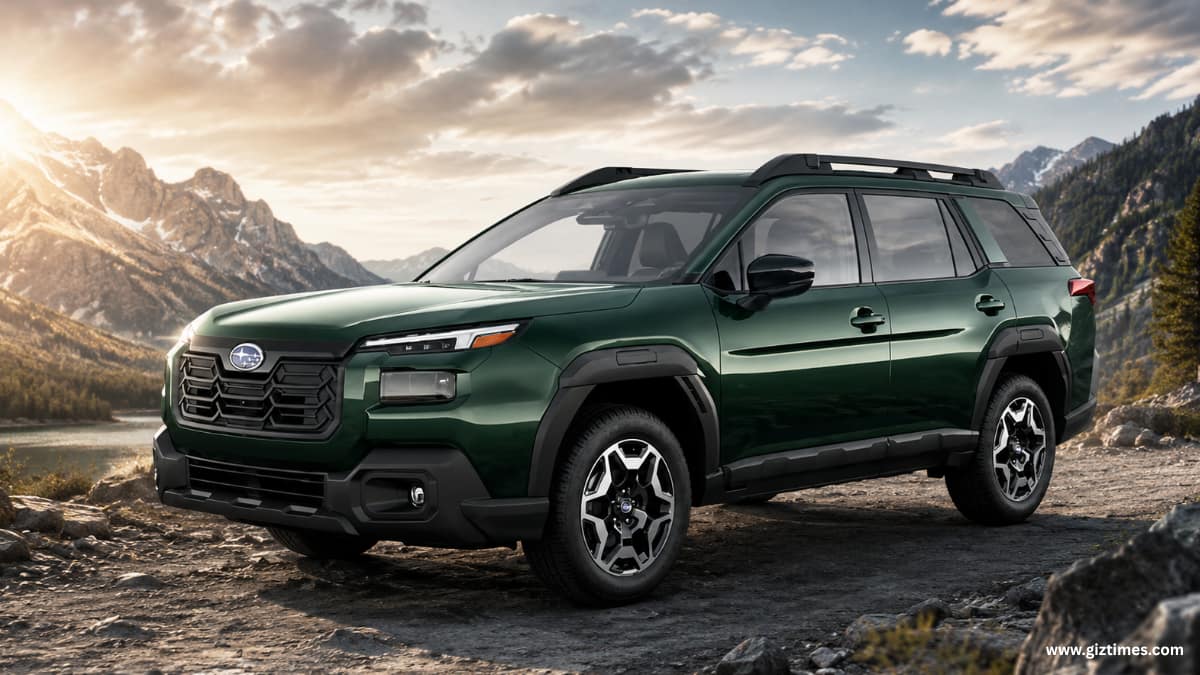
HYDERABAD, India (GizTimes) – The seventh-generation Subaru Outback represents one of the most dramatic identity shifts in the model’s history. After decades of sitting between a wagon and an SUV, the 2026 version moves decisively closer to mainstream SUV territory with a taller stance, boxier proportions, and a more upright design language. Subaru is not simply redesigning the Outback visually. It is repositioning the vehicle for a market that increasingly values SUV presence, technology integration, and everyday practicality over traditional wagon styling.
At the same time, Subaru faces a difficult balancing act. The Outback built its reputation on being different from conventional crossovers. The new model improves room, comfort, infotainment speed, and driver assistance technology, but it also risks blending into a crowded midsize SUV segment. That tension defines the entire vehicle.
Why This Vehicle Exists
The 2026 Outback exists because the market has changed faster than the Outback’s original identity. Buyers now prioritize higher seating positions, rugged styling, and SUV-like practicality, even when they rarely leave paved roads. Subaru’s redesign reflects that reality directly.
The new shape is not only decorative. The flatter roofline and increased height improve rear passenger headroom and boost cargo capacity by roughly two cubic feet behind the second row. Subaru understood that usability remains one of the Outback’s strongest selling points, especially for families and outdoor-focused buyers who need flexibility more than outright performance.
What makes the redesign interesting is that Subaru did not abandon the Outback’s core formula underneath. Standard all-wheel drive remains, boxer engines continue, and the Wilderness trim still prioritizes genuine off-road capability. Instead of reinventing the vehicle mechanically, Subaru modernized its packaging and user experience.
There is also a strategic reason behind retaining the naturally aspirated 2.5-liter and turbocharged 2.4-liter boxer engines. Subaru is prioritizing manufacturing continuity and drivetrain familiarity over pursuing aggressive electrification targets immediately. That creates a contrast against rivals increasingly moving toward hybrid systems.
This decision creates both strengths and weaknesses. The turbocharged 260-horsepower XT and Wilderness trims maintain strong capability and real-world versatility. Still, the base 180-horsepower engine now feels increasingly exposed in a segment where hybrid competitors deliver stronger low-speed torque and better efficiency simultaneously.
A non-obvious shift emerges here. Subaru is no longer positioning the Outback primarily as an alternative to SUVs. The redesign suggests Subaru now sees the Outback itself as a full SUV competitor, directly targeting buyers considering vehicles like the RAV4 rather than buyers specifically searching for wagons.
Framework Integration
The biggest technological improvement in the 2026 Outback is not the screen size itself, but the way Subaru reworked the interaction model between software and hardware.
The cabin now combines a 12.1-inch horizontal infotainment touchscreen with a 12.3-inch digital instrument cluster, powered by a Qualcomm Snapdragon processor for faster responsiveness. Previous Subaru systems often received criticism for laggy performance and excessive reliance on touch. Subaru’s decision to reintroduce more physical climate controls reveals an important trend in current automotive technology.
Instead of chasing maximum digitization, Subaru focused on decreasing friction during real-world driving. Test drivers and owners praised the return of physical controls because they improve usability without requiring drivers to navigate menus while moving. That reflects a growing industry realization that software-defined vehicles still need intuitive physical interfaces.
The technology story also extends into the updated EyeSight driver assistance suite. Enhanced adaptive cruise control, lane-centering improvements, emergency stop assist, and hands-free highway driving support up to 85 mph push the Outback closer toward semi-automated highway capability. Subaru is effectively integrating mainstream advanced driver assistance features without turning the Outback into a technology-first product.
This is where the Outback’s architecture strategy becomes visible. Subaru is layering modern software capability onto a familiar mechanical platform rather than redesigning the entire vehicle around electrification or fully digital architecture. The result is a vehicle that feels technologically updated without alienating traditional buyers.
The Wilderness trim further strengthens this balance. Adaptive dampers, upgraded suspension tuning, all-terrain tires, and 9.5 inches of ground clearance create a package that remains unusually capable off-road while preserving stable on-road dynamics. Reviewers noted reduced body roll and sharper handling than expected, suggesting Subaru focused heavily on suspension calibration rather than relying purely on rugged marketing aesthetics.
Comparison
The comparison between the Subaru Outback and the Toyota RAV4 reveals two very different approaches to modern SUV design. Toyota prioritizes hybrid efficiency, mainstream accessibility, and ownership costs. Subaru focuses more heavily on capability, interior practicality, and all-weather versatility.
The difference becomes quite clear in how each company approaches future mobility trends. Toyota uses hybrid technology as a bridge toward electrification, while Subaru continues refining mechanical capability and software usability within a gasoline-focused framework.
| Category | 2026 Subaru Outback | Toyota RAV4 |
|---|---|---|
| Vehicle Positioning | SUV-oriented wagon evolution | Mainstream compact SUV |
| Base Engine | 2.5-liter boxer four-cylinder | 2.5-liter four-cylinder |
| Base Horsepower | 180 hp | Around 203 hp |
| Optional Powertrain | 2.4-liter turbocharged boxer | Hybrid and plug-in hybrid systems |
| Turbo Output | 260 hp / 277 lb-ft | Plug-in hybrid offers stronger acceleration |
| Drivetrain | Standard AWD | AWD available depending on trim |
| Ground Clearance | 8.7 inches standard | Off-road trims available |
| Wilderness/Off-Road Setup | 9.5 inches, adaptive dampers, all-terrain tires | Woodland Edition and TRD Off-Road trims |
| Infotainment | 12.1-inch touchscreen | Large touchscreen depending on trim |
| Instrument Cluster | 12.3-inch digital cluster | Digital instrumentation available |
| Driver Assistance | Updated EyeSight with hands-free highway support up to 85 mph | Toyota Safety Sense |
| Cabin Philosophy | Physical controls reintroduced for usability | Straightforward and practical layout |
| Major Market Strength | Off-road versatility and spaciousness | Hybrid efficiency and resale value |
The most important difference is philosophical rather than numerical. The RAV4 is optimized for efficiency and broad-market appeal. The Outback is optimized for versatility and environmental adaptability. Buyers prioritizing hybrid economy and lower ownership costs will likely lean toward Toyota. Buyers wanting more cargo flexibility, higher ground clearance, and stronger off-road confidence may find the Outback more compelling.
Public Reaction Analysis
Public reactions reveal a split between emotional attachment and practical acceptance.
Many buyers praised the improved technology, larger interior feel, and SUV-like practicality. Some specifically appreciated that the new Outback now feels like a bridge between the Forester and Ascent while still offering a turbocharged option. That reaction suggests Subaru successfully identified a market gap for buyers wanting something larger and more rugged than a compact crossover without moving into a full three-row SUV.

At the same time, criticism surrounding the loss of wagon identity reflects a deeper industry-wide issue. Vehicles increasingly converge toward similar SUV proportions because those designs maximize sales potential and packaging efficiency. Longtime enthusiasts see the new Outback as losing some of the uniqueness that originally separated it from mainstream crossovers.
Pricing also became a major point of discussion. Subaru increased the starting price to roughly $36,445 after removing the previous entry-level trim. While the company added more standard equipment, including heated seats, wireless smartphone connectivity, upgraded safety systems, and a power tailgate, some buyers still question whether the base engine justifies the higher entry price.

The reactions comparing the Outback with the RAV4 expose another significant market trend. Buyers increasingly evaluate SUVs through long-term ownership value rather than pure specifications. Comments praising Toyota hybrids while criticizing “Toyota tax” pricing show consumers balancing reliability, efficiency, capability, and perceived value simultaneously rather than focusing on a single category.
Why It Matters
The 2026 Outback matters because it demonstrates how automakers are adapting legacy vehicles to survive in an SUV-dominated market without completely abandoning their original character.
Subaru’s strategy reflects a broader shift happening across the industry. Vehicles are evolving more software-focused, but buyers still value usability and physical interaction. SUVs are becoming more rugged visually, even when most customers primarily drive on-road. Advanced driver assistance systems are becoming mandatory competitive features rather than luxury additions.
The Outback also highlights a growing divide in automotive strategy. Companies like Toyota aggressively expand hybrid technology to improve efficiency and emissions performance. Subaru instead appears focused on maximizing versatility and all-weather capability within conventional powertrain architecture.
That choice may become increasingly important as consumers continue debating whether hybrid systems, fully electric vehicles, or improved gasoline platforms represent the most practical transition path toward future mobility.
Extra Takeaways
One subtle but important detail is how the Wilderness trim now influences the perception of the entire Outback lineup. Even buyers who never drive off-road often associate rugged hardware with durability and confidence. Subaru benefits from this “halo effect” more effectively than many competitors because the Wilderness package delivers genuine capability rather than purely decorative upgrades.
The return of physical climate controls also signals a quiet industry correction. Automakers spent years replacing buttons with touchscreens, but real-world feedback increasingly favors hybrid interfaces that balance software flexibility with tactile usability.
Much of the discussion now centers on whether Subaru can modernize the Outback without fully sacrificing its wagon identity, which could define how successfully the model competes in the next generation of SUV-focused mobility.
