

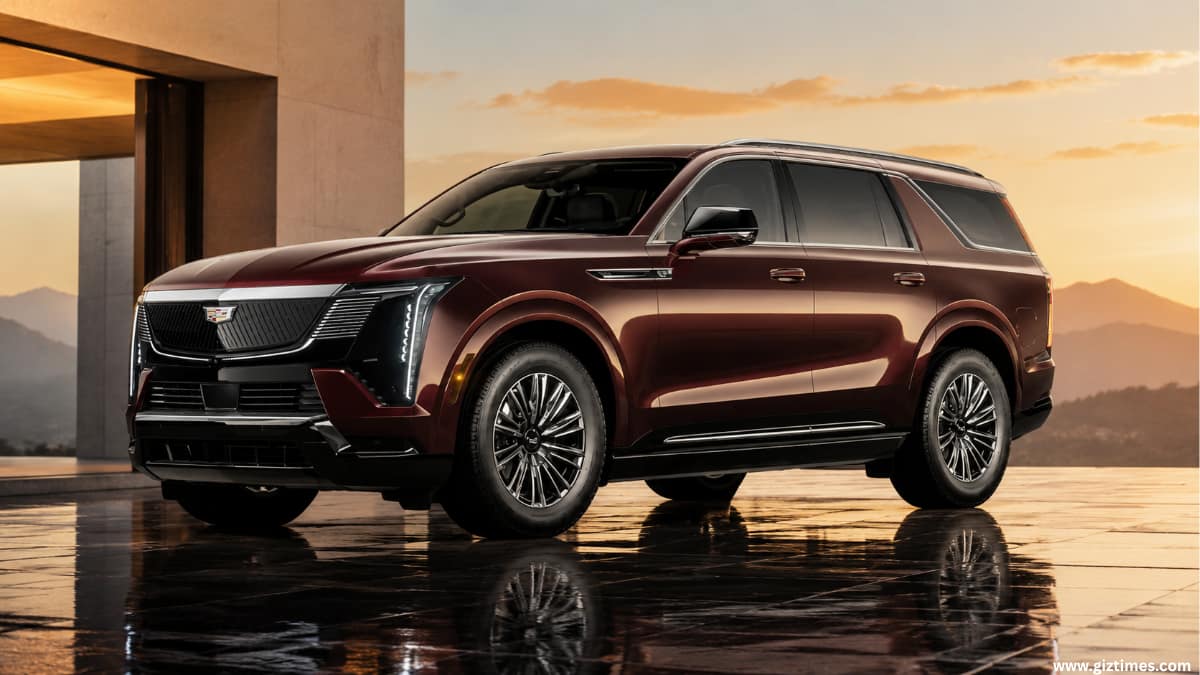
HYDERABAD, India (GizTimes) —The 2026 Cadillac Escalade IQL represents Cadillac’s latest step toward electrifying its flagship SUV lineup. Rather than creating a completely new vehicle, Cadillac developed the existing Escalade IQ formula by stretching the body and dedicating the added length to passenger comfort and cargo capacity. The result is a full-size luxury electric SUV that mirrors the role of the traditional Escalade ESV while maintaining the same battery, powertrain, and performance credentials as the standard model.
What makes the IQL interesting is not what Cadillac changed, but what it deliberately chose not to change. Instead of chasing higher horsepower or longer range, the company invested almost entirely in interior usability.
Why This Vehicle Exists
Luxury SUV buyers have historically prioritized space, presence, and comfort. The Escalade IQL addresses that demand in an electric format by extending overall length to 228.5 inches and improving third-row accommodations without altering the core electric architecture.
The strategy is straightforward. Cadillac already had a vehicle capable of delivering 750 horsepower, 785 lb-ft of torque, a 460-mile driving range, and a 4.7-second 0–60 mph sprint. Rather than engineering a larger battery or a more powerful drivetrain, Cadillac focused on solving a practical problem: making the third row genuinely usable for adults and increasing cargo flexibility for families.
The numbers support that objective. Third-row legroom grows to 36.7 inches, cargo space behind the third row reaches 24.2 cubic feet, and maximum cargo capacity expands to 125.2 cubic feet. Buyers receive more utility while maintaining nearly identical performance.
A non-obvious implication emerges from this decision. Cadillac effectively treats electric range as a solved problem within this segment. The company believes that once a luxury EV reaches around 460 miles of range, additional interior space becomes a stronger selling point than incremental gains in battery capacity or efficiency. The IQL reflects that shift in priorities.
Framework Integration
The Escalade IQL combines traditional luxury SUV thinking with modern EV technology.
On the technology side, the vehicle retains a dual-motor all-wheel-drive system producing up to 750 horsepower and 785 lb-ft of torque in Velocity Max mode. A battery pack surpassing 205 kWh supports a Cadillac-estimated range of 460 miles, while DC fast charging can add up to 116 miles of range in approximately 10 minutes using a 350-kW charger.
The vehicle also benefits from Air Ride Adaptive Suspension and Magnetic Ride Control, systems designed to adjust ride characteristics based on road conditions continuously. This is particularly important in a vehicle of this size because controlling weight, maintaining comfort, and preserving stability become increasingly difficult as dimensions grow.
At the same time, Cadillac’s market positioning strategy is equally important. The IQL is effectively the electric successor to the long-wheelbase Escalade ESV. Instead of creating a niche EV product, Cadillac is transferring an already successful luxury formula into the electric era.
The combination reveals Cadillac’s broader philosophy. The company is not asking traditional Escalade buyers to accept compromises for electrification. It aims to deliver the same commanding presence, passenger comfort, and utility they already expect while replacing the combustion powertrain with a high-performance electric system.
Comparison
The Escalade IQL and Lucid Gravity approach the luxury EV SUV segment from very different directions. Cadillac prioritizes maximum size, passenger space, and traditional flagship SUV presence. Lucid focuses on efficiency, charging speed, and extracting full-size interior volume from a smaller footprint.
| Specification | Cadillac Escalade IQL | Lucid Gravity Grand Touring |
|---|---|---|
| Powertrain | Dual-Motor AWD | Dual-Motor AWD |
| Horsepower | 750 hp | 800+ hp |
| Range | 460 miles | 450 miles (EPA-estimated) |
| 0–60 mph | 4.7 seconds | Under 3.5 seconds |
| Battery Capacity | 205+ kWh | Not provided |
| Charging | 116 miles in 10 minutes | 200 miles in approximately 11 minutes |
| Architecture | Not provided | 926-volt architecture |
| Seating | Up to 7 passengers | 5, 6, or 7 passengers |
| Cargo Space | 125.2 cu ft maximum | 120+ cu ft total usable volume |
| Length | 228.5 inches | Not provided |
| Towing Capacity | 7,500 lbs | Not provided |
The comparison highlights a clear divide. Lucid uses technology and efficiency to maximize performance and charging convenience. Cadillac leverages scale and packaging to deliver an experience closer to a traditional full-size luxury SUV.
Public Reaction Analysis
Public reactions reveal an interesting pattern. Many observers acknowledge that the Escalade IQL’s efficiency should be considered relative to its size rather than against smaller EVs. For some consumers, the vehicle’s massive dimensions are not viewed as a drawback but as the very reason for its existence.
This suggests that Cadillac’s target audience is not comparing the IQL with compact electric crossovers. Buyers appear to understand the trade-off between size and efficiency and are willing to accept it in exchange for space, comfort, and presence.
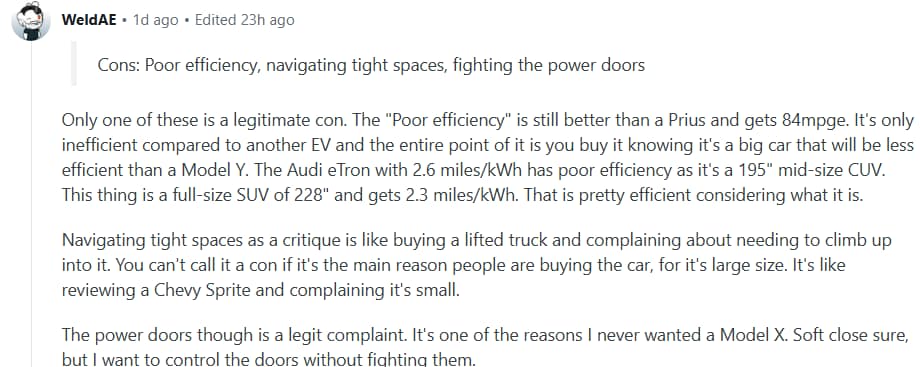
Another theme centers on practicality. Some users criticize features such as power-operated doors, arguing that luxury technology should enhance convenience rather than complicate everyday interactions. This highlights a broader challenge for premium EVs: advanced features must feel intuitive rather than novel.

A second reaction focuses on depreciation concerns. Even when buyers appreciate the vehicle’s range and capability, uncertainty about future resale values can delay purchase decisions. This indicates that adoption barriers in the luxury EV market are increasingly financial rather than technological. The product itself may be attractive, but long-term value retention remains a major consideration.
Why It Matters
The Escalade IQL demonstrates how the luxury EV market is evolving beyond simple range competition.
Early electric vehicles contested primarily on battery size and driving distance. The IQL suggests that manufacturers are entering a new phase where packaging, passenger comfort, and lifestyle utility become stronger differentiators.
The vehicle also shows how established luxury brands can transition legacy nameplates into the software-driven and electrified era without abandoning their traditional customer base. Instead of redefining what an Escalade should be, Cadillac is preserving the core identity while changing the propulsion system beneath the hood.
That strategy could prove influential as more manufacturers convert their flagship SUVs to electric platforms.
Final Takeaways
One of the most revealing aspects of the Escalade IQL is the minimal range sacrifice. Cadillac increased passenger and cargo space significantly while reducing estimated range by only five miles compared with the standard Escalade IQ.
The vehicle also illustrates a growing trend in premium EVs, in which access to the charging network becomes almost as important as battery specifications. Cadillac’s compatibility with Tesla Superchargers through a GM-approved NACS adapter expands real-world usability beyond the vehicle’s raw range figures.
Much of the discussion now centers on balancing maximum interior space with long-term ownership value, which could define the success of luxury electric SUVs in the years ahead.
