

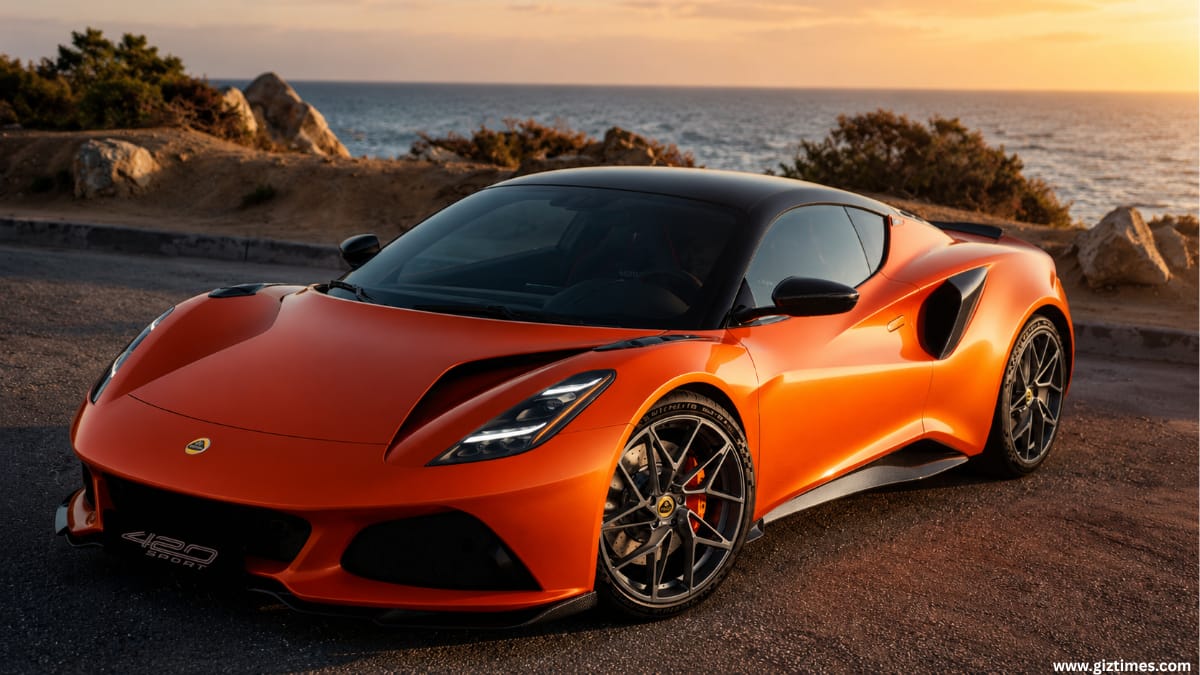
HYDERABAD, India (GizTimes) — The Lotus Emira 420 Sport arrives as the most focused version of the Emira platform and the final evolution of Lotus’ internal-combustion sports car strategy. Scheduled for summer 2026, the model combines higher output, lower weight, improved cooling, additional downforce, and track-oriented chassis upgrades. Lotus positions it as the lightest, most powerful, and most aerodynamically advanced Emira ever built.
What makes the 420 Sport particularly interesting is not the introduction of a new engine or a new platform. Instead, Lotus has concentrated on extracting more performance from an existing architecture through calibration, lightweight engineering, and aerodynamic refinement. That decision defines the car’s market position against established rivals such as the Porsche 718 Cayman GT4 RS.
Why This Vehicle Exists
The Emira 420 Sport exists because Lotus is seeking to apply its long-standing engineering philosophy to a modern regulatory environment. The company boosted power from the existing Mercedes-AMG-sourced 2.0-liter turbocharged four-cylinder while simultaneously reducing mass and improving airflow management.
The result is 416 bhp, 369 lb-ft of torque, a 0-62 mph time of 3.9 seconds, and a top speed of 186 mph. When equipped with the Lightweight Handling Pack, the car sheds approximately 25 kg through a titanium exhaust, lithium-ion battery, carbon-fiber components, and other lightweight materials.
What stands out is that Lotus achieved these gains without redesigning the powertrain architecture. Instead of pursuing an entirely new mechanical package, the company focused on improving how existing systems interact. That approach aligns with a manufacturer preparing for a future increasingly centered on electrification while still delivering a highly engaging combustion-engine sports car.
Framework Integration
The Emira 420 Sport reflects a combination of performance-focused technology and system-level engineering optimization.
The most visible technology addition is the Lotus Track Performance software. By allowing drivers to analyze telemetry, lap times, and vehicle performance data, Lotus extends the car’s capability beyond mechanical performance. The vehicle becomes both a driving machine and a performance-analysis tool. This bridges the gap between enthusiast track days and professional motorsport-style feedback.
The engineering side is equally noteworthy. Lotus lowered the chassis by 5 mm, introduced Multimatic two-way adjustable dampers, fitted Michelin Pilot Sport Cup 2 tires, enhanced brake cooling, and revised suspension settings. These changes are supported by a redesigned aerodynamic package featuring a new splitter, larger intakes, wheel arch vents, revised side intakes, rear spoiler, and carbon-fiber louvered tailgate.
A non-obvious insight emerges from these upgrades. The headline figures focus on horsepower and weight reduction, but the larger engineering story is thermal management. Lotus improved radiator airflow by 15% and exhaust-cooling airflow by 30%, while increasing downforce by 25 kg without increasing drag. This suggests the company prioritized sustained performance consistency rather than simply chasing peak performance numbers. On a demanding circuit, maintaining cooling efficiency can be just as valuable as adding horsepower.
The removable tinted glass roof also reflects Lotus’ broader market strategy. It adds a lifestyle-oriented element to a vehicle otherwise engineered for track use, expanding appeal without requiring a separate body style.
Comparison
The Lotus Emira 420 Sport and Porsche 718 Cayman GT4 RS represent two different approaches to high-performance sports cars. Lotus focuses on extracting maximum capability from a turbocharged four-cylinder platform through optimization and lightweight engineering. Porsche pursues a motorsport-inspired formula built around a naturally aspirated high-revving engine and extensive track development.
| Specification | Lotus Emira 420 Sport | Porsche 718 Cayman GT4 RS |
|---|---|---|
| Engine | 2.0-liter turbocharged four-cylinder | 4.0-liter naturally aspirated flat-six |
| Power | 416 bhp (420 PS) | 500 PS (493 hp) |
| Torque | 369 lb-ft | 450 Nm |
| Transmission | 8-speed dual-clutch | 7-speed PDK dual-clutch |
| Drivetrain | Rear-wheel drive | Rear-wheel drive |
| 0-100 km/h / 0-62 mph | 3.9 sec | 3.4 sec |
| Top Speed | 186 mph | 196 mph |
| Weight Reduction Strategy | Titanium exhaust, lithium-ion battery, carbon-fiber components | CFRP panels, lightweight glass, reduced insulation |
| Weight Reduction | Approx. 25 kg with Lightweight Pack | Approx. 35 kg lighter than standard GT4 PDK |
| Suspension | Multimatic two-way adjustable dampers | Adjustable motorsport-inspired suspension |
| Aerodynamic Gain | +25 kg downforce with unchanged drag | Significantly increased downforce over GT4 |
| Performance Software | Lotus Track Performance telemetry system | Not specified in provided data |
| Unique Feature | Removable tinted glass roof | GT3-derived 9,000-rpm engine |
| Starting Price | Around $125,400 | Not provided |
Based on the available data, the Lotus gains an advantage in integrated performance technology, cooling optimization, and open-air versatility. The Porsche maintains an edge in outright power, acceleration, top speed, and race-derived engine character.
Public Reaction Analysis
Early reactions reveal an interesting divide between modern performance priorities and classic enthusiast expectations.
Many enthusiasts praised the aerodynamic revisions, weight-reduction measures, and the more aggressive appearance. These reactions suggest buyers recognize the value of incremental engineering improvements when they are tied directly to measurable performance outcomes.

At the same time, dialogues around transmission choice expose a recurring tension in the sports car market. Some enthusiasts remain disappointed that the flagship Emira relies exclusively on a dual-clutch transmission. Their concern is not necessarily about speed but about involvement. For this group, a manual gearbox remains part of the emotional appeal of a Lotus sports car.

Others supported the DCT decision because faster shifts and improved track performance align with the vehicle’s mission. The debate highlights how performance cars increasingly balance measurable capability against traditional driver engagement.
Why It Matters
The Emira 420 Sport demonstrates how sports car manufacturers are adapting to an industry moving toward electrification. Instead of investing in an entirely new combustion platform, Lotus concentrated on software, aerodynamics, cooling, weight reduction, and chassis tuning.
This approach mirrors broader trends in future mobility, where performance improvements increasingly come from system integration rather than larger engines or entirely new architectures. The car effectively serves as a case study of how software-enhanced, aerodynamically optimized vehicles can continue to evolve even when core mechanical components remain largely unchanged.
As Lotus transitions toward hybrid and electrified products, the Emira 420 Sport becomes a showcase of the company’s final lessons from decades of combustion-engine sports car development.
Final Takeaways
The claim that the Emira 420 Sport is the fastest four-cylinder production car in Lotus history is particularly notable because the achievement comes from refinement rather than a new engine architecture.
The removable roof panel also suggests that Lotus is broadening the Emira’s appeal beyond dedicated track enthusiasts, making it capable of serving both performance-focused and lifestyle-oriented buyers.
The improved airflow figures indicate that cooling efficiency was treated as a primary engineering objective rather than a secondary benefit of the aerodynamic redesign.
Much of the discussion now centers on balancing measurable track performance with traditional driver involvement, a balance that could define the future identity of high-performance sports cars.
