

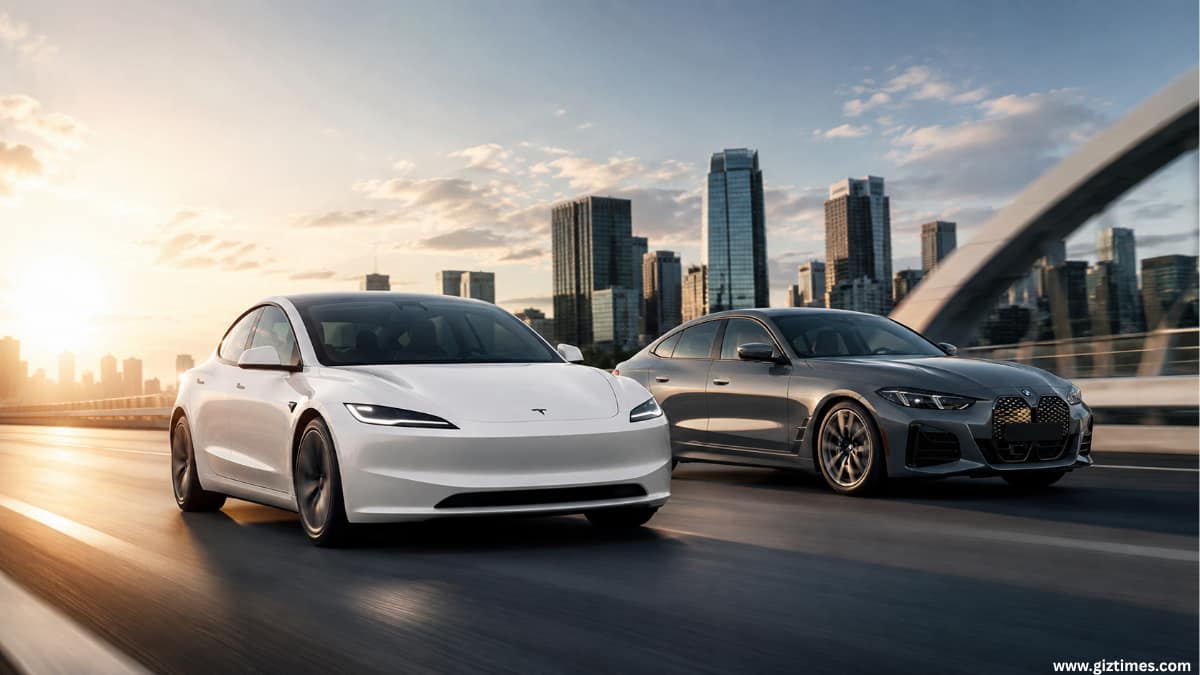
HYDERABAD, India (GizTimes) — The refreshed Tesla Model 3 arrives with a familiar mission: deliver long-range electric mobility, strong performance, and software-driven functionality in a package designed for broad adoption. While the update introduces improvements in comfort, efficiency, and cabin technology, the bigger story is how Tesla continues refining a formula that has already reshaped the electric sedan market.
The competitive challenge comes from the BMW i4 Gran Coupe, a premium electric sedan that blends traditional BMW driving characteristics with modern EV technology. Both vehicles target buyers seeking performance and usefulness, but they approach the problem from fundamentally different approaches.
Why This Vehicle Exists
The Tesla Model 3 was created around a specific engineering objective: to maximize real-world electric vehicle usability rather than focusing solely on luxury or outright battery size.
That philosophy is visible throughout the vehicle. The Long Range All-Wheel Drive version delivers an EPA-estimated range of up to 363 miles (584 km), while the Performance model reaches 0–60 mph in as little as 2.9 seconds. Instead of pursuing these numbers through larger batteries alone, Tesla emphasizes aerodynamic efficiency, powertrain optimization, and software management.
This approach creates an important strategic advantage. Greater efficiency does not simply enhance range; it also reduces dependence on charging stops during long journeys. The latest exterior revisions, including aerodynamic improvements and redesigned lighting elements, reinforce this focus by extracting more distance from the available energy.
The low-mounted battery pack also contributes to handling stability by lowering the center of gravity. Combined with instant electric torque, the Model 3 is engineered to provide responsive acceleration while maintaining predictable road manners.
Framework Integration: Auto Meets Tech and Architecture Strategy
The Tesla Model 3 demonstrates how modern vehicles increasingly operate as software-defined products rather than purely mechanical machines.
Tesla’s software-first mindset extends beyond the infotainment system. Over-the-air updates allow vehicle functions, interface improvements, and performance enhancements to be delivered after purchase. This means the ownership experience can evolve without requiring hardware changes.
The minimalist cabin design supports this strategy. Most functions are integrated into a central touchscreen, reducing physical controls and concentrating vehicle management into a digital interface. The addition of a rear passenger touchscreen further expands software interaction within the cabin, giving rear occupants direct access to entertainment and climate controls.
A less obvious insight emerges when comparing Tesla’s ecosystem approach with traditional automotive thinking. Tesla’s competitive advantage is not based on a single feature such as acceleration or range. Instead, the company has built an interconnected system in which efficiency, charging infrastructure, software updates, and the user interface work together. Each component reinforces the others. This creates a user experience that competitors cannot replicate solely through hardware improvements.
The BMW i4 also embraces digitalization through BMW Operating System 8.5, the Curved Display, Quick-Select controls, and the BMW Intelligent Personal Assistant. However, BMW’s strategy remains rooted in combining EV technology with familiar luxury-car expectations, whereas Tesla prioritizes a technology ecosystem designed around continuous software integration.
Comparison
The Tesla Model 3 and BMW i4 target similar buyers but represent two distinct interpretations of the electric sedan. Tesla prioritizes efficiency, charging convenience, and software integration, while BMW emphasizes luxury, practicality, and traditional driving engagement.
| Category | Tesla Model 3 | BMW i4 Gran Coupe |
|---|---|---|
| Maximum Range | Up to 363 miles (584 km) | 307–333 miles (eDrive40) |
| Performance | 0–60 mph in as little as 2.9 seconds (Performance) | Updated M60 performance flagship introduced |
| Charging Speed | Up to 175 miles (282 km) of range in approximately 15 minutes | Up to 108 miles of range in approximately 10 minutes |
| Charging Network | Access to Tesla Supercharger network | Access to Tesla Superchargers, Electrify America, IONNA, EVgo, and ChargePoint |
| Interior Philosophy | Minimalist touchscreen-focused design | Premium luxury-focused cabin with Curved Display |
| Software Updates | Over-the-air updates highlighted as a core feature | BMW Operating System 8.5 and digital ecosystem |
| Rear Passenger Technology | Dedicated rear touchscreen | Not specified |
| Cargo Flexibility | Traditional sedan layout | Gran Coupe hatchback design for greater cargo versatility |
| Driving Layout | Long Range AWD and Performance variants | RWD eDrive40, AWD xDrive40, AWD M60 |
| Reliability Recognition | Not specified | Recognized by Consumer Reports as one of the most reliable EVs |
Public Reaction Analysis
Public reactions focused less on vehicle capability and more on ownership economics.
One perspective highlights leasing as a pathway to access reliable transportation without committing to the full purchase price. This reflects a growing segment of EV buyers who view electric vehicles as rapidly evolving technology products rather than long-term assets. For these consumers, flexibility carries significant value.

The opposing view focuses on depreciation, arguing that leasing effectively transfers the cost of value loss to the user. This reaction reveals a persistent concern in the EV market: uncertainty about long-term resale values as battery technology, charging infrastructure, and vehicle software continue to advance rapidly.

Together, these reactions suggest that purchasing decisions are increasingly influenced by financial risk management rather than traditional measures such as horsepower or luxury features. Buyers are evaluating not only the vehicle itself but also how quickly the technology landscape may change during ownership.
Why It Matters
The Tesla Model 3 remains influential because it helped redefine expectations for what an electric sedan should deliver. Its combination of long range, rapid acceleration, software integration, and charging accessibility pushed the industry toward a more holistic EV ownership model.
The vehicle’s continued focus on efficiency rather than simply larger batteries also reflects a broader industry trend. As electric vehicles mature, engineering optimization is becoming as important as battery capacity.
Competition from vehicles like the BMW i4 displays how traditional automakers are responding. BMW brings luxury, practicality, and established driving dynamics into the EV segment, while Tesla continues emphasizing ecosystem integration and software-driven functionality.
This competition accelerates innovation across charging networks, battery technology, digital interfaces, and vehicle software, advancing the broader transition to electrified mobility.
Final Takeaways
The refreshed Model 3’s improved sound insulation and upgraded cabin materials indicate that Tesla is addressing areas where competitors traditionally held an advantage.
The BMW i4’s hatchback-style Gran Coupe design shows that practicality remains a differentiator in the premium EV segment, even as software and charging technology receive increasing attention.
BMW’s confirmation that a Neue Klasse-based successor will replace the i4 after the 2026 model year also emphasizes how rapidly EV architectures are evolving across the industry.
Much of the debate now centers on charging convenience and software integration, which could define long-term leadership in the electric sedan market.
