

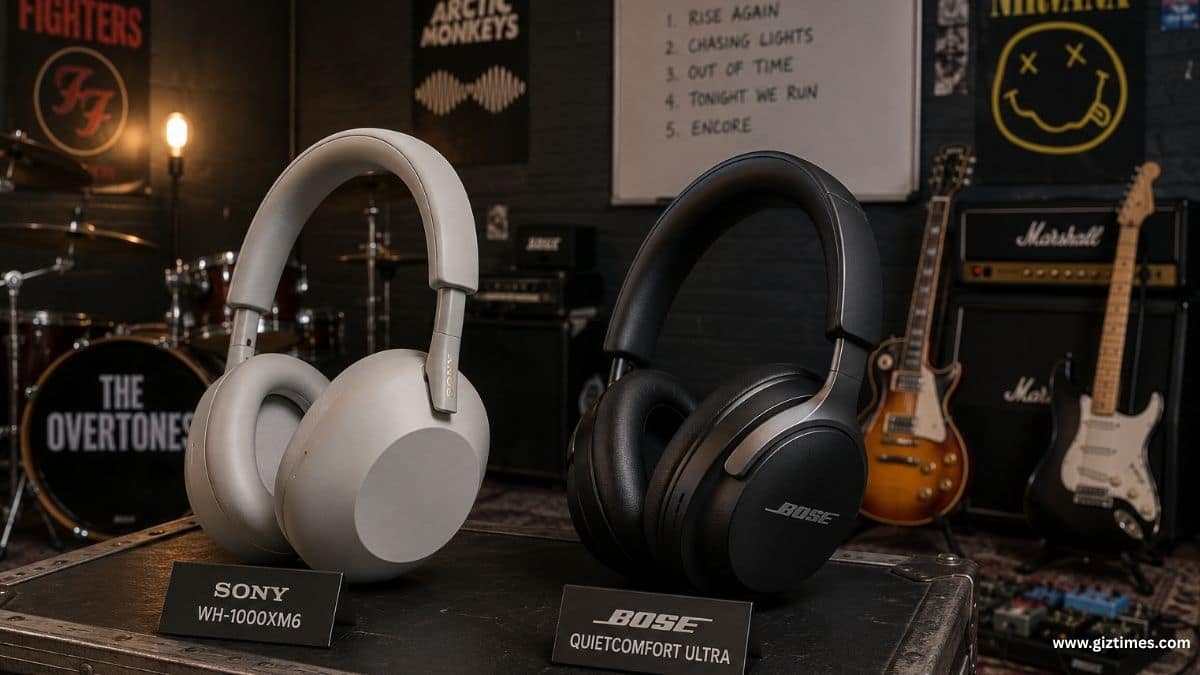
HYDERABAD, India (GizTimes) —Premium noise-canceling headphones have gone beyond being merely sound-good products in the modern market. Today, consumers spending over $400 look for headphones that are reliable, convenient in usage, easily maintainable, and not turning into e-waste after just two years.
The Sony WH-1000XM6 and the Bose QuietComfort Ultra follow exactly those principles. However, while Sony focuses on portability and long-lasting usability, Bose pays more attention to comfort ergonomics and immersive audio realism. Therefore, the latter is still more comfortable for long listening sessions, while the former offers a better overall ownership experience.
Why This Product Exists
The reason the Sony WH-1000XM6 exists is simple – the backlash against the non-folding XM5. Although the previous generation introduced advanced ANC and improved call quality, it also removed the most convenient hinge. Therefore, the new model is completely collapsible again to make it easier to use in everyday scenarios.
At the same time, Bose did something unexpected for their flagship line. Instead of focusing on portability or longevity, the brand concentrated on comfort tuning and immersive experience. The decreased clamping force, softer fit, and deep ear cavities create a headset designed to disappear while wearing. Thus, Bose recognizes the necessity to make even the best ANC system as unnoticeable as possible.
Processor Longevity and Repairability
Sony’s strongest point is probably not its ANCh capabilities. At least, not the current ones. Instead, it is about the processing power and future-proofing that the headphones offer.
Firstly, the new QN3 processor is seven times faster than the older QN1 chip. From a marketing perspective, it looks like an obvious improvement. However, from the technical side, it gives Sony much more freedom to introduce various features. Because the headphones become software-defined products, most ANC enhancements happen via updates. Therefore, more powerful chips mean more options available.
Secondly, the WH-1000XM6 introduces several software innovations at once. Adaptive NC Optimizer, spatial scene awareness in transparency mode, AI beamforming, support for the new LE Audio, and spatial processing all use processing power. In addition, it looks like Sony has much more room to expand further.
In contrast, Bose decided to concentrate on acoustic immersion rather than sheer computational power. Although the QuietComfort Ultra is also based on a sophisticated DSP architecture, it still looks like a more conservative solution from an upgrade perspective.
Finally, repairability creates another difference between competitors.
According to the repair rating, the new Sony headset deserves the Medium classification. Not only does it have a reinforced foldable hinge to ensure durability, but it also includes replaceable earpads. As a result, long-term maintenance costs go down considerably.
Although Bose made its QuietComfort Ultra very comfortable, it also makes it less repairable. Despite the use of high-quality materials, the headphones remain fully sealed, which complicates their servicing over time. In addition, it also increases the likelihood of full replacement rather than parts-only fixing.
From a financial perspective, premium headphones are increasingly becoming similar to smartphones. People keep their expensive devices longer and take better care of them than earlier. Therefore, Sony tries to optimize its design accordingly, while Bose still ignores that issue.
Real-World Noise Cancellation and Transparency
As it was mentioned above, Sony continues to lead in ANC. However, there is one key difference in the new model. Compared to its predecessor and other models on the market, the new headset offers much stronger stability and efficiency in various situations. Firstly, the system shows much better results when canceling mid- and high-frequency sounds. For example, it is not easy for competitors to handle sudden environmental noise.
Secondly, Sony introduces much faster processing, which allows for avoiding pressure artifacts while moving. In other words, the XM6 becomes very convenient to use while commuting.
However, Bose still wins in transparency mode. Although Sony introduced significant improvements to this functionality, its ANC solution remains less effective in terms of preserving spatial perception. Nevertheless, the user feedback suggests that other devices, including Apple’s headphones, remain leaders in that regard. Call quality shows a clear difference between the two brands.
In fact, Sony has created an innovative AI beamforming system that uses six microphones to improve noise isolation in a loud environment. In turn, Bose is known to perform well indoors, but the external sound isolation remains less efficient in that case. Furthermore, reducing the number of microphones from 12 to 10 raises concerns regarding the dependence on software solutions.
Comparison
| Technical Dimension | Sony WH-1000XM6 | Bose QuietComfort Ultra | Technical Interpretation |
|---|---|---|---|
| Product Philosophy | Computational travel headphone focused on adaptive processing and mobility | Luxury comfort headphone focused on immersion and ergonomic refinement | Sony prioritizes algorithmic optimization and versatility; Bose prioritizes sensory comfort and acoustic presentation |
| Noise-Canceling Architecture | QN3 HD Noise Canceling Processor with significantly faster real-time adaptive calculations | CustomTune adaptive ANC with psychoacoustic tuning | Sony’s faster processing pipeline improves transient ANC corrections; Bose focuses more on perceptual comfort calibration |
| ANC Consistency in Motion | Maintains stable cancellation while walking or commuting | Occasional cabin-pressure artifacts during movement | Sony’s adaptive filtering appears more stable against changing seal pressure and head motion |
| Acoustic Isolation Strategy | Aggressive low-frequency attenuation with strong environmental suppression | Smoother and less fatiguing cancellation curve | Sony targets maximum isolation efficiency; Bose targets long-session listening comfort |
| Transparency / Ambient Pass-through | Major improvement in voice isolation and environmental reconstruction | More organic and natural external sound rendering | Bose reproduces ambient frequencies with less digital coloration; Sony prioritizes intelligibility |
| DSP Philosophy | Heavy computational audio enhancement and scene adaptation | Spatial immersion and psychoacoustic widening | Sony behaves more like an adaptive signal-processing platform; Bose behaves more like a cinematic audio system |
| Spatial Audio Implementation | 360 Reality Audio upmixing and head-tracked virtualization | Bose Immersive Audio with a stronger spatial widening effect | Bose produces a more dramatic out-of-head presentation; Sony remains more restrained and positional |
| Processor Generation Leap | QN3 processor claimed at 7× faster performance versus QN1 | Incremental DSP refinement rather than a raw compute leap | Sony is emphasizing computational headroom for future adaptive features |
| Mechanical Design | Foldable chassis returns for travel efficiency | Foldable structure retained from previous QC philosophy | Sony improves portability and practicality after XM5 criticism |
| Structural Ergonomics | Firmer clamp force with relatively shallow earcup depth | Softer clamp with deeper ear cushions | Bose distributes pressure more evenly for extended wear sessions |
| Long-Term Wear Behavior | Better passive stability during transit and movement | Reduced hotspot fatigue during prolonged listening | Sony favors secure fit dynamics; Bose favors pressure minimization |
| Repairability Direction | Toolless earpad replacement improves maintenance lifecycle | More integrated/sealed assembly approach | Sony signals stronger user-serviceability thinking |
| USB-C Audio Path | No true digital USB-C lossless playback mode | Supports direct USB-C digital audio | Bose provides a cleaner wired digital chain for high-resolution playback |
| Battery Efficiency | 30-hour ANC runtime despite higher computational workload | 30-hour runtime with immersive features enabled | Sony’s efficiency gains suggest improved power-management optimization |
| Water / Dust Protection | No official IP certification | No official IP certification | Neither model is engineered as a fitness-oriented headphone |
| Portability Optimization | Compact folding plus improved hinge practicality | Lightweight comfort-first portability | Sony optimizes bag efficiency; Bose optimizes wearing comfort |
| Target User Profile | Frequent travelers, commuters, ANC-focused users, tech-oriented buyers | Comfort-focused listeners, immersive audio fans, long-session users | The choice depends more on ergonomic philosophy than raw specification superiority |
| Long-Term Product Strategy | Future-proofed adaptive platform with maintainability focus | Premium sensory experience with refined tuning | Sony appears more engineering-forward; Bose more experience-forward |
Public Reaction Analysis
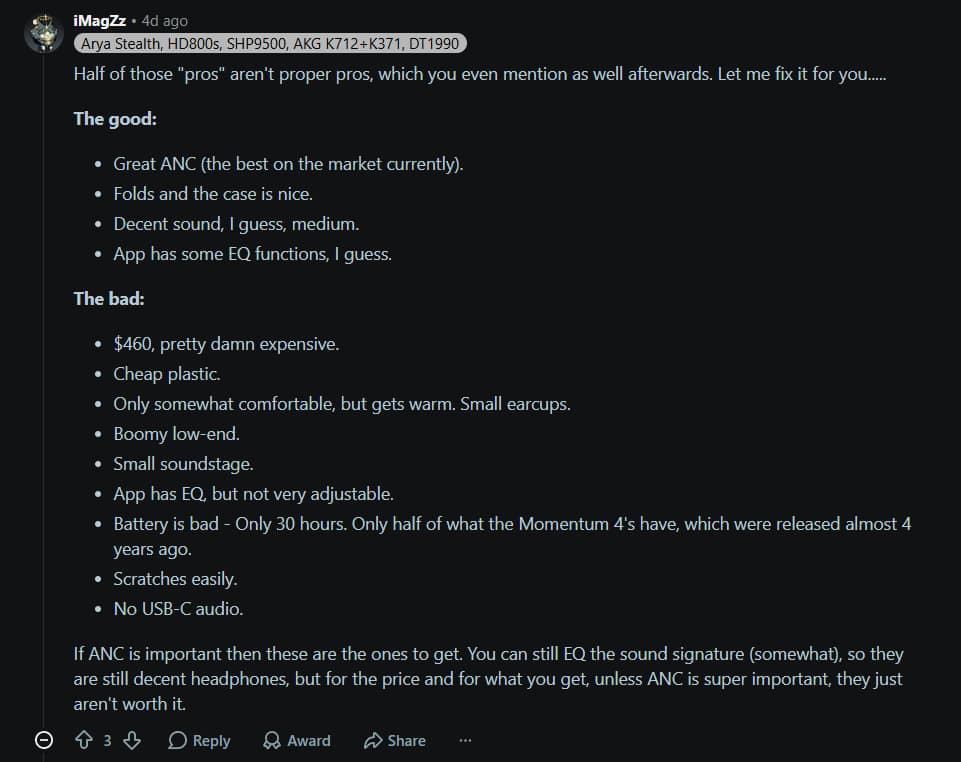
Public reactions around the XM6 reveal a strange contradiction. Many users simultaneously acknowledge that Sony currently delivers the best ANC on the market while also questioning whether the overall package justifies the price. That tension appears repeatedly in user discussions.
What stands out is that criticism is no longer centered on audio quality alone. Users are increasingly talking about plastics, heat buildup, comfort fatigue, scratches, battery expectations, and maintenance practicality. In other words, premium headphone buyers are starting to evaluate these products like long-term personal devices rather than disposable audio accessories.
One reaction specifically criticizes the XM6’s “only” 30-hour battery life compared to the much longer endurance offered by competitors like the Momentum 4. Another praises Sony’s feature richness while still preferring Apple’s transparency implementation. These comments show that technical leadership is no longer enough by itself. Buyers now expect specialization across every category simultaneously.
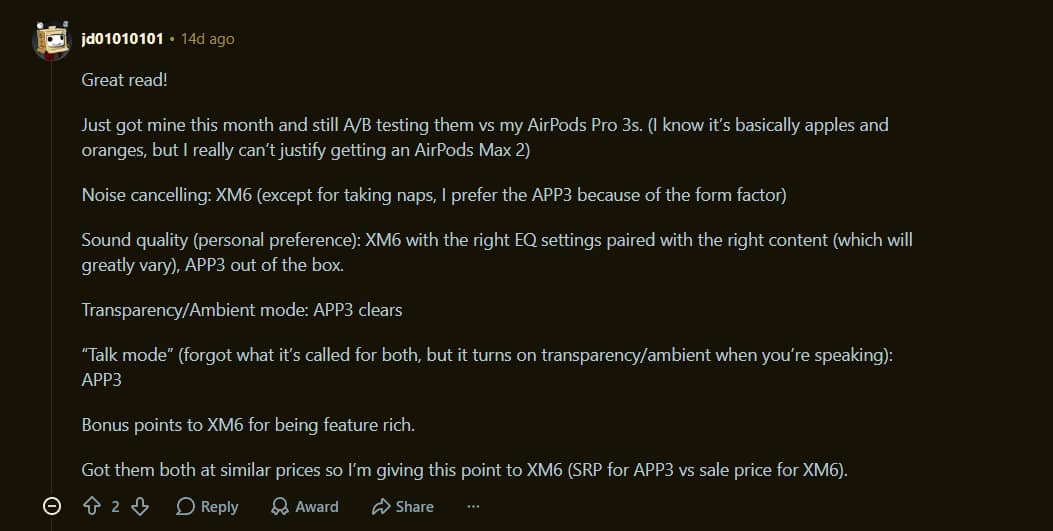
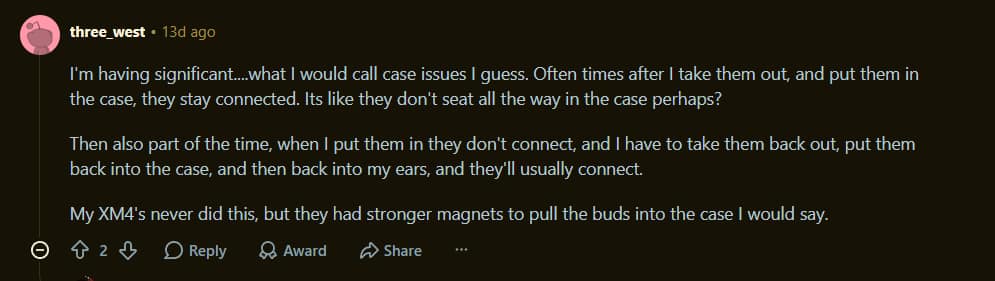
 Interestingly, Bose avoids some of Sony’s ergonomic criticism but attracts its own concerns around microphone consistency and environmental handling. The comfort advantage is real, but Bose’s ecosystem increasingly feels like a refinement-focused product rather than a fast-evolving technology platform.
The non-obvious insight here is that the market is quietly rewarding reliability of experience over raw feature count. Sony recognized this after the XM5 backlash. The restored foldable hinge and replaceable components are not nostalgic design reversions. They are defensive engineering decisions designed to reduce friction in everyday ownership.
What This Means for Buyers
The WH-1000XM6 wins because Sony managed to balance the portability and performance aspects successfully. It means that users no longer have to choose one of these characteristics, which is a huge achievement for Sony’s 1000X series. Indeed, most top-end ANC headphones become less portable, harder to maintain, and too fragile. Therefore, Sony fixed this problem in advance, preventing its product line from stagnating. However, Bose is also successful in its efforts, which is why the QuietComfort Ultra remains very comfortable.
Overall, as a long-term investment, Sony’s product is more advantageous. Higher processor speed, an easier-to-maintain design, improved portability and durability, and excellent noise-cancellation performance create an excellent basis for daily use.
Other Takeaways
However, there is one thing that the headphones share – a lack of IP rating. Indeed, despite the premium price, neither headphone claims any level of water-resistance. However, the trend shows that customers are looking for headphones that can withstand a bit of a workout as well. Another trend that is emerging in the market is different approaches to premium headphones. While Sony tends to make its processors better, Bose focuses on improving audio immersion and comfort.
Eventually, the coming Bluetooth LE Audio ecosystem development might play the most crucial role.
Read More:
