

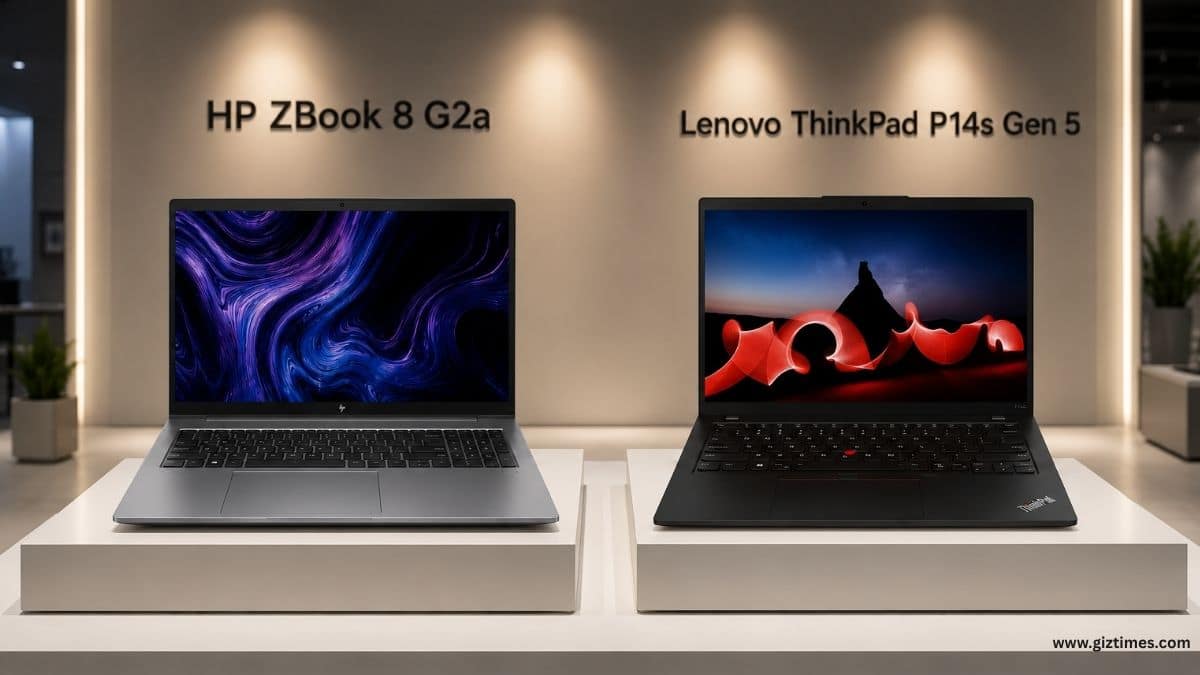
HYDERABAD, India (GizTimes) —Mobile workstations used to follow a simple formula: bigger chassis, louder cooling, dedicated NVIDIA graphics, and enough battery life to survive a meeting room. The new HP ZBook 8 G2a changes that formula completely.
Instead of chasing maximum GPU horsepower, HP is betting on a different future, one built around AI acceleration, integrated graphics that are finally powerful enough for serious work, and far better efficiency. The result is a workstation that behaves less like a portable desktop replacement and more like a high-end productivity machine designed for modern hybrid workflows.
That creates a direct contrast with the Lenovo ThinkPad P14S Gen 5. Lenovo still treats the workstation category as a traditional rendering-focused machine, especially on Intel and NVIDIA configurations. HP is clearly targeting a broader audience: developers, creators, prosumers, analysts, and professionals who care just as much about battery life, portability, and AI-ready hardware as raw rendering throughput.
Why HP Is Rethinking the Mobile Workstation
The HP ZBook 8 G2a exists because workstation buyers are changing.
A few years ago, professional laptops were designed mainly around CAD workloads, GPU rendering, and simulation software. That required thick cooling systems, discrete GPUs, and large batteries just to survive moderate workloads. The old HP ZBook 15 G2 perfectly represented that era, weighing over 6 pounds with large power bricks and aggressive thermal requirements.
The ZBook 8 G2a is built for a completely different workload pattern.
Modern professionals spend far more time inside browser-heavy workflows, AI-assisted applications, video conferencing, code environments, creative tools, and cloud-connected productivity systems. HP recognized that these tasks benefit more from efficiency, sustained responsiveness, and local AI acceleration than brute-force GPU rendering.
That is why the centerpiece of the ZBook 8 G2a is not a discrete RTX GPU. It is the AMD Ryzen AI processor with up to 55 NPU TOPS.
This matters because AI workloads are becoming permanent background tasks. Features like local Copilot processing, AI-assisted coding, intelligent camera framing, voice cleanup, workflow prediction, and productivity automation increasingly run continuously instead of occasionally. A laptop designed around traditional CPU-GPU architecture wastes battery doing these tasks. A dedicated NPU handles them more efficiently.
HP is essentially treating AI acceleration as a permanent system layer rather than a marketing checkbox.
Lenovo’s ThinkPad P14s Gen 5 approaches the market differently. The Intel variant expands the chassis specifically to accommodate NVIDIA RTX graphics and heavier cooling hardware. That still makes sense for CUDA-heavy workflows and specialized rendering pipelines, but it also creates a machine that behaves more like a legacy workstation than a next-generation mobile productivity device.
The ZBook’s philosophy is simpler: most professional users do not actually need workstation-class discrete graphics all day long. They need long battery life, strong multitasking performance, lighter thermals, and hardware that remains relevant as AI workloads become standard.
Processor Longevity
The biggest long-term advantage of the HP ZBook 8 G2a is architectural direction.
The AMD Ryzen AI PRO 400-series chips are designed around workloads that are still emerging. The integrated XDNA NPU delivering up to 55 TOPS is already above the threshold being pushed for Copilot+ AI systems. That gives the ZBook a longer practical lifespan because future operating system features and professional software are increasingly being optimized around local AI acceleration.
The ThinkPad P14S Gen 5 AMD variant includes an NPU as well, but it tops out at 16 TOPS. The Intel Core Ultra versions rely more heavily on traditional CPU and GPU balancing. That difference becomes important over time. The ZBook’s processor architecture feels designed for the next generation of software. The ThinkPad still feels optimized for the previous one.
There is also a thermal implication here. The ThinkPad P14S Intel model reaches aggressive thermal spikes during sustained workloads, briefly hitting 100°C before throttling down. HP’s system philosophy is more conservative, using lower system TDP targets and AI-assisted workload balancing through HP Smart Sense.
That likely translates into better long-term silicon health and more stable battery behavior over years of use. A non-obvious implication emerges from this comparison: integrated graphics are no longer the weak point in mobile workstations. Battery efficiency is.
The Radeon 890M-class integrated graphics inside the ZBook are already strong enough for a huge percentage of professional workloads. What users increasingly notice instead is fan noise, thermal discomfort, charger dependency, and battery degradation. HP is optimizing around the new bottleneck, while Lenovo is still optimizing around the old one.
Repairability
Both systems move in a positive direction by returning to dual-channel slotted DDR5 memory instead of soldered RAM. The ThinkPad P14S Gen 5 supports up to 96GB DDR5 through two SO-DIMM slots. The ZBook 8 G2a supports up to 64GB DDR5-5600 using accessible SODIMM configurations.
In real-world ownership, this matters more than most consumers realize. Soldered memory kills upgrade flexibility and shortens device lifespan. A workstation with modular RAM can evolve with software demands instead of becoming obsolete when memory pressure increases.
Repairability on both systems falls into the Medium category rather than Easy.
Storage upgrades remain accessible, but both systems rely on compact internal layouts with thermal pads, tightly integrated cooling systems, and increasingly dense motherboard structures. The ThinkPad also introduces firmware limitations on secondary storage expansion. HP’s advantage is that the overall platform is less thermally stressed. Lower sustained heat usually means lower long-term wear on surrounding components like VRMs, batteries, and cooling assemblies.
That reduces the total cost of ownership over several years.
Comparison
The real difference between these machines is not raw benchmark positioning. It is a usage philosophy.
The ThinkPad P14S Gen 5 behaves like a classic mobile workstation that has become lighter. The HP ZBook 8 G2a behaves like a future AI laptop that gained workstation capabilities.
| Feature | HP ZBook 8 G2a | Lenovo ThinkPad P14s Gen 5 |
|---|---|---|
| Processor Architecture | AMD Ryzen AI PRO 400-series | Intel Core Ultra / AMD Ryzen PRO 8040HS |
| NPU Performance | Up to 55 TOPS | Up to 16 TOPS |
| Graphics Strategy | High-end integrated Radeon graphics | NVIDIA RTX 500 Ada or Radeon 780M |
| Memory Design | Dual-channel DDR5 SODIMM | Dual-channel DDR5 SODIMM |
| Maximum RAM | 64GB DDR5-5600 | 96GB DDR5 |
| Storage | PCIe Gen 5 NVMe | PCIe Gen 4 NVMe |
| Weight | Starts at 1.46 kg | Starts at 1.31 kg AMD / 1.61 kg Intel |
| Battery Capacity | 68Wh | Up to 75Wh Intel / 52.5Wh AMD |
| Claimed Mobility Focus | AI-first mobile workstation | Traditional workstation flexibility |
| Wireless | Wi-Fi 7 | Wi-Fi 6E |
| Chassis Philosophy | Thin AI productivity workstation | Enterprise workstation split design |
Public Reaction Analysis
The public reactions around the ThinkPad P14S Gen 5 reveal a consistent pattern: users like the value, but they are constantly managing compromises.
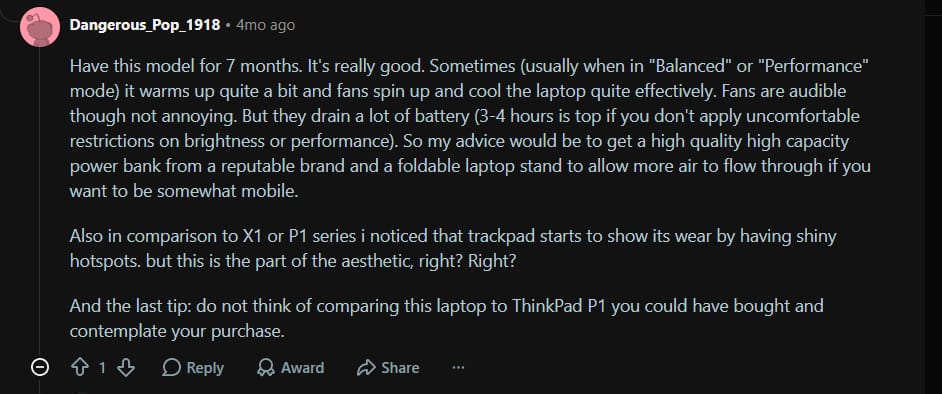
Battery life complaints appear repeatedly. One user specifically mentions getting only 3–4 hours under balanced or performance modes while dealing with aggressive fan behavior and heat buildup. Another user warns that the AMD variant trades efficiency for performance tuning, resulting in higher temperatures and lower endurance.
Interestingly, nobody complains about the lack of raw power. That is important. The frustration is centered around thermals, portability friction, charger dependence, and display quality inconsistencies. Even positive comments carry caveats about OLED battery drain, thermal behavior, and panel lottery concerns.
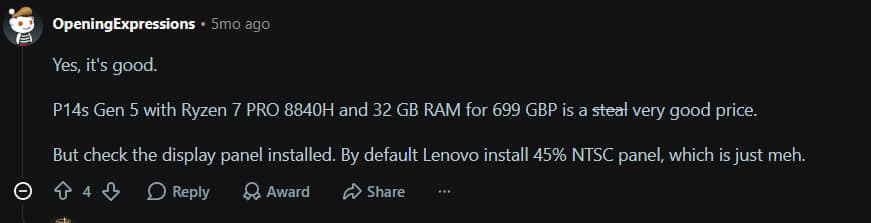
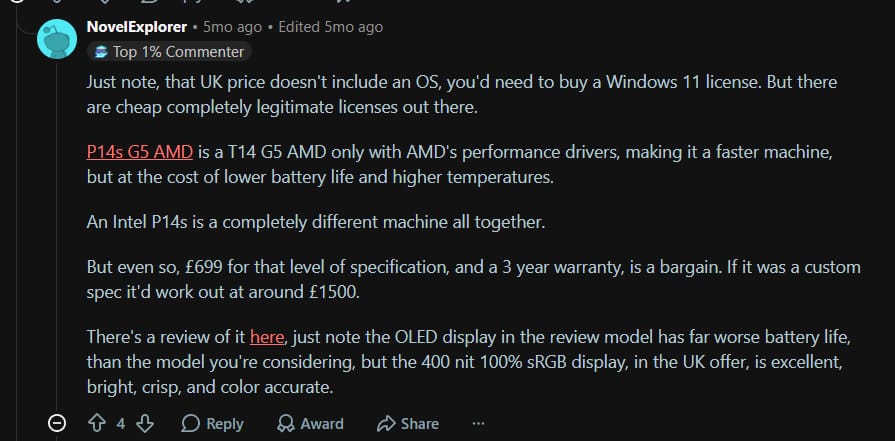
 That indirectly validates HP’s direction. The ZBook 8 G2a is clearly optimized around reducing these compromises instead of maximizing workstation-class brute force. HP understands that modern professional buyers increasingly judge laptops based on how often they interrupt workflows, not how high their benchmark scores climb.
Another subtle pattern appears in the reactions: users keep comparing the P14S against other ThinkPads like the X1 or P1. That suggests identity confusion inside Lenovo’s own lineup. The machine sits awkwardly between portability and workstation behavior.
The ZBook 8 G2a avoids that confusion by defining itself much more clearly as an AI-first professional machine.
Where the Workstation Market Is Heading
The ZBook 8 G2a matters because it signals where mobile workstations are heading next.
The industry is slowly moving away from the assumption that professional users always need discrete GPUs. AI acceleration, integrated graphics improvements, and cloud-assisted workflows are changing what “pro performance” actually means. For a large segment of users, battery efficiency and local AI responsiveness now matter more than CUDA rendering capability.
That does not make the ThinkPad P14S obsolete. CUDA-dependent engineers, simulation specialists, and heavy 3D professionals still benefit from NVIDIA workflows. But those users are becoming a narrower category than before. For everyone else, the HP ZBook 8 G2a is simply the more modern interpretation of a professional laptop.
It delivers the kind of performance that aligns better with how most professionals actually work in 2026.
Other Takeaways
One of the most interesting details is how aggressively both companies are moving back toward repairable memory configurations after years of soldered RAM trends. That reversal quietly acknowledges that enterprise buyers now prioritize lifecycle flexibility over ultra-thin industrial design.
Another important detail is the rise of integrated graphics credibility. AMD’s Radeon integrated graphics have improved enough that manufacturers are willing to build entire workstation-class identities around them instead of treating them as fallback solutions.
The workstation market is no longer divided between “thin laptops” and “real workstations.” That line is disappearing.
The upcoming evolution of AI-native professional software will likely determine whether HP’s AI-first workstation strategy fully replaces the legacy GPU-heavy mobile workstation model.
Read More:
- Unreal Engine 6 at Rocket League RLCS: Everything Announced, Why Epic Skipped UE5, and the Hardware Arms Race Ahead
- Galaxy Watch8 and Pixel Watch 4 Represent Two Completely Different Futures of Smartwatches
- BMW M440i vs Porsche 911 Carrera Cabriolet: Why BMW’s Formula Targets a Wider Performance Audience
