

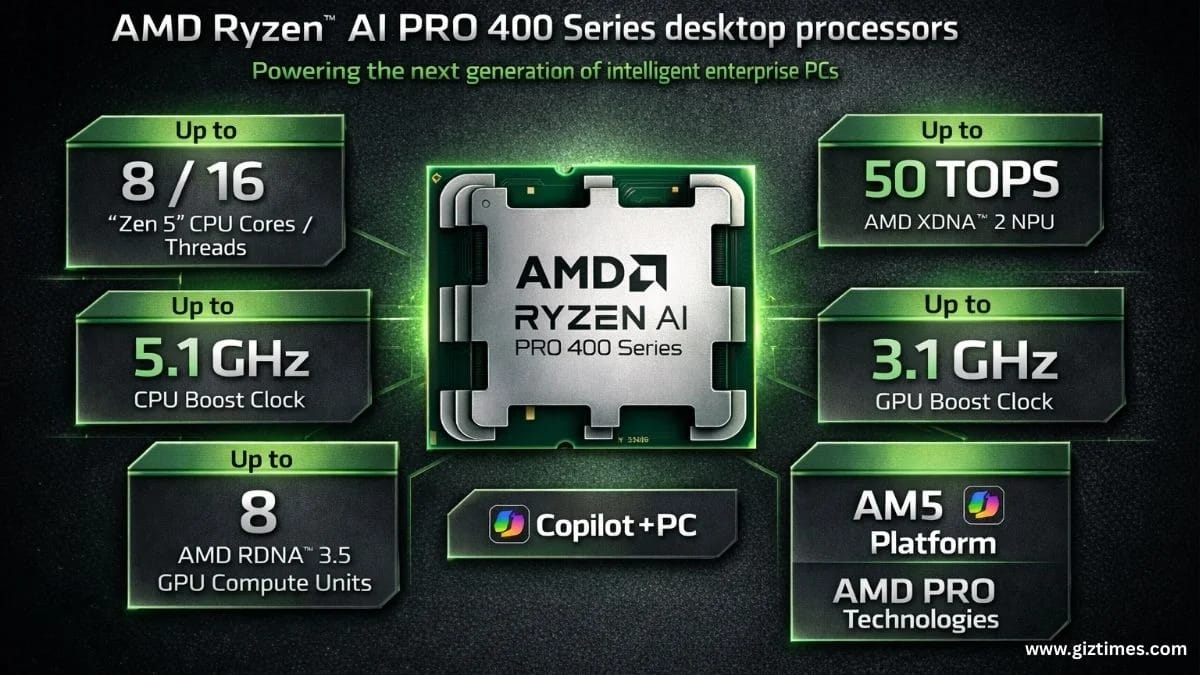
AMD made waves today by unveiling its first Ryzen AI desktop processors, the Ryzen AI 400 series, tailored for the AM5 socket, finally bringing cutting-edge Zen 5 CPU architecture, upgraded RDNA 3.5 integrated GPUs, and high-performance 50 TOPS neural processing units to desktop systems aimed primarily at business users. The lineup includes six Pro-branded models: the top-tier Ryzen AI 7 Pro 450G and its low-power 35W GE sibling, plus the Ryzen AI 5 Pro 440G/GE and Ryzen AI 5 Pro 435G/GE.
AMD announces Ryzen AI PRO 400 Series desktop CPUs for AI-focused computing
by
u/Fcking_Chuck in
pcmasterrace
These APUs serve as straightforward successors to the Ryzen 8000G family, not challengers to the performance-focused Ryzen 9000 series, and crucially, they meet Microsoft’s strict Copilot+ PC requirements. This certification unlocks premium Windows 11 AI capabilities, such as the timeline-based Recall feature for searching past activities and Click to Do for instant AI actions from screen content, positioning AMD as a pioneer in Copilot+-ready x86 desktops.
These chips are mainly made for businesses and office use. Because they carry the Ryzen Pro name, they include special features designed for companies. They support advanced remote management, which means IT teams can control and fix computers from far away. They also have strong security features, like secure boot (which makes sure the system starts safely) and better protection for system firmware.
In addition, these chips work smoothly with popular IT management tools used by big computer brands like Dell, HP, Lenovo, and Framework. This makes it easier for companies to set up, manage, and protect many computers at the same time. Rather than hitting retail shelves in boxed form for hobbyist builders, expect these to power pre-configured business PCs launching in Q2 2026, think slim office towers, mini-PCs, or all-in-one workstations that prioritize integrated graphics over add-in cards.
AMD is using the same chip design that already worked well in laptops and adapting it for desktop computers. So, the technology is not completely new; it is based on the Ryzen AI 300 and newer 400-series laptop chips. However, for desktops, AMD has adjusted the chips to focus more on stability and reliability for business use, instead of chasing very high performance for gaming or tech enthusiasts. It’s a familiar design, slightly updated, and made mainly for companies that need dependable performance rather than extreme power.
Diving into the silicon, the Ryzen AI 7 Pro 450G stands as the hero with its hybrid 8-core setup: four beefy Zen 5 cores boosting to 5.1GHz for heavy lifts and four compact Zen 5c cores for efficiency, spanning 16 threads and backed by 16MB of L3 cache. Graphics come courtesy of the Radeon 860M iGPU, wielding 8 RDNA 3.5 compute units capable of handling 1080p gaming at modest settings, multi-4K displays, or hardware-accelerated video encoding.
The most important feature is the built-in XDNA 2 NPU, which can perform up to 50 trillion operations per second. This powerful AI engine is designed to run generative AI directly on the computer. In simple terms, you can use on-device chatbots, edit photos with tools like Stable Diffusion, or translate languages in real time without sending your data to cloud servers.
The Ryzen AI 5 Pro 440G and 440GE models come with 6 cores and 12 threads and can reach speeds of up to 4.8GHz. They include Radeon 840M graphics with around 4 to 6 compute units. The slightly lower Ryzen AI 5 Pro 435G and 435GE models can reach up to 4.6GHz. All of these versions include the same powerful AI engine.
They support fast DDR5 memory and LPDDR5x memory up to 128GB, along with PCIe 4.0 for storage and graphics expansion. They also include USB4 ports for high-speed connections and are ready for Wi-Fi 7. Overall, these chips offer a balanced mix of strong AI performance, good processing power, and modern connectivity for business desktop systems.
AMD deliberately skips laptop flagships like the 12-core Ryzen AI 9 HX 370/375 or top Radeon 890M iGPU here, citing impracticality for desktop gaming amid DDR5 memory prices that have skyrocketed fast kits now cost as much as entire budget GPUs due to AI server demand and supply squeezes. This business-first approach shines in scenarios where strong iGPUs reduce costs for CAD, video conferencing, or virtual desktops, dodging the frames-per-dollar pitfalls of current mini-ITX builds.
AMD made these chips using TSMC’s small and efficient 4nm technology. After doing well in laptops for about 18 months, AMD is now bringing its Ryzen AI chips to desktop computers. This is happening at a time when making computer chips is still challenging worldwide. At the same time, competitors like Intel are launching new chips too, such as Lunar Lake, so the competition is strong. Like what AMD showed at CES 2026, these new desktop chips are more of an upgrade than a big breakthrough. They offer small improvements in CPU cores, graphics, and AI performance. The goal is to compete in the new “Copilot+” AI PC market without making unrealistic claims.
For business users, the Ryzen Pro features make it easier for companies to set up and manage many PCs at once. The power usage (TDP) is designed to support quiet systems, including fanless desktops, and machines that can run all day and night.
Public reactions on the Reddit thread r/Terraria show a highly technical discussion about AI hardware performance.
One user questioned the usefulness of AI accelerators inside CPUs, arguing that most local AI models such as large language models and image generation tools prefer running on GPUs, and even then, performance is limited by GPU memory.

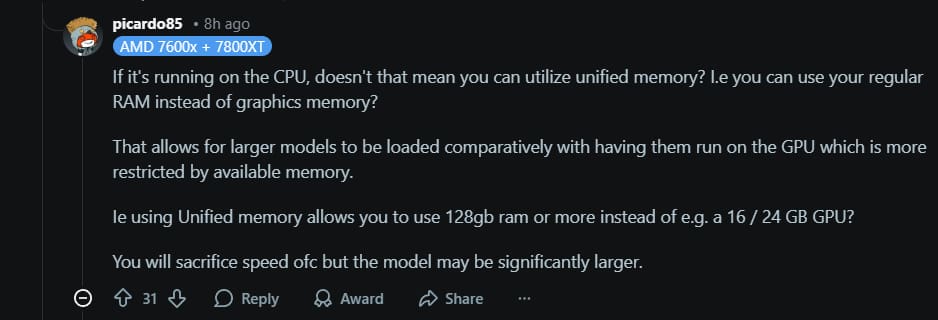
Another user explained that if AI models run on the CPU, they can use the computer’s regular RAM through unified memory. This means you could use a lot more memory, like 128GB, instead of being limited to 16–24GB on a GPU. However, the model would run slower.
Another user agreed that it would run much slower. They also said that because RAM is expensive right now, AMD’s Ryzen AI Max+ 395 (Strix Halo) might be a better option for running large AI models.

Gamers who use AM5 motherboards may want stronger X3D versions or more powerful models. These new chips are not mainly made for high-end gaming. But for businesses, they are a good option. They offer affordable desktop computers with built-in AI features. These systems can run AI tasks directly on the computer instead of sending data to the cloud, which helps protect privacy. They also use the familiar x86 platform, so companies can easily use their existing software.
AMD may release more powerful versions in the future. For now, this launch shows that AMD is focusing on practical and business-friendly AI desktop computers.
