Close Menu
GizTimes
    Facebook X (Twitter) Instagram
    Facebook X (Twitter) Instagram
    GizTimesGizTimes
    Source on Google
    • Home
    • Tech News
    • AI
    • Gadgets
    • Cybersecurity
    • Auto
    • Cars
    • Games
    GizTimes
    Home » Intel Redefines the AI PC Market with a Split Strategy: Affordable Efficiency vs Premium Ambition
    Tech News

    Intel Redefines the AI PC Market with a Split Strategy: Affordable Efficiency vs Premium Ambition

    Yuvraj TiwariBy Yuvraj TiwariApril 17, 2026No Comments5 Mins Read
    Facebook Twitter Pinterest Telegram LinkedIn Tumblr WhatsApp Email
    Intel Redefines the AI PC Market with a Split Strategy: Affordable Efficiency vs Premium Ambition
    Intel Redefines the AI PC Market with a Split Strategy: Affordable Efficiency vs Premium Ambition
    Share
    Facebook Twitter LinkedIn Pinterest Telegram Email

    HYDERABAD, India (GizTimes) —Intel’s latest client roadmap isn’t just about rolling out new processors; it signals a broader shift in strategy. With Core Series 3 (Wildcat Lake) and Core Ultra Series 3 (Panther Lake), the company is no longer chasing a single definition of performance. Instead, it’s splitting its lineup into two distinct paths: efficiency-focused chips for the mainstream and AI-driven performance for premium systems.
    This isn’t just a branding exercise. It directly affects how long these processors stay relevant and who should consider buying them.

    Why This Product Exists

    At the hardware level, both families share a key advantage: Intel’s 18A node with RibbonFET and PowerVia. That means even lower-cost Core Series 3 chips benefit from efficiency improvements that used to be reserved for high-end silicon.

    The difference lies in how Intel chooses to use that advantage.

    Core Ultra Series 3 is designed for scale. It brings more cores, much stronger Xe3 graphics (up to 12 cores), and a full multi-engine AI stack reaching 180 TOPS. It’s built for demanding workloads that rely on CPU, GPU, and NPU working together, like content creation, gaming, and AI inference.

    Core Series 3 takes a more restrained approach. This involves reducing core count, restricting the GPU capabilities to only two Xe3 cores, and dramatically lowering AI capacity (15-17 TOPS). The focus is clearly efficiency in constrained power envelopes, such as 15W laptops and low-budget computers.

    This approach is clear: provide good enough performance for everybody and reserve game-changing performance for premium customers.

     Processor Longevity

    Here, longevity isn’t just about raw speed; it’s about how well a chip can adapt over time.
    Core Ultra Series 3 is built with future workloads in mind. Its 5th-gen NPU, scalable Xe3 graphics, and high memory bandwidth (up to LPDDR5X-9600) position it well for a shift toward local AI processing. While 180 TOPS isn’t essential today, it provides a buffer against becoming outdated too quickly.

    Core Series 3 approaches longevity differently. Its upgraded Darkmont efficiency cores narrow the gap between performance and efficiency, enabling everyday tasks to run smoothly on low-power cores. That helps extend usability for basic workloads.

    But there’s a limit. With minimal GPU resources and modest AI capability, these chips aren’t built for increasingly AI-heavy software. They’ll hold up fine for browsing, office work, and light multitasking, but may struggle as AI-native applications become more common.

    The key takeaway: both chips share advanced manufacturing, but only one is truly prepared for where software is heading. The other is optimized for present-day efficiency rather than future demands.

    Comparison

    Intel isn’t just offering different performance tiers, it’s segmenting use cases.

    Category Core Ultra Series 3 Core Series 3 (Wildcat Lake)
    Core Configuration Up to 4P + 8E + 4 LP-E Up to 2P + 4 LP-E
    GPU Up to 12 Xe3 cores (Arc B390) 2 Xe3 cores
    AI Performance Up to 180 TOPS 15–17 TOPS
    Memory Support Up to LPDDR5X-9600 Not specified
    Target Devices Premium laptops, gaming, creators Budget laptops, Chromebooks, edge devices
    Power Profile High-performance mobile ~15W efficiency-focused
    Battery Claim Up to ~18.5 hours streaming Up to ~18.5 hours streaming

    The table shows something subtle: battery life parity exists across tiers. The differentiation is not endurance—it’s capability under load.

    Public Reaction Analysis

    Early responses have been measured rather than enthusiastic.

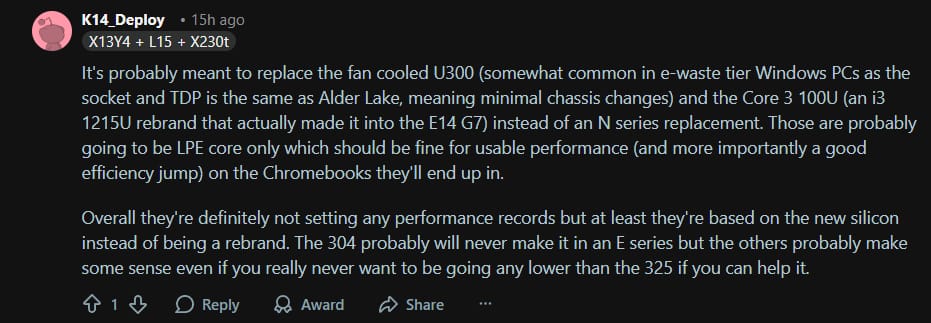
    On the positive side, people recognize that Core Series 3 isn’t just a rebrand; it brings genuinely new silicon and better efficiency. At the same time, its limitations are already clear, with some users advising against lower-end models like the Core 3 304.
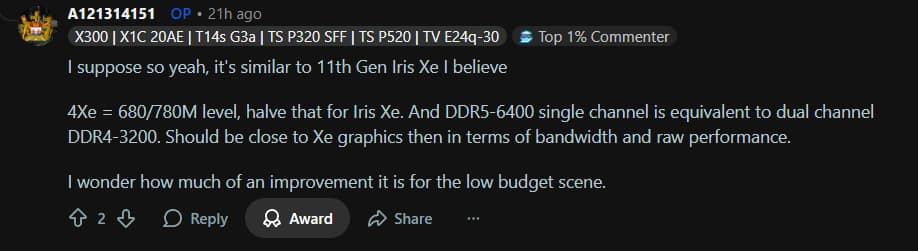
    There’s also skepticism around GPU and memory performance, with comparisons to older Iris Xe suggesting limited real-world gains in budget systems.

    Overall, the reaction follows a pattern: appreciation for the efficiency improvements, paired with an understanding that this is baseline hardware, not something aspirational.

    Why It Matters

    Intel’s split strategy makes choices simpler in one sense but introduces a new kind of trade-off.
    In the past, spending more generally meant better performance across the board. Now, buyers are choosing between two philosophies: long-term efficiency or long-term capability.

    For mainstream users, Core Series 3 enables affordable laptops that still feel modern. Anyone who is even remotely curious about AI workloads will find that Core Ultra makes more sense. This is reminiscent of the development seen in smartphones, where mid-range smartphones become “good enough,” whereas high-end smartphones prioritize longevity over speed.

    Other Takeways

    The most notable shift isn’t raw performance, it’s consistency.
    With PowerVia, these chips can maintain up to 90% of their performance even on battery, reducing the usual drop-off when unplugged. Since both tiers benefit from this, the real distinction shifts entirely to compute capability rather than stability or efficiency.

    The upcoming Nova Lake transition will ultimately show whether Intel’s divide between efficiency and flagship performance reshapes the PC market or simply adds a new layer of complexity for buyers.

    Read More:

    • Baidu’s ERNIE Image Turbo: How ERNIE Image Turbo’s Focus on Speed is Shaping the Generative AI Trend in 2026
    • Sony WH-1000XM6 vs AirPods Max 2: Apple’s Ecosystem Premium Faces a Real-World Value Challenge
    • Samsung’s $1,599 R85H Introduces Micro RGB But Is the Tech Too Advanced for Today?
    Share. Facebook Twitter Pinterest LinkedIn Tumblr Email
    Yuvraj Tiwari
    • X (Twitter)
    • LinkedIn

    Yuvraj Tiwari is a tech journalist for GizTimes.com and a Master’s student at the University of Hyderabad. With a keen eye for software trends and a love for cutting-edge gadgets, he brings a fresh, analytical perspective to the latest news in the tech industry. Previously he worked for Kirti Kranti News Paper as a writer for 4 years.

    Related Posts

    Architecting Autonomous Personal Computing: NVIDIA RTX Spark and Windows in the Agentic AI Era

    June 4, 2026

    Bentley Continental GT S: Performance Dialed Through Software, Positioned Through Feel

    May 6, 2026

    Oppo Find N6 vs Galaxy Z Fold7: Foldable Focusing on Long-Term Capability over Longevity

    April 14, 2026

    Amazon to End Support for Legacy Kindle and Fire Devices on May 20, 20264

    April 10, 2026

    Steam Gaming Now Available on Apple Vision Pro, and It Is Surprisingly Great

    April 9, 2026

    Samsung Reportedly Planning Galaxy S27 Pro as Ultra-Level Flagship Without S Pen

    April 6, 2026
    Leave A Reply Cancel Reply

    Latest Post
    Cars

    Cadillac Escalade IQL: Why Cadillac Chose Space Over More Power in the Luxury EV Race

    June 26, 2026

    HYDERABAD, India (GizTimes) —The 2026 Cadillac Escalade IQL represents Cadillac’s latest step toward electrifying its…

    Cars

    Chevrolet Corvette ZR1X: Why Hybrid Power Has Turned America’s Sports Car Into a Hypercar Challenger

    June 20, 2026

    HYDERABAD, India (GizTimes) —The Chevrolet Corvette ZR1X represents the most ambitious performance leap in Corvette…

    Cars

    Rivian R2’s Real Mission: Turning Adventure EVs Into a Mainstream Market Product

    June 16, 2026

    HYDERABAD, India (GizTimes) —The Rivian R2 is more than a smaller version of the company’s…

    Cars

    BMW Vision Neue Klasse X: Why BMW Thinks Software, Not Horsepower, Will Define Electric Performance

    June 14, 2026

    HYDERABAD, India (GizTimes) —The BMW Vision Neue Klasse X and the closely related BMW M…

    Games

    The Infinite Museion vs Lex Imperialis, Which Rogue Trader Expansion Delivers More?

    June 13, 2026

    HYDERABAD, India (GizTimes) — Owlcat Games has expanded Warhammer 40,000: Rogue Trader once again with The…

    AI

    DiffusionGemma 26B-A4B-IT: How Parallel Text Generation Challenges the Autoregressive AI Era

    June 13, 2026

    ANUPPUR, India (GizTimes) — For years, large language models have relied on a single assumption:…

    Cars

    Toyota bZ (2026): Why Toyota’s EV Strategy Is Shifting From Specifications to Ownership Experience

    June 11, 2026

    HYDERABAD, India (GizTimes) —Toyota has significantly reworked its electric SUV strategy with the 2026 Toyota…

    Cars

    Boreham Ford Escort Mk1 RS: Why Lightweight Engineering May Be the Ultimate Performance Luxury

    June 9, 2026

    HYDERABAD, India (GizTimes) —The Boreham Ford Escort Mk1 RS marks the return of one of…

    Games

    Minecraft Dungeons II Launches September 29, Everything Revealed After the New Gameplay Showcase In YouTube Reveal Trailer

    June 9, 2026

    HYDERABAD, India (GizTimes) — Minecraft Dungeons II was officially revealed during Minecraft Live 2026, with its…

    AI

    AI Agents and Their Impact on the Changing Nature of Work via Intelligent Automation

    June 8, 2026

    ANUPPUR, India (GizTimes) — AI systems are about to enter a new era. In contrast…

    GizTimes

    Giztimes is a technology information site that covers tech-related news and specs, but it also concentrates on conveying the impact that technological breakthroughs have on people’s lives. We provide our readers with comprehensive, data-based, and hand-picked information about the latest trends and innovations in the field of artificial intelligence, cybersecurity, gadgets, automobiles, gaming, consumer tech, and digital technology in general. Our goal is to publish high-caliber analytics that will be of use to professionals and regular readers alike.

    Pages
    • Home
    • About Us
    • Contact Us
    • Disclaimer
    • Editorial Ethics
    • Ethics & Standards
    • Our Team
    • Ownership & Funding Disclosure
    • Publication Description
    • Publisher & Founder Profile
    Policy Pages
    • Corrections Policy
    • Community Guidelines
    • DMCA Copyright Policy
    • Diversity & Inclusion Policy
    • Editorial Policy
    • Fact-Checking Policy
    • Privacy Policy
    • Terms and Conditions
    Facebook X (Twitter) Instagram YouTube LinkedIn WhatsApp Telegram RSS
    © 2026 GizTimes. All Rights Reserved

    Type above and press Enter to search. Press Esc to cancel.