


HYDERABAD, India (GizTimes) —The announcement follows the natural cycle of life and Outmodedness associated with the earlier generations of e-readers and tablets. Starting from May 20, 2026, Amazon plans to cease all support services for its earliest models of Kindle and Fire tablets. According to the company’s statement, these changes will affect devices released in and prior to 2012, depriving them of their main function – namely, purchasing, borrowing, and downloading of new books.
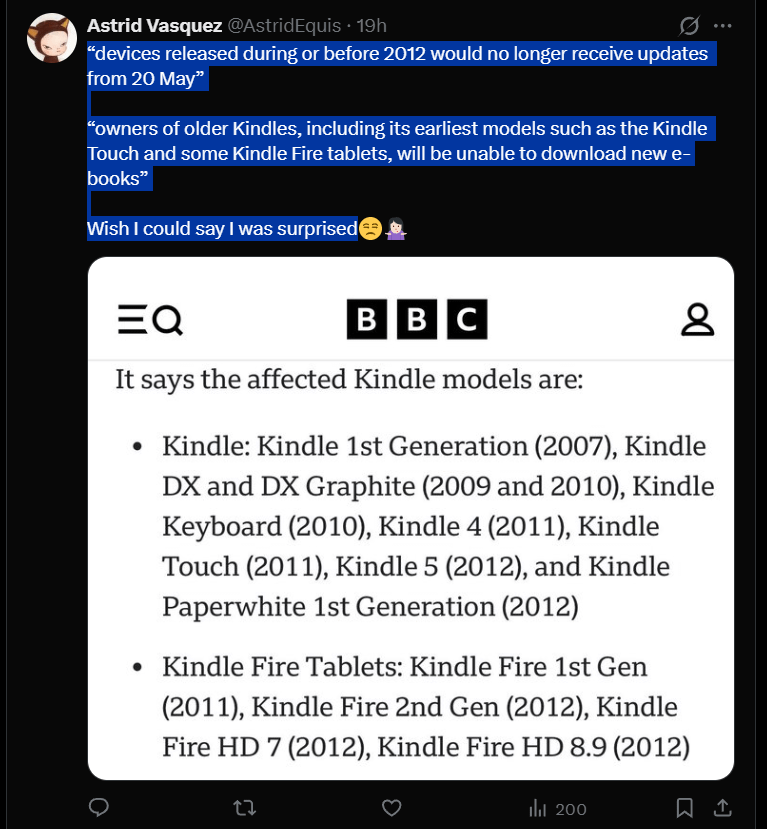
Among those devices losing access to new content will be the first-generation Kindle (2007), as well as the Kindle DX family, the keyboard-equipped Kindle (2010), Kindle 4 (2011), Kindle Touch (2011), Kindle 5 (2012), and the first Paperwhite Kindle (2012). Additionally, owners of Fire tablets introduced back in 2011, 2012, and the earliest Fire HDs will be unable to purchase books in the future. It is important to note that although such hardware will continue functioning and display already uploaded books, users will have no way of accessing new materials via the Kindle Store anymore. As a further complication, Amazon warns against resetting factory settings of devices beyond the specified period since it would lead to permanent inability to reestablish connection to the necessary services.
As for the number of users concerned, the figure may reach around 2 million devices, or 3% of all Kindle and Fire customers. To ease the process, the firm is willing to provide some discounts, encouraging users to upgrade their devices. Amazon says that the mentioned devices had been in operation for approximately 14 to 18 years; however, with new technologies and data requirements, it becomes harder to provide relevant services.
Analysts suggest that cybersecurity may also have an influence on the decision of the firm. Paolo Pescatore says that the decision seems logical to him, considering the age of hardware and its incapability to meet modern encryption requirements or to operate with new software frameworks needed for secure access to digital material. Many of those devices were made when web architecture and demands were significantly different from today, which poses challenges for their further maintenance.
Environmental organizations, on the other hand, claim that the step made by Amazon could contribute to e-waste production, potentially reaching 624 tons. Ugo Vallauri, head of the Restart Project, says that forcing consumers to replace still functional hardware may cause significant problems related to sustainable development.
It may be considered as one of the examples showing the extent to which digital products depend on platforms nowadays. Contrary to physical books, which may remain operable for decades, access to libraries requires maintenance of software services, which may eventually stop functioning. Thus, there is growing concern related to the lifespan of electronic devices compared to the lifespan of their software components. Moreover, this problem may be observed not only regarding Amazon Kindle and Fire line, but also in the context of other companies producing e-readers or tablets, which also provide limited support within a certain period of time.
Public reaction has been mixed, reflecting a split between pragmatic acceptance and frustration.
One commenter wrote, Well, hold on, can you just upload any supported format via USB, worst case? Even Caliber should allow you to load in books, framing the change as a limitation of Amazon’s ecosystem rather than the device itself; this view suggests a technically literate segment of users is willing to bypass platform restrictions and retain device utility through alternative workflows.
 In contrast, another response-“Wish I could say I was surprised”-captures a more resigned skepticism, interpreting the move as predictable and reinforcing perceptions of planned Outmodedness. Together, these reactions illustrate a broader trend in consumer tech where users increasingly question closed ecosystems while simultaneously adapting to them through workarounds or reluctant acceptance.
 The upcoming May 20, 2026, support cutoff will likely determine whether Amazon’s transition strategy balances technological progress with user trust or accelerates concerns over planned Outmodedness.
