

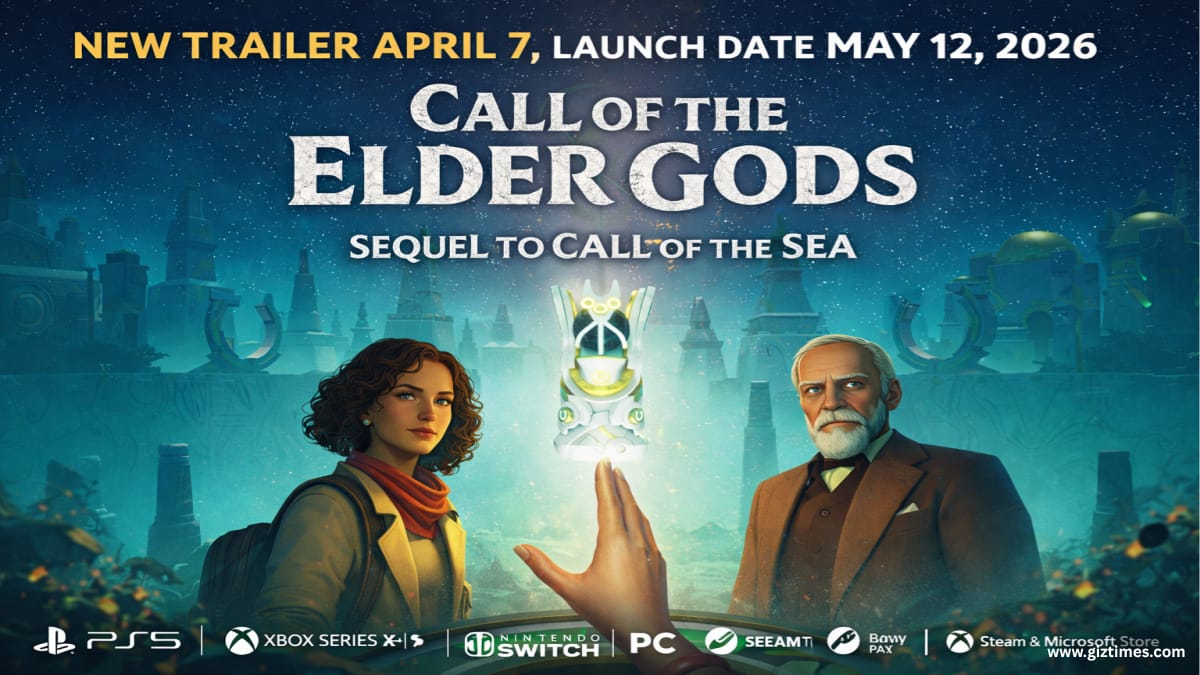
HYDERABAD, India (GizTimes) —Recently, on April 7, 2026, a trailer of Call of the Elder Gods, the sequel to the Call of the Sea, was released, thus confirming the release date of May 12, 2026, as well as a broader scope and multiplatform launch with the availability of the game on Xbox Game Pass upon day one.
Call of the Elder Gods, developed by Out of the Blue Games and published by Kwalee, will be available for PS5, Xbox Series X|S, Nintendo Switch 2, and PC platforms. The title is considered a first-person, Lovecraftian, narrative puzzle adventure and continues a story-oriented tradition of the franchise while not having any combat-related content.
In the sequel set 30 years after the events of the first game, two main characters will feature: Evangeline Drayton and a recurring character, Harry Everhart. The plot will develop based on the visions of each character that emerge from their connection to an ancient artifact. The game takes inspiration from the work of H. P. Lovecraft and focuses on grief, family, and mental instability in terms of cosmic horror.
Compared to the original installment, the sequel is going to include more puzzles and expand gameplay geographically to cover several global areas: the Arctic and desert environments. In addition, the players will need to switch between the two protagonists, solving observation-based puzzles in some cases. The gameplay will also involve optional elements of adjustable difficulties through the use of hints and journals, and additional lore will also be presented to players.
It should be mentioned that the game will emphasize its narrative part, thus featuring full voice acting provided by such actors as Yuri Lowenthal and Cissy Jones. Moreover, the narrator of the original game, Norah Everhart, will be included in the sequel.
It is important since, compared to other narrative games, the next installment is an example of a broader scope with an emphasis on its own characteristics that are not going to change even when expanding the story. Instead of adding combat mechanics or focusing on action to become more attractive to players, Call of the Elder Gods chooses a story-oriented approach while developing it further.
The sequel can be seen as a more cinematic version of the original installment compared to similar narrative puzzle video games such as The Witness or Return of the Obra Dinn.
As for public response, it is currently rather moderate, showing a cautious attitude with regard to the title. For instance, one player wrote, I thought it was better as a story rich walking sim than a puzzle game, expressing their concerns regarding the quality of puzzles and narration in the game.
In this case, we can see that, being a story-rich game, the first installment did not satisfy the players’ expectations regarding puzzle gameplay, and in its sequel, they are probably looking for better gameplay mechanics, despite a more engaging storyline.
 This reaction highlights a key tension in narrative puzzle games: the balance between storytelling and gameplay. The player appreciated Call of the Sea as a story-driven experience but felt its puzzles and narration sometimes disrupted immersion, particularly when explanations felt excessive. This suggests that for Call of the Elder Gods, expectations are not just for more puzzles, but for smarter design—where environmental storytelling replaces explicit guidance. It reflects a broader player demand for subtlety and player agency in narrative games.
 This response signals positive engagement with the franchise. The desire to revisit the original before the sequel indicates that the first game left a lasting impression, especially in terms of story continuity. It also suggests that the sequel’s connection to past events is strong enough to encourage re-engagement, which is a positive indicator of brand loyalty and narrative investment.
 Although brief, this reaction represents straightforward excitement. It reflects confidence in the developer, Out of the Blue Games, and interest in the sequel’s concept. Minimal but positive reactions like this are common in early announcement phases, where trailers and core ideas are enough to build anticipation even without detailed hands-on impressions.
The upcoming May 12 launch will likely determine whether the series’ expanded scope successfully enhances its narrative puzzle identity.
