

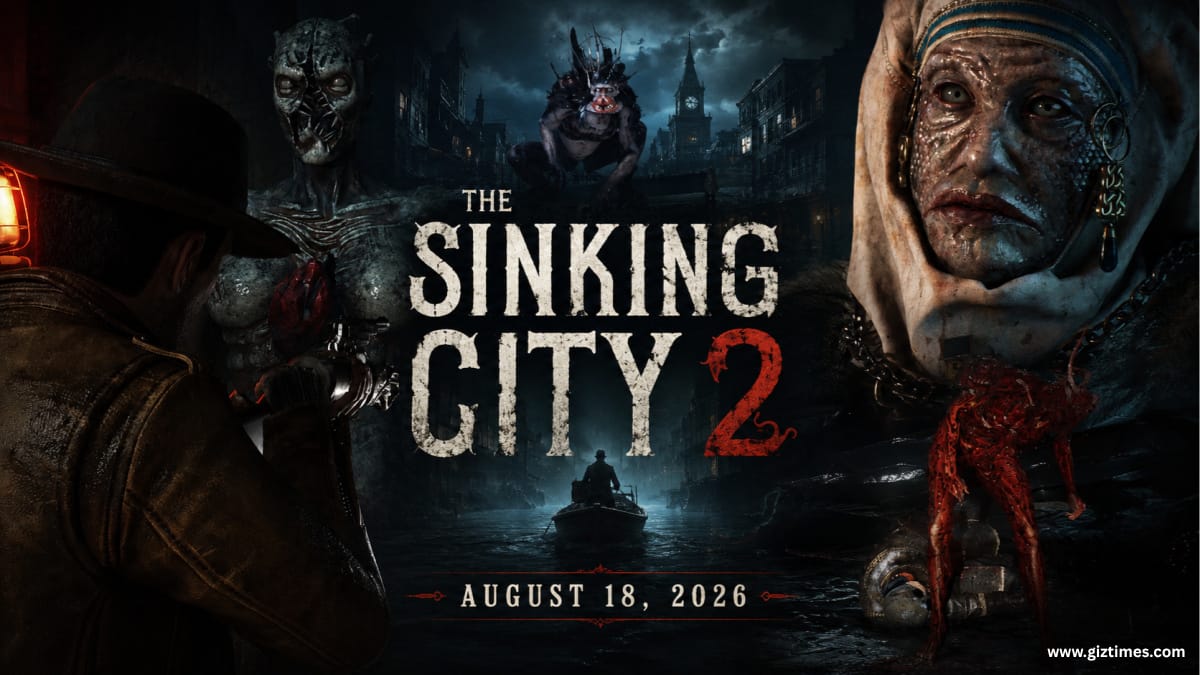
HYDERABAD, India (GizTimes) — The Sinking City 2 launches on August 18, 2026, for PC, PlayStation 5, and Xbox Series X|S, marking a major turning point for Frogwares and its Lovecraft-inspired franchise. Built in Unreal Engine 5 and set in a flooded version of Arkham during the 1920s, the sequel abandons the investigation-first structure that defined the original game and instead embraces full survival horror design. The recently available Steam demo and multiple gameplay reveals have given players their first look at this new direction, creating both excitement and scrutiny around whether Frogwares can successfully reinvent one of its most recognizable properties.
What makes this release particularly significant is that Frogwares is not simply expanding its formula. The studio is repositioning The Sinking City in a different segment of the horror market, one that places far greater importance on combat, resource management, environmental tension, and replayable survival systems.
Why This Matters in Gameplay
The original Sinking City was built around detective work, clue analysis, and player-driven investigations. The sequel retains some of those systems, but they now serve a supporting role rather than the main attraction.
Players will spend more time managing ammunition, exploring dangerous environments, solving environmental puzzles, and deciding when to fight or retreat. Encounters with enemies such as The Slither, Deep Ones, and Shadow Entities are designed around scarcity and pressure rather than straightforward action. This fundamentally changes how players interact with the world.
The flooded city of Arkham reinforces that design philosophy. Exploration extends across ruined districts, abandoned hospitals, flooded streets, hidden shortcuts, and underground eldritch locations. Boat traversal returns, but it now appears more integrated into survival and navigation rather than simply serving as transportation.
One notable design choice is the treatment of investigations. Optional investigations reward players with safer routes, supplies, upgrades, and lore. This means detective mechanics are no longer a separate activity. Instead, they become tools that support survival, creating a stronger connection between narrative discovery and gameplay progression.
Framework Integration
From a performance perspective, Unreal Engine 5 represents the biggest technological leap the franchise has ever seen. The game incorporates Lumen lighting, Nanite geometry, improved water simulation, enhanced environmental detail, and more advanced atmospheric effects. These upgrades are particularly important because horror games rely heavily on visual immersion and environmental tension.
The available demo requirements also provide insight into Frogwares’ ambitions. Running the demo at 1080p and 30 FPS requires an RTX 3060 or RX 7600 XT alongside a modern processor, while the recommended specification targets 2160p using an RTX 4070 or RX 7800 XT. Although these requirements currently apply only to the demo, they suggest that visual fidelity is a major priority for the project.
At the same time, the franchise enters this release carrying historical baggage. Community discussions surrounding The Sinking City Remastered frequently reference technical issues, performance problems, and clunky combat from the original release. The sequel therefore faces a dual challenge: proving that its survival horror systems are compelling while also demonstrating that Frogwares can deliver a smoother technical experience.
A non-obvious implication emerges when comparing both games. The remaster doubles down on what players already loved, investigation, atmosphere, and detective work, while the sequel shifts toward combat-heavy survival horror. Rather than competing with its own legacy, Frogwares appears to be creating two distinct pillars within the same franchise: one centered on detective horror and another centered on survival horror. That strategy potentially broadens the audience instead of forcing longtime fans into a single gameplay style.
Comparison
The contrast between The Sinking City Remastered and The Sinking City 2 reveals how aggressively Frogwares is repositioning the series. While both games share Lovecraftian themes and flooded cities, their design priorities differ substantially.
| Category | The Sinking City Remastered | The Sinking City 2 |
|---|---|---|
| Setting | Oakmont, Massachusetts | Arkham, New England |
| Engine | Unreal Engine 5 Remaster (original UE4) | Unreal Engine 5 |
| Core Focus | Detective Horror | Survival Horror |
| Main Gameplay Loop | Investigations, clue gathering, deductions | Resource management, exploration, combat, puzzles |
| Investigation Importance | Core gameplay system | Optional but rewarding |
| Open World Structure | Fully explorable city districts | Flooded city with exploration and shortcut-based progression |
| Combat Role | Secondary activity | Major gameplay pillar |
| Protagonist | Charles W. Reed | Calvin Rafferty |
| Platform Availability | PC, PS5, Xbox Series X/S | PC, PS5, Xbox Series X/S |
| Release Status | Available | Launches August 18, 2026 |
Public Reaction Analysis
The community response shows a pattern that goes beyond simple excitement. Players are not merely praising the visuals or horror elements. They are actively evaluating whether the sequel can maintain the identity of the original game while expanding its appeal.
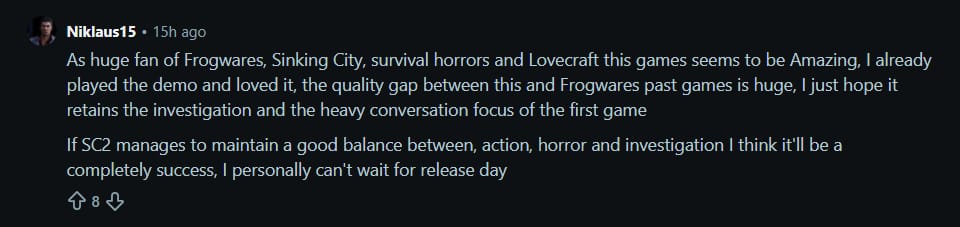
One recurring sentiment is appreciation for the noticeable increase in production quality. Players who experienced the demo repeatedly point to the large quality gap between The Sinking City 2 and previous Frogwares projects. This suggests that visual presentation and technical ambition are already influencing perceptions before launch.

Another theme centers on balance. Fans are enthusiastic about the stronger horror direction, but they continue to mention investigations and dialogue-heavy storytelling. Rather than wanting a complete departure from the original, many appear to want a hybrid experience where action, horror, and investigation coexist.
The positive reaction toward the demo itself is equally revealing. Players describe demos as confidence-building tools that help inform purchasing decisions. In a market where many games launch without public hands-on access, the availability of a demo is creating goodwill and reducing uncertainty.

Questions about support for cloud gaming services and console platforms indicate another trend: players are already thinking about accessibility and platform flexibility, not just gameplay. That level of interest usually reflects confidence that a game is worth following before release.
Why It Matters
The Sinking City 2 arrives at a time when survival horror is experiencing renewed popularity. Rather than directly competing through scale or budget, Frogwares is attempting to differentiate itself through Lovecraftian cosmic horror, detective-inspired systems, and a uniquely flooded urban setting.
Success would strengthen the studio’s position in a market increasingly dominated by established horror franchises. It would also validate Frogwares’ decision to evolve beyond the investigative focus that originally defined the series.
The project carries additional weight because it was developed under challenging wartime conditions while the studio simultaneously adapted to a new technological foundation and genre direction. If the game delivers on its ambitions, it could significantly elevate the visibility of both Frogwares and The Sinking City franchise.
Extra Takeaways
The Steam demo may be one of the game’s most important marketing assets. Community feedback suggests it is functioning as more than a preview; it is actively converting curiosity into purchase confidence.
The choice of Arkham as the setting also serves a strategic purpose. Compared with Oakmont, Arkham carries stronger recognition among fans of Lovecraft-inspired fiction, potentially giving the sequel broader appeal even among players unfamiliar with the first game.
Support for 15 languages further indicates that Frogwares is positioning the title for a wider global audience than previous entries in the franchise.
If successful, The Sinking City 2 could transform Frogwares from a niche detective-horror developer into a major survival horror contender, but balancing its new horror identity with the investigative strengths that built the franchise remains the biggest risk.
