

ANUPPUR, India (GizTimes) — The first batch of AI video tools aimed to make videos from prompts, focusing on how good the output looked, how real it seemed, and how fast it was made. But Google Flow is something else. It doesn’t just look at video generation; it tries to put everything in one place; ideation, asset creation, scene development, editing, orchestration, and project management.
Making films isn’t just about creating images or videos. It’s way more than that. You’ve got to coordinate all sorts of stuff like characters, locations, story flow, camera moves, audio, editing, fixes, and production tasks. Usually, each part happens separately.
That’s why Flow might be huge. It’s trying to tie all those stages together using computation. If it works, we won’t just see better AI-made clips. We’ll have whole new ways of organizing creative projects.
Why This Architectural Shift Is Happening
The growth of AI video generation has shown a key issue. While the models got better at making awesome individual clips, the process for creating professional videos stayed really scattered. There were still too many different apps, libraries, and systems involved. It got easier to create stuff, but organizing everything became super complicated.
Google’s answer takes a big architectural shift, not just small improvements. They didn’t make a new fancy text-to-video model. What they did was connect various special systems together. So, Veo 3.1 does the cinematic video synthesis and generates audio. Gemini Omni can handle tons of data types at once – texts, images, audio, and videos. Other tools help with generating, editing, and developing visuals. All these work together not as separate models but as parts of a unified production platform.
What’s crucial about this setup is that now it tackles problems happening between creative steps, not just within them. When filmmakers work on projects, they constantly switch between tasks – like going from concept art to storyboards, then to video generation, and finally to editing. Every time you switch, there’s friction. Google aims to minimize these switches by bringing all the stages into a single space.
This also means they see film-making more as handling information smoothly rather than just focusing on high-quality renderings. They’ve made systems that keep context flowing through the creation phases, showing they think future competition will be about how seamlessly you can manage your workflow, not just how amazing your models are.
The Technical Architecture Behind AI-Native Filmmaking
Flow’s architecture focuses on bringing together generation, control, memory, and orchestration technologies.
Veo 3.1 acts as the rendering engine, pumping out video with cool features like cinematic camera moves, real-world physics, and sync’d audio. It even does dialogue and supports resolutions up to 4K. This upgrade helps fix earlier issues where visuals might look amazing but act silly in a realistic setting. Veo makes things feel more like proper movie-making.
Gemini Omni brings its own neat trick: it can reason through mixed inputs. So, you’re not stuck with just text; now you can use images, audio, and video too. It all combines into one big, unified direction. Plus, there’s Omni Flash which lets you edit in conversation form – change stuff back and forth while keeping everything lined up correctly.
Then we’ve got Ingredients. This part tackles the issue of how to keep generated videos consistent. Imagine trying to make characters and settings look the same across multiple scenes; it’s tough. But Ingredients handles the hard work by keeping track of those assets. Add voice consistency tools into the mix, and suddenly longer narratives become possible, not just stand-alone snippets.
But here’s the real game changer – the Flow Agent. Traditionally, if an AI makes something, you have to micromanage each step. The Flow Agent gets smarter; it remembers project details, suggests storylines, pitches ideas, plans shots, sorts assets, and streamlines edits. So instead of giving direct orders all day, creators can focus on bigger picture stuff – brainstorming and overall planning.
It’s less about just making media now, and way more about putting together whole film productions, end-to-end.
Comparison between Google Flow and Runway
The most meaningful comparison isn’t about output quality but rather workflow architectures. Both Google Flow and Runway are growing beyond simple generation to become integrated creative spaces, though they take different routes in the market.
Flow builds up from Google’s AI ecosystem, combining multimodal reasoning, asset management, and agentic workflows for cinematic generation within a single production framework. On the other hand, Runway grows from a media platform aimed at creators into a wider AI media ecosystem that centers on world modeling, production tools, and workflow control.
| Dimension | Google Flow | Runway |
|---|---|---|
| Core Vision | AI-native filmmaking operating system | AI media studio plus world-model platform |
| Video Engine | Veo 3.1 | Gen-4.5 |
| Multimodal Layer | Gemini Omni / Omni Flash | Gen-4.5 ecosystem with integrated workflow tools |
| Character Consistency | Ingredients system for characters, props, and locations | Reference-image-based consistency across scenes |
| Workflow Tools | Storyboard Studio, Scene Builder, Asset Grid, Flow Agent | Edit Studio, Multi-Shot Video, Scene Builder, Performance Capture |
| Editing Paradigm | Conversational editing through Omni Flash | Application-driven editing environment |
| Agentic Features | Dedicated Flow Agent with project memory and planning | Focus on workflow tools and media creation systems |
| Platform Positioning | Unified AI filmmaking environment | AI media creation and world-model platform |
| Commercial Model | Subscription tiers integrated with Google AI ecosystem | Credit-based subscriptions plus API access |
The comparison reveals a broader market trend. Competition is no longer centered on which model produces the most realistic clip. Instead, companies are competing to become the primary operating environment where creators spend their entire production cycle.
Public Reaction on Google Flow
Public reaction to AI filmmaking shows two clashing viewpoints.
First off, many think this tech is democratizing filmmaking. Catchphrases like “Everyone’s a filmmaker now” really hit this point. When people see apps using Gemini Omni Flash turning images into video, they feel that professional movie-making skills are within their reach. This is all about opening up new creative possibilities for everyday folks.
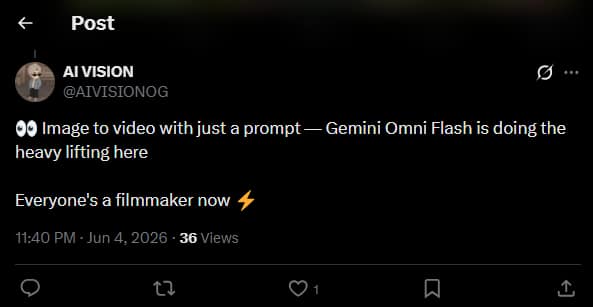
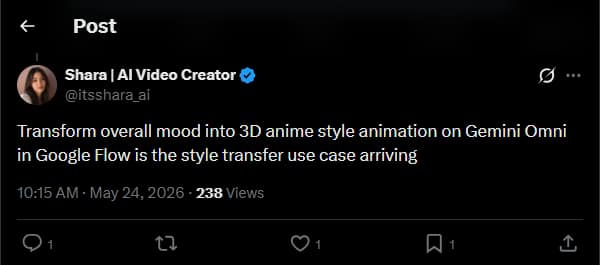
Then there’s how AI lets users flex their creative muscles differently. More folks are using these tools to switch up anime styles or try out new workflow methods. People aren’t just seeing AI as something that generates content; it’s also becoming a way to transform what you’ve got into something totally new.
But here’s the rub: a lot of criticism pops up too. Some gripe about rules on showing minors and glitches that bug users. For instance, Flow can whip up a made-up kid, yet it draws the line at animating or sharing images with them. So telling tales aimed at the whole family becomes tough. Add to that some plain ol’ technical hitches, which just frustrate creators.
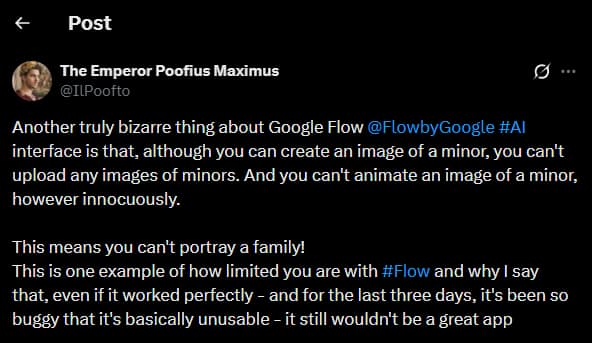
These gripes link to known issues with Flow’s management processes. Users wanna know if the platform will truly fit into steady creative routines, no hiccups. It’s evolving from a “Does it work?” stage to “Will it suit my needs?“
This adjustment in hopes reveals the industry growing up, becoming more practical.
Why Google Flow is needed
Google Flow matters because it redefines what an AI creative product can do.
Before, older AI media tools just automated single tasks. But Flow tries to automate the links between those tasks. This difference might seem small, yet it totally changes how production systems get made.
When AI-native production environments work, some cool economic shifts happen. Smaller groups could pull off jobs that usually need bigger teams. Plus, pre-production could speed up thanks to AI for storyboarding and scene planning. Assets become easier to manage too. So creators spend less time making software line up and more on reviewing results and guiding systems.
The skills needed start changing too. Knowing the traditional tech stuff is still great, but now there’s a need for guiding workflow design, system managing, and picking good assets. It’s like the creator becomes a director of computer processes rather than working every tool themselves.
Also, for Google, Flow fits together their pieces better – Veo, Gemini, Imagen, Nano Banana, cloud tech, search functions, mobile apps, and AI-driven systems all boost each other within one big package instead of being separate things.
Extra Insights
One of the coolest findings about Flow is that its main issue might be predictability rather than how well it creates stuff. The platform consistently shows it can be really creative, yet it struggles with mod problems, UI issues, and credit and memory woes.
Another biggie is how Flow shifts labor instead of cutting it entirely. Creating lots of variations becomes super quick, yet picking from them takes more time. It looks like future creative jobs could focus more on curating stuff than actually making it.
This shift could be huge. Instead of eliminating creative choices, AI moves them to other parts of the process.
At its core, while Google Flow proves it can combine generation, editing, and production in one filmmaking space, making it dependable and easy to rely on for pros is the true test ahead.
Read More:
- Architecting Autonomous Personal Computing: NVIDIA RTX Spark and Windows in the Agentic AI Era
- Lotus Emira 420 Sport: Why Lotus Chose Optimization Over Reinvention in Its Fight Against the Porsche GT4 RS
- GIGABYTE AORUS ELITE vs Alienware AW3225QF: The Future-Proof Gaming Monitor vs the Perfect Curved OLED Experience
