

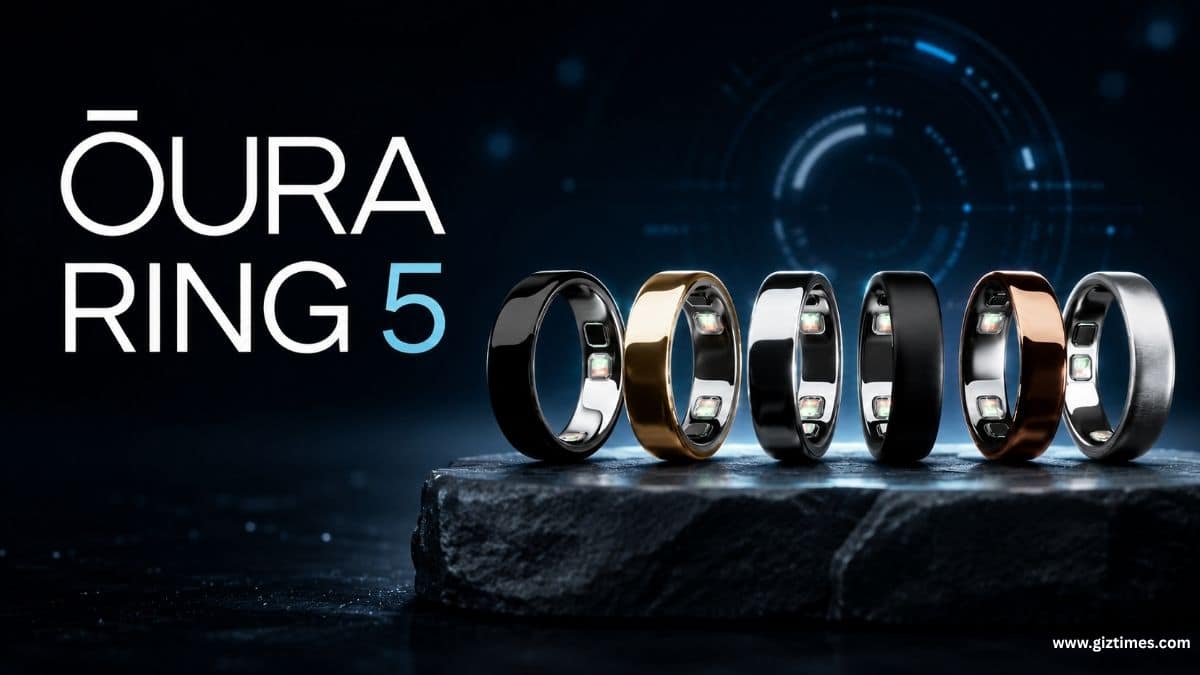
ANUPPUR, India (GizTimes) — For many years, the wearable technology industry was engaged in a fierce battle over sensors, batteries, and biometrics. With the Oura Ring 5, it looks like this competition has moved elsewhere, towards the realm of health AI interpretation. Not just because the new ring’s main claim is that it is 40% smaller. The real change here is that with this product, Oura is trying to rebrand its device into a continuous health AI platform rather than a passive wellness tracker.
This choice is particularly interesting given how fast the wearable technology sector is evolving. It becomes progressively harder for manufacturers to find a unique way to stand out via hardware innovation. As a result, our industry leaders are moving the competitive battleground upward into the realm of predictive software and clinically focused health intelligence. While the actual ring becomes less conspicuous, AI intelligence starts getting commodified as the new product category.
It is why this specific product release is of strategic importance. Oura is no longer interested in convincing customers to buy another fancy wearable device for their health. What the company tries to achieve now is to build an ecosystem of users who trust the AI system and let it continually monitor their physiology, predict behaviors, and participate in their healthcare workflow.
Why AI is integrated in Wearable
This is clearly what’s happening to the entire wearable computing field. Raw biometric data collection became almost standard for all smart devices available on the market. The challenge is making sense of this information and transforming it into personalized, coherent, and actionable recommendations for each user individually.
As a result, we can see how much hardware and AI development have become intertwined. Oura managed to reduce the number of optical sensing pathways from 18 to 12. Meanwhile, it increased the power of LEDs by four times. The outcome was not just a thinner device but also cleaner physiological signals, such as improved active heart-rate measurement (+24%) and HRV precision during sleep (+12%).
The whole point of these design changes was to ensure that AI algorithms work properly with biometric data collected.
Oura is building its product around a complex ecosystem that requires uninterrupted access to clean biometric data in order to build accurate predictions for each user. Hence, the necessity of making the device smaller and easier to wear constantly. More wear leads to better data which, in turn, allows for improving the accuracy of predictions and building more effective health profiles.
And, of course, the new AI system has to make sense of these biometric data. That is where Oura Advisor comes in place. It leverages state-of-the-art retrieval-Augmented Generation models and processes user’s biometric data, activity data, symptoms, and behavioral patterns to provide relevant insights based on real-time monitoring of physiological contexts.
Oura is trying to tackle one of the major problems of digital health – overwhelming users with data without proper AI-based interpretations.
In addition, this strategy has a lot of implications for the clinical use of the Oura Ring in the future. Features such as Health Radar, Predictive Stress Analysis, Nighttime Blood Pressure Monitoring, or integration with Counsel Health are clearly leading us in the direction of medical-grade devices and services.
But there is one hidden implication that becomes clear once you look closer at the Oura ecosystem – its focus on ambient medicine.
Comparison between Oura Ring 5 and Ultrahuman
The strategic contrast between Oura and Ultrahuman reveals where the smart ring market is heading. Neither company is positioning its product primarily as a tracker anymore. Both are building AI-centered health ecosystems. The difference is in how they approach monetization, infrastructure, and user ownership.
Oura is pursuing vertically integrated predictive wellness AI with subscription-based recurring revenue and medically governed intelligence systems. Ultrahuman is pursuing modular health intelligence with subscription-free economics, edge AI processing, and ecosystem extensibility.
| Category | Oura Ring 5 | Ultrahuman |
|---|---|---|
| Core Strategy | Predictive health platform | Continuous health intelligence system |
| AI Direction | Generative AI, RAG systems, telehealth integration | Behavioral prediction, metabolic intelligence, Jade AI |
| Hardware Positioning | 40% smaller wearable optimized for continuous sensing | Lightweight titanium smart ring ecosystem |
| Processing Model | Combination of edge processing and cloud AI | Investment in on-device machine learning |
| Health Focus | Sleep, stress, cardiovascular, women’s health, predictive monitoring | Metabolic optimization, recovery, preventive health |
| Ecosystem Approach | Unified subscription ecosystem | Modular “PowerPlugs” AI-health modules |
| Revenue Model | $5.99 monthly subscription model | No mandatory subscription |
| Long-Term Vision | AI-guided health companion | Wearable computing platform |
| Competitive Differentiator | Clinical AI governance and predictive guidance | Subscription-free AI health stack |
The most important competitive difference may not be technological. It may be psychological.
Oura is betting consumers will eventually pay recurring subscriptions if the AI becomes sufficiently useful, medically credible, and personalized. Ultrahuman is betting subscription fatigue will eventually push users toward ownership-based models instead. That creates a broader market question: can wearable AI become indispensable enough to justify ongoing access fees?
Public Reaction on the Oura Ring 5
There seems to be a disconnect between public reaction to the Oura Ring 5: there is excitement about its physical direction while skepticism prevails regarding its commercial strategy.
Miniaturization appears to be the key feature of the Oura Ring 5 that excites users. The repeated mentions of the 40% size reduction as a crucial step forward point to one particular aspect. As a reminder, Oura positions itself as moving from wearable gadgets to invisible everyday items, which requires abandoning the visual language of wearables and embracing regular jewelry looks instead.
That said, there seems to be a much more significant trend here: the increasing popularity of nighttime blood pressure measurements. One of the explanations behind this can be quite simple: as the Oura Ring 5 is expected to move toward more medical applications for the data collected and processed by it, users are increasingly considering it as part of such infrastructure instead of a regular wearable wellness product.
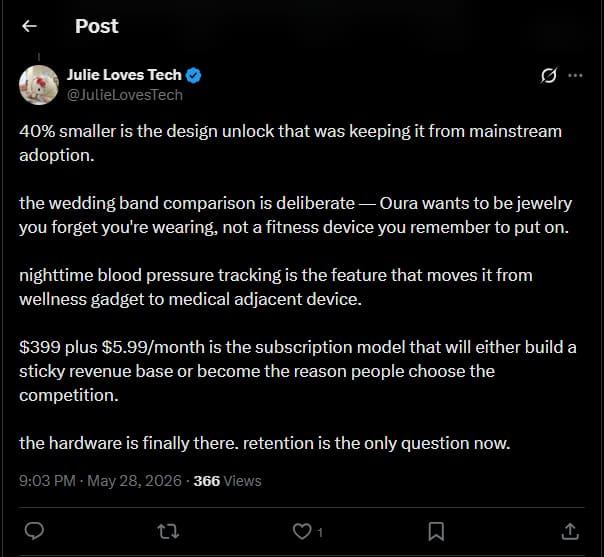
And speaking of which, the negative reaction toward the subscription fee cannot be ignored either.
What is interesting, the main concern expressed by users was not the price per se, but rather the feeling of loss of control over personal biometric data. While this concern is certainly understandable given the current state of affairs in the industry, it is especially relevant for the type of technology used by Oura: as the algorithms grow more personalized, the switching costs for the customer grow higher as well.

Furthermore, it should also be mentioned that Oura seems to face one additional issue with regard to the Indian market. With the new pricing structure, the device is placed in the upper tier and, therefore, cannot reach wider markets. This might be a major obstacle to its further growth.

Why Oura Ring 5 is an important Innovation
The Oura Ring 5 matters for the reason that it demonstrates the growing capabilities of the wearable AI industry.
Namely, the product represents the stage of evolution when wearable AI technology moves away from simple data analytics to building predictive infrastructure based on behavioral data.
The current AI system developed by Oura involves many different types of analysis including, among others, sleep, stress, metabolism monitoring, female health status predictions, anomaly detection, escalation to telemedicine, and conversational health guidance. In other words, Oura is effectively building an adaptive model of individual physiology.
This changes the competitive logic of wearables entirely since the success of predictive systems depends, first of all, on the amount of data accumulated and personalization of the algorithm itself. The more time spent by the customer inside the ecosystem, the more accurate the model is going to be. And this makes replicating competitor’s systems much harder than it used to be.
Speaking of which, the Oura women’s health LLM matters for another important reason: it showcases the industry trend shifting from developing generic AI models towards training specialized AI for the specific types of health issues and datasets. What Oura does is avoiding the problems associated with hallucinations in generic LLMs by using the dataset derived from clinical data and retrieval techniques.
In turn, this explains why the “private AI” positioning is so important for Oura: as devices become more intimate, trust infrastructure becomes necessary as well. And this means that the following aspects might become the core of competitive advantage in wearable health AI technology in the near future:
Medical reliability of the models; Trustworthiness of the datasets.
Extra Insights
First of all, it is worth noting the trend of edge processing and the shift towards special AI models based on LightGBM and other machine learning architectures used instead of huge generative networks. It can mean that wearable AI can develop in quite a different way from standard generative models due to the limitations in computing resources and battery life.
Next, it is interesting to see the increasing trend of merging consumer health platform and formal healthcare infrastructure as shown by the Counsel Health integration. In other words, wearables are increasingly turning into health triage systems.
Finally, another example worth mentioning is UltraHuman: in terms of competitive positioning, it is a completely different kind of platform for wearable AI, which emphasizes modularity and decentralization. This trend can indicate future market segmentation into premium ecosystems and decentralized systems focused more on data ownership.
Read More:
