


ANUPPUR, India (GizTimes) — OpenAI’s acquisition of Weights.gg appears small on paper: a six-person startup with roughly $4 million in funding and a consumer platform that shut down before the deal became public. Yet the transaction signals something larger. OpenAI did not buy a voice-cloning website. It acquired expertise in low-latency speech generation, community-scale voice modeling, and systems optimized around real-world audio experimentation.
The crucial question is not whether OpenAI will make their ChatGPT speak better. The crucial question is whether personalized AI voices will become a new layer inside OpenAI’s infrastructure, completely transforming the way users interact with assistants, APIs, education tools, enterprise support systems, and other services.
Why This Acquisition Is an Important Step
Weights.gg was a consumer voice cloning company building on lightweight generative models, fast inference pipelines, and Retrieval-Based Voice Conversion systems. Their ecosystem allowed to clone voices from short samples and achieved an estimated monthly active user base of 287,740 before shutting down.
This acquisition is telling about OpenAI’s integration strategy. Instead of keeping Weights.gg as a separate product, the company spread the acquired engineers across multimodal, infrastructure, and audio teams. The implication is clear – it wasn’t about the product but about the underlying technology.
Reducing speech latency, improving emotional realism, and refining synthetic voice quality are some obvious short-term goals. They all matter since conversational AI gains value from interaction persistence rather than interaction transactionality. Personalized voice helps build such persistence.
What makes it even more interesting – voice may become identity infrastructure. In the long run, users may start recognizing AI not by model but by voice characteristics, including personality and speaking style. Competitiveness moves from “Who has the best model?” to “Who offers the most stable and long-lasting AI relationship.“
It is a capability shift.
Mental Friction Score While Using Voice Engines
Mental Friction Score measures the amount of effort users have to put to reach desired results.
Voice engines from traditional AI companies create friction because users need to frequently adjust parameters like tone, pacing, emotion, or context. Even advanced assistants may sound generic or inconsistent between sessions.
Weights.gg’s ecosystem was optimized around customization workflows – choosing models, adjusting pitch, preserving accents, modifying formants, and maintaining vocal identity during conversion. Architecture of that system was built around user freedom to express himself.
If OpenAI will manage to incorporate these capabilities, mental friction score is going to decrease in three ways:
First, fewer changes will be needed as AI will remember the preferred speaking style.
Second, interaction persistence increases, as the same voice can be used in all ChatGPT sessions, API calls, enterprise tools, and other services.
Third, trust formation gets faster, as humans build familiarity with voices faster than with text-based interfaces.
One of the hidden implications here is that personalized voices may decrease prompt effort. Users explain less when the assistant’s voice behaves in the expected way. Prompt reduction becomes a competitive advantage.
In this case, voice becomes more than just output formatting.
Public Reaction on the Acquisition Change
Public opinion about the deal reveals distrust towards OpenAI’s previous safety concerns with respect to voice engines:
“Preach caution on Voice Engine, then acquire a cloning platform. Competitive pressure is real.“

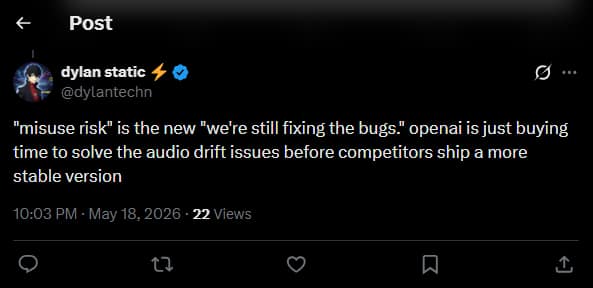
“‘misuse risk‘ is the new ‘we’re still fixing the bugs.‘ openai is just buying time to solve the audio drift issues before competitors ship a more stable version‘
“the caution was never about safety it was about not shipping garbage. now they bought someone who actually made it work“

The common theme here is quite telling. People started interpreting safety messaging from OpenAI as engineering delay rather than safety concerns.
That creates a new challenge for OpenAI. If users start perceiving safety messaging as marketing tactic, future safety decisions will face increasing criticism.
At the same time, it indirectly confirms one thing – people believed Weights.gg solved practical problems with usability and realism of voice synthesis before major AI labs did.
The perception itself becomes competitive pressure.
What will this Acquisition
This acquisition seems to align with OpenAI’s audio ambitions including realtime translation, conversational agents, and developer APIs. Improvements to latency and natural speech synthesis will be directly helpful in achieving those.
But the long-term consequences may be even more profound.
Text interfaces created standardization in information exchange. Personalized voice interfaces may help standardize AI relationships.
Enterprise support systems will maintain their branded identities. Educational platforms will develop persistent tutor personas. Realtime assistants will adjust their speech characteristics according to context rather than content.
Competitive battle may soon move to the emotional layer of AI.
Extra Takeaways
Weights.gg faced challenges with GPU expenses, monetization pressures, legal threats, and unauthorized celebrity cloning before shutting down.
Acquisition by OpenAI allows inheriting the technology without associated liabilities. The company acquires capability without risks associated with consumer repository.
This may become a new pattern in AI development – big players acquiring consumer technologies pioneered by startups after proving demand but before getting into legal trouble.
Personalized AI voices may become a breakthrough in reducing friction and deepening human-AI interaction. But the key challenge will be balancing voice consistency with safety, consent, and misuse risks.
