

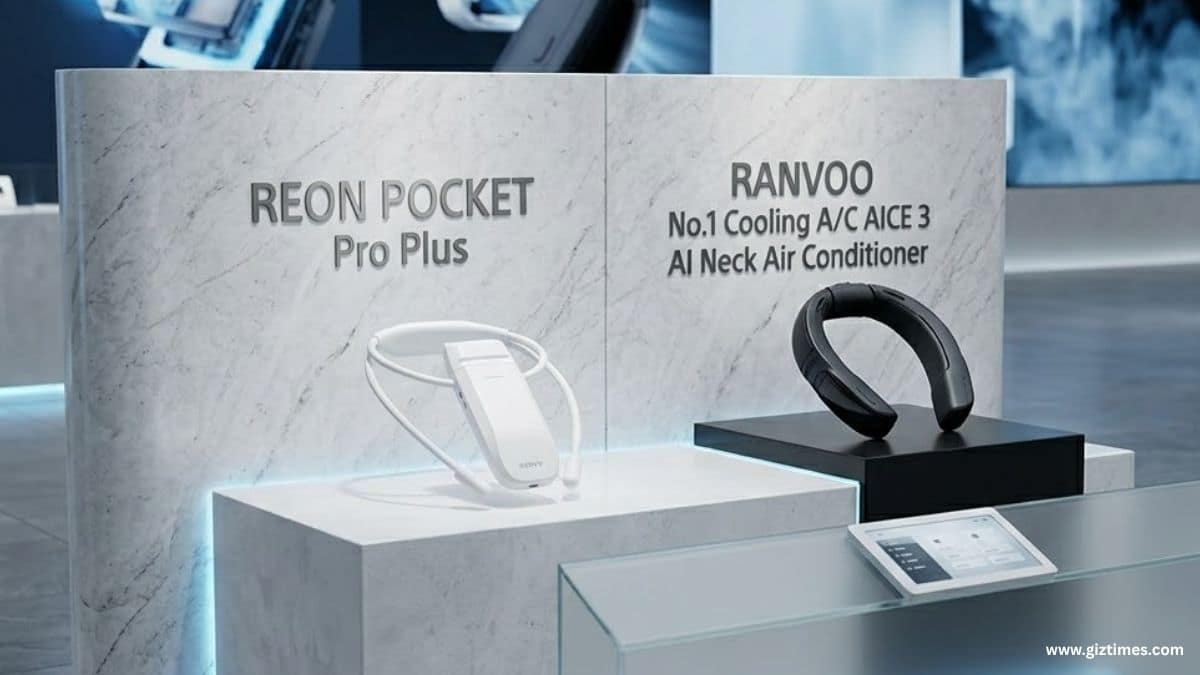
HYDERABAD, India (GizTimes) —Wearable cooling devices used to be novelty gadgets built around weak fans and exaggerated promises. The latest generation is trying to become something far more specific. The Sony REON POCKET PRO Plus focuses on disappearing into professional life without drawing attention, while the RANVOO AICE 3 embraces visibility by turning itself into a full wearable climate system with health tracking, speakers, airflow tunnels, and AI-controlled thermoregulation.
The interesting part is that these products are no longer competing for the same users. Sony is optimizing for subtle thermal correction inside offices, trains, and business clothing. RANVOO is optimizing for aggressive environmental control during outdoor exposure, sports, and prolonged heat stress. One tries to feel invisible. The other wants to feel powerful.
Why This Product Exists
Sony’s REON POCKET PRO Plus exists because conventional portable cooling still creates social friction. Neck fans are noisy, visually obvious, and often ineffective in quiet professional environments. Sony’s entire engineering direction revolves around solving that discomfort. The device hides under clothing, reduces operational noise by up to 80% compared to earlier generations, and uses a stainless steel cooling plate pressed directly against the neck rather than blasting air across the face.
That changes the experience completely. The cooling becomes private instead of performative. You are not announcing that you are overheating. You are stabilizing your body temperature quietly while remaining visually normal in a meeting, on public transport, or during commuting.
The RANVOO AICE 3 approaches the same problem from the opposite direction. Instead of minimizing presence, it maximizes intervention. The device combines four semiconductor cooling engines, eight air ducts, four fans, biometric sensors, speakers, a touchscreen, and AI-driven thermal management into a 520g wearable system.
This product exists because airflow-only neck fans break down in genuinely harsh climates. High humidity and extreme outdoor temperatures reduce the effectiveness of passive airflow. RANVOO compensates by combining direct thermoelectric cooling with full-body airflow circulation. The result is less like a wearable accessory and more like a personal environmental control unit.
The biggest difference is psychological. Sony assumes users want thermal relief without changing how they look or behave socially. RANVOO assumes users are willing to wear visible hardware if it materially improves comfort.
Processor Longevity and Adaptive Intelligence
Sony’s long-term advantage comes from restraint. The REON POCKET PRO Plus does not try to become a smartwatch replacement or a wearable operating system. Its intelligence is tightly focused on thermal sensing, movement estimation, and environmental prediction through the TAG 2 sensor system.
That narrow focus may actually improve longevity. Thermal management algorithms age more slowly than broader wearable ecosystems because they rely less on rapid feature expansion. Sony’s approach depends on stable sensor fusion rather than continuously evolving app ecosystems. Even several years later, the core experience of silent adaptive cooling under clothing will remain functionally relevant because the hardware is purpose-built around a single task.
RANVOO’s MetauraOS is more ambitious but also more vulnerable to aging. The AICE 3 integrates heart rate monitoring, blood oxygen tracking, touchscreen interaction, firmware-based AI tuning, music playback, AQI analysis, and exercise tracking.
That creates a stronger “smart wearable” experience today, but it also means long-term value depends heavily on continued software support and app compatibility. Once a wearable starts acting like a miniature operating system, user expectations shift. Firmware updates, Bluetooth stability, health synchronization, and app maintenance become part of the ownership experience. Without sustained support, some of the product’s identity weakens over time.
There is a non-obvious implication here. Sony’s product behaves more like infrastructure, while RANVOO behaves more like consumer electronics. Infrastructure products usually age more slowly because their purpose remains stable. Consumer-electronics hybrids often feel outdated as software ecosystems advance.
Comparison
These products solve overheating through completely different philosophies. Sony reduces thermal discomfort by targeting the body directly with minimal disruption. RANVOO attacks the surrounding environment through airflow saturation, active cooling, and biometric adaptation.
The result is not simply “lightweight vs powerful.” It is precision cooling versus environmental dominance.
| Category | Sony REON POCKET PRO Plus | RANVOO AICE 3 |
|---|---|---|
| Core Philosophy | Hidden personal thermoregulation | Immersive wearable climate system |
| Cooling Method | Dual Peltier contact modules | 4-core semiconductor + airflow system |
| Cooling Style | Skin-contact thermal transfer | Combined airflow + thermal pads |
| Noise Profile | Extremely quiet | 32dB–52dB, depending on mode |
| Weight | Approx. 194g main unit | Approx. 520g |
| Battery Runtime | Up to 15 hours SMART COOL | 2.5–7 hours cooling |
| Smart Features | Thermal sensing + TAG 2 | Full biometric ecosystem |
| Display | Smartphone app focused | 1.9-inch OLED touchscreen |
| Audio Features | None | Built-in speakers and microphone |
| Wearability Goal | Hidden under business clothing | Visible outdoor wearable |
| Repairability Direction | Semi-modular accessories | Highly integrated structure |
| Market Position | Professionals and commuters | Outdoor users and heat-intensive activity |
Public Reaction Analysis
Public reactions reveal an important insight into how users define “effective cooling.”
Sony users repeatedly praise invisibility rather than raw thermal power. Comments describing the device as not very noticeable, extremely quiet, and suitable for public transportation suggest buyers value social comfort almost as much as physical comfort. The cooling becomes psychologically easier to use because it does not alter public appearance dramatically.
At the same time, criticism exposes the limitations of contact-based cooling. Several users acknowledge that the device cools only the contact area and does not replicate true environmental air conditioning. That distinction matters because Sony is not trying to create immersion. It is trying to create thermal stabilization.
There is also a contradiction hidden in complaints about price. Users criticize the nearly ¥30,000 cost while simultaneously describing the experience as uniquely useful for commuting and long-distance travel. That usually indicates a product category moving from “gadget” to “specialized utility.” People resist the price because they still mentally categorize wearable cooling as an accessory, even though they increasingly depend on it functionally.
The backpack criticism is also revealing. Once a wearable climate device becomes part of daily movement patterns, ergonomic interference matters more than raw cooling numbers. These products are no longer desk gadgets. They are mobility products.
Why It Matters
The REON POCKET PRO Plus makes wearable cooling more socially acceptable. That is probably its most important contribution.
Instead of competing against portable fans, Sony is quietly competing against the need to visibly manage heat at all. In workplaces where appearance, silence, and discretion matter, that positioning is extremely strong.
The RANVOO AICE 3 expands the category in a completely different direction. It treats wearable cooling as a platform. Health tracking, audio integration, AI environmental adjustment, and touchscreen controls push the device toward becoming a wearable environmental computer rather than a single-purpose cooler.
That creates a broader question for the market. Do users want specialized thermal tools, or do they want all-in-one wearable climate ecosystems?
The answer likely depends on the environment. Urban professionals prioritize invisibility. Outdoor users prioritize intensity.
Other Takeaways
Sony’s decision to prioritize silent thermoelectric contact cooling instead of airflow indirectly solves another problem: battery efficiency. Because the system is not continuously trying to move large volumes of air, it achieves runtimes that are dramatically longer than those of the much larger RANVOO device.
The RANVOO AICE 3 reveals the opposite trade-off. Its immersive cooling experience depends on substantial power draw, heavier hardware, and increased acoustic presence. The device behaves more like wearable HVAC infrastructure than lightweight consumer tech.
There is also an emerging class divide visible here. Sony’s design language aligns with professional invisibility and business mobility, while RANVOO leans toward recreational tech culture, where visible gadgets are socially acceptable or even desirable.
The next generation of wearable thermal ecosystems will likely determine whether invisible personal cooling or immersive climate wearables become the dominant approach to portable thermoregulation.
