

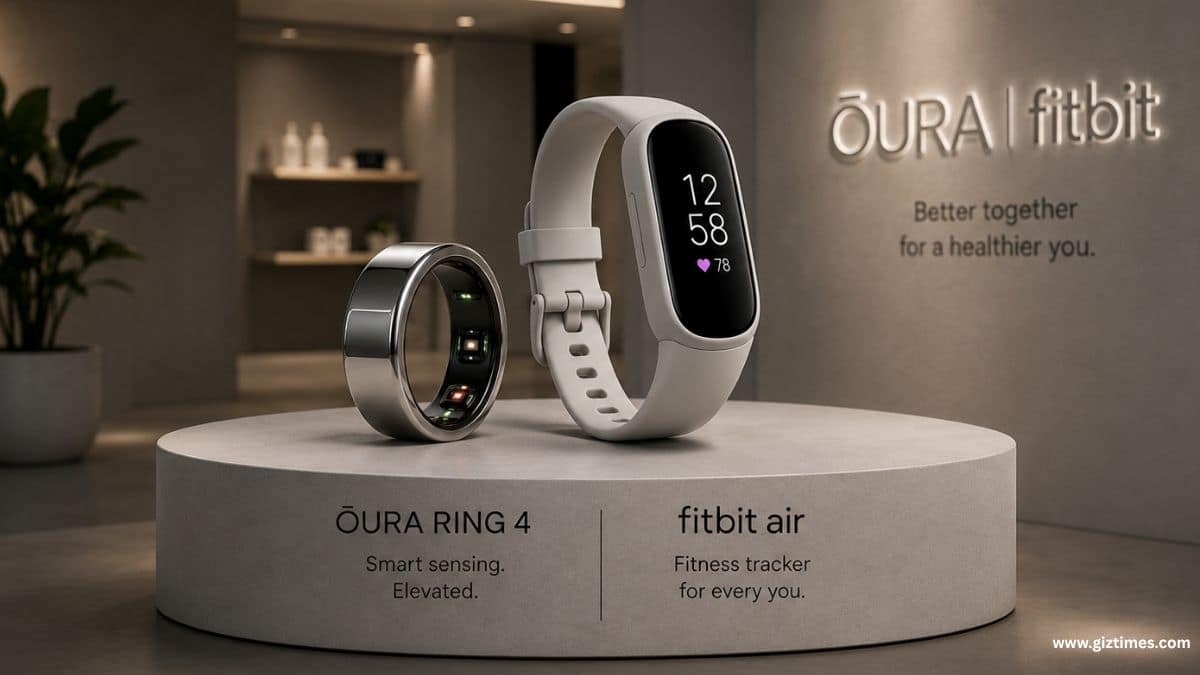
HYDERABAD, India (GizTimes) —The wearable market is moving in two completely different directions at once. On one side, the Google Fitbit Air strips fitness tracking down to a lightweight, screenless wristband that costs just $99.99 and focuses heavily on AI-driven coaching and passive health monitoring. On the other hand, the Oura Ring 4 treats wellness tracking like a luxury long-term investment, combining clinically validated sleep analytics with premium materials and an ongoing subscription ecosystem.
What makes this comparison interesting is that both products are trying to solve the same modern problem: people want health data without the cognitive overload of smartwatches. But they approach that problem from opposite directions. Fitbit Air wants to become the affordable AI health layer for everyday users. Oura Ring 4 wants to become an invisible recovery companion that quietly builds a deep physiological profile over years of continuous wear.
The result is not really a battle between a wristband and a ring. It is a battle between accessibility and refinement.
Why These Devices Exist: Screenless vs Invisible
Google built the Fitbit Air around a very specific frustration with modern wearables: too many screens, too many notifications, and too much hardware complexity. The company intentionally removed the display, restricted notification mirroring, and reduced the device to a 12 g sensor platform focused almost entirely on passive data collection and AI interpretation.
That decision explains nearly every hardware trade-off in the product. The lack of onboard GPS keeps costs low. The lightweight textile band improves overnight comfort. The reliance on Gemini AI shifts much of the experience away from hardware and into software subscriptions. Google is effectively treating the Fitbit Air as a low-cost biometric entry point into its broader Google Health ecosystem.
Oura took the opposite approach. The Ring 4 exists because many users no longer want health tracking to look like technology at all. The entire product philosophy revolves around invisibility. Instead of pushing fitness metrics throughout the day, Oura prioritizes long-term physiological consistency, especially during sleep and recovery periods.
The ring form factor also solves a problem wrist wearables still struggle with: stable overnight sensor contact. Finger arteries produce cleaner biometric signals during sleep, which is why Oura invested heavily in its 18-path PPG architecture and advanced sleep staging algorithms.
This creates a very different user experience. Fitbit Air behaves like an active daily fitness companion. Oura Ring 4 behaves more like a passive physiological observer.
The Real Hardware Difference Is Sensor Placement
The most important distinction here is not processor power or battery size. It is where the sensors live on the body.
The Fitbit Air’s wrist-based architecture is better suited for active movement and casual daily interaction. The lightweight band makes it easier to wear during walking, cycling, cardio sessions, and general daytime activity. The Smart Wake alarm system also benefits from the wrist placement because haptic feedback is naturally easier to notice during sleep.
But wrist tracking introduces instability during intense movement. Google’s own documentation acknowledges that the textile Performance Loop can shift during workouts, causing ambient light leakage that reduces heart-rate accuracy. Connected GPS dependency also weakens the fitness experience for runners and cyclists who expect standalone workout tracking.
Oura Ring 4 performs differently because finger placement naturally improves blood-flow signal quality during rest. Its 18-path sensor system dynamically adjusts LED pathways depending on finger orientation and skin contact. That architecture significantly improves overnight oxygen sensing and reduces biometric dropouts during sleep.
The trade-off is that rings are mechanically awkward during strength training. Heavy barbells, dumbbells, and grip-intensive exercises create pressure points and scratching risks. Many Oura users remove the ring entirely during gym sessions, which weakens workout continuity.
That difference quietly defines the ideal buyer for each product. Fitbit Air is better for people who actively exercise and want frequent interaction with their fitness data. Oura Ring 4 is better for people who care more about recovery trends, sleep quality, and passive wellness tracking than real-time workouts.
The Update Roadmap Reveals Their Long-Term Strategy
Google’s roadmap is heavily AI-centric. The Fitbit Air hardware itself is relatively modest, but Google is aggressively expanding the software layer through the Gemini-powered Google Health Coach. Features like conversational biometric analysis, adaptive workout planning, meal recognition, and EMR integration show that Google sees the wearable primarily as a data collection node for cloud-based health intelligence.
That creates an unusual value proposition. The device becomes more useful over time, not because of hardware upgrades, but because Google keeps expanding the AI ecosystem behind it. Even the subscription strategy reflects this shift. The hardware price is intentionally low because the long-term monetization comes from Google Health Premium.
Oura’s roadmap is more algorithmic and clinically focused. Instead of conversational AI, the company is improving physiological modeling itself. The Ring 4 introduced an 18-path sensing architecture, while the newer Oura Ring 5 already pivots toward low-profile sensor domes after discovering that perfectly flush interiors reduced signal stability.
That is a subtle but important insight. Oura is prioritizing data fidelity over aesthetic minimalism. The company realized that comfort alone was not enough if rotational slippage weakened measurement reliability. Fitbit Air, meanwhile, still accepts lower workout precision in exchange for lower cost and greater simplicity.
The contrast reveals something deeper about the two ecosystems. Google is optimizing for mass adoption. Oura is optimizing for biometric precision.
Comparison
The two products overlap in health tracking, but their priorities diverge sharply once you examine the hardware and long-term ownership model.
| Feature | Google Fitbit Air | Oura Ring 4 |
|---|---|---|
| Starting Price | $99.99 | $349 |
| Subscription Requirement | Optional | Mandatory for full analytics |
| Form Factor | Screenless wristband | Smart ring |
| Weight | 12 g | 3.3–5.2 g titanium |
| Battery Life | 7–8.5 days | 4–8 days depending on size |
| GPS | Connected GPS only | Phone-tethered GPS |
| Sleep Tracking Focus | Smart Wake + sleep stages | Clinically validated sleep staging |
| AI Layer | Gemini Health Coach | Oura Advisor + Health Radar |
| Workout Focus | Cardio Load, Readiness, automatic detection | Passive wellness, limited athletic depth |
| Strength Training Suitability | Better wrist ergonomics | Often removed during lifting |
| Sensor Strength | Affordable all-day fitness tracking | High-fidelity overnight biometrics |
| Warranty | 1 year | 1-year standard, extended plans available |
Public Reaction Analysis
The public response around the Oura Ring 4 reveals a consistent behavioral pattern: users are not buying it for fitness motivation. They are buying it because it quietly changes daily habits through passive awareness.
One user specifically described how sleep tracking encouraged earlier meal timing and highlighted stress patterns within their relationship dynamics. Another mentioned the two-week adaptation period before the ring becomes fully accurate.
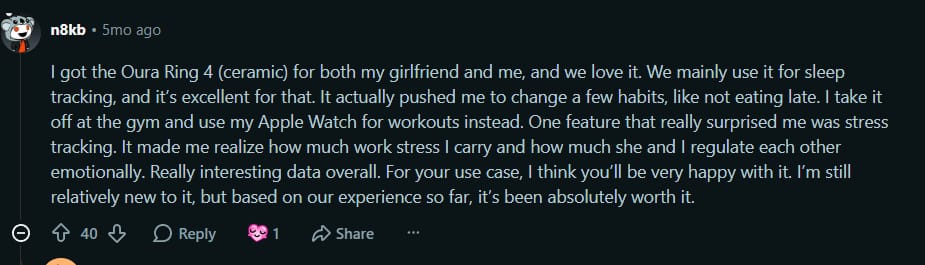

 That learning phase is important because it reflects how Oura positions itself psychologically. The product becomes more valuable as it gathers longitudinal baseline data. It is less about instant gratification and more about building a personalized physiological archive over time.
Interestingly, nobody in the reactions focused heavily on workouts. Even satisfied users still relied on separate devices like the Apple Watch during gym sessions. That unintentionally reinforces Oura’s actual role in the wearable market: it is not replacing sports watches. It is replacing the need for conscious wellness monitoring.
Fitbit Air targets the opposite emotional behavior. Its entire software design encourages active interaction through AI conversations, readiness scores, cardio load analysis, and adaptive coaching. It wants users to check insights regularly rather than passively accumulating data.
The non-obvious insight here is that both devices reduce screen fatigue, but they do so differently. Fitbit Air reduces distraction while still encouraging engagement. Oura reduces engagement itself.
What This Means for Buyers
The Fitbit Air dramatically lowers the financial and psychological entry barrier to modern health tracking. At $99.99 with optional subscriptions, it finally makes passive wellness tracking accessible to mainstream users who previously avoided expensive smartwatches or recurring subscription ecosystems.
For active individuals, that matters more than perfect biometrics. Most consumers benefit more from consistent sleep tracking, cardio load awareness, and lightweight comfort than from ultra-granular physiological analysis.
Oura Ring 4 serves a different buyer entirely. Its value only becomes obvious over long-term use. The ring works best for users who prioritize recovery, sleep quality, stress monitoring, and passive health awareness over real-time exercise coaching. But the ongoing subscription model changes the buying equation significantly. Over several years, ownership costs have become dramatically higher than the initial hardware price suggests.
That makes the Oura ecosystem feel less like consumer electronics and more like a premium health service.
Other key takeaways
Google’s aggressive AI integration suggests the Fitbit Air may evolve faster through software than hardware revisions. The wearable itself is relatively simple, but the surrounding ecosystem could expand rapidly as Gemini capabilities mature. Oura’s introduction of the Ring 5 also quietly exposes a limitation of flush sensor design. The company essentially admitted that comfort-first engineering reduced measurement stability during movement. That creates an unusual situation where the Ring 4 now exists as the “comfort-first” option inside Oura’s own lineup.
The upcoming expansion of Google’s Gemini Health ecosystem will likely determine whether affordable AI-driven wellness tracking truly becomes mainstream or remains overshadowed by premium recovery-focused platforms like Oura.
Read More:
- AI Voice Fraud Has Skyrocketed: How Voice Cloning Compromises the Reliability of Voice as a Security Measure
- How the Hybrid Porsche 911 Carrera 4 GTS Uses Technology to Reinvent Performance Without Losing Its Identity
- Modern Warfare 4’s Korean War Story and Current-Gen Focus Signal a Major Shift From MW3
