


ANUPPUR, India (GizTimes) — The majority of postgraduates and PhD candidates use free AI services to assist them in their rigorous academic work. However, it is not uncommon for them to run into a “functional wall,” especially in terms of context limitations and usage restrictions. As a result, they end up settling for surface-level assistance since they do not have access to advanced features, which would address any errors or misinterpretations.
For them, Gemma-4-31B-it can be a structural shift in how AI is used in academic workflows. Instead of functioning as a passive query-response system, it operates as an active research co-pilot capable of handling long-context reasoning, multimodal inputs, and iterative problem-solving. The tension is not about capability alone, how far a researcher can trust it before verification becomes mandatory.
This model compresses multiple stages of research into a single interaction loop, but that compression introduces a new constraint: a clearly defined hallucination horizon that determines its safe operational zone.
Why to Choose Gemma-4-31B-it
In general, the reason lies in efficiency considerations and improved reasoning architecture. Firstly, Gemma-4-31B-it is designed as a densely packed transformer with 30.7 billion parameters optimized not just for scale but for “intelligence-per-parameter”. As a result, the model provides high-level reasoning on affordable hardware, allowing for effective research workflows to be localized rather than performed in the cloud.
With 256k token context window, Gemma-4-31B-it has changed the game completely: a postgraduate student can upload entire papers, datasets, and codebase within one session. That eliminates the fragmentation that used to happen with literature review and paper synthesis because now the researcher works within the same environment.
Introduction of “Thinking Mode” is the second driving force. In this mode, Gemma-4-31B-it breaks the question down into complex chains of multi-step reasoning that could reach thousands of tokens beyond the limits of a single response. The model is able to produce hypotheses, verify logic, and analyze problems.
Usability-wise, Gemma-4-31B-it transforms the research cycle into the following:
- Literature review = context ingestion
- Hypothesis forming = guided reasoning
- Analysis = structured decomposition
- Writing = synthesis of results
That means not just more efficient research, but tight coupling between thought processes and production.
Hallucination Horizon of Gemma-4-31B-it
Within the proposed framework, Gemma-4-31B-it acts within the hallucination horizon—that is, within the range of contexts that allow for reliable reasoning until human verification becomes crucial.
Firstly, its excellent performance on reasoning tasks, such as GPQA Diamond (84.3%) and AIME 2026 (89.2%), shows strong reasoning skills in structured domains. Yet, the performance of the model might vary depending on different conditions.
There are several constraints to consider:
First, there is a trade-off between reasoning depth and factual grounding. Although thinking mode provides the user with logically sound answers, those answers might be wrong due to the faulty data introduced in the input.
Secondly, long context degrades model performance. Although it allows for extensive content ingestion, the longer the context, the slower the inference speed and the less precise attention distribution. That means that synthesis will still remain reliable, while more precise tasks would require manual verification.
Finally, the vulnerability of the model to safety prompts shows that in case of unverified data the model might fail in its logic. Specifically, during the prompt safety test, Gemma-4-31B-it demonstrated zero resistance to prompt injection and manipulation.
Overall, for postgraduate and Ph.D. researchers using Gemma-4-31B-it, the following holds: it is highly reliable in providing context, structuring, and reasoning, but goes outside the hallcination horizon while generating conclusions based on its data.
Gemma-4-31B-it Vs ChatGPT (Free) Vs Gemini Free
The comparison is not about which model is “smarter,” but how each system enables or constrains research workflows. ChatGPT and Gemini operate as platform-gated intelligence systems, while Gemma-4-31B-it operates as a locally deployable reasoning engine. This creates a fundamental usability divergence.
| Specification Category | Gemma 4 31B-it | ChatGPT Free (GPT-5.3 / 5.4) | Gemini Free (3 Flash / 3.1 Pro) |
|---|---|---|---|
| Deployment Model | Local / self-hosted / cloud optional | Fully platform-controlled | Platform + deep ecosystem integration |
| Context Window | 256K tokens | 16K tokens | 32K tokens |
| Reasoning Access | Full (Thinking Mode available) | Limited (GPT-5.4 gated) | Limited (3.1 Pro capped) |
| Research Workflow | Continuous, large-context reasoning | Session-limited, message capped | Integrated, but usage throttled |
| Customization | Full modification (Apache 2.0) | Use-only GPTs (no creation in free tier) | Create & share Gems |
| Multimodal Capability | Text + Image (high fidelity) | Multimodal via system routing | Native multimodal (text, image, audio, video) |
| Cost Structure | Low-cost / local execution | Usage caps + fallback models | Usage limits but broader free access |
| Speed vs Scale Tradeoff | Slows with large context | Stable due to controlled infra | Balanced via system optimization |
The strength of Gemma is that it isn’t capability itself; it is the ability to fully control the research process, with an unrestricted 256K context window and reasoning mode.
ChatGPT, on the other hand, is designed for reliable reasoning but has limitations such as message limits and reasoning tiers that limit its utility in long-term projects.
Gemini strikes the balance between both extremes, providing better multimodal support and greater flexibility in the free tier, but still limiting higher reasoning capacity and research scope.
The important point that is easy to overlook is the following:
Where ChatGPT and Gemini manage risks by controlling their environment, Gemma gains capabilities but leaves the user to manage the risks.
Public Reaction on Gemma-4-31B-it Performance
Analysis of public reactions confirms the trend of focusing not on the capabilities but the efficiency of AI models. In other words, people emphasize the “only 31B” part much more often than they talk about capabilities of the machine.
Surprise about the output quality compared to the model’s size indicates that people have not fully adapted to the new paradigm of thinking about intelligence of AI models.
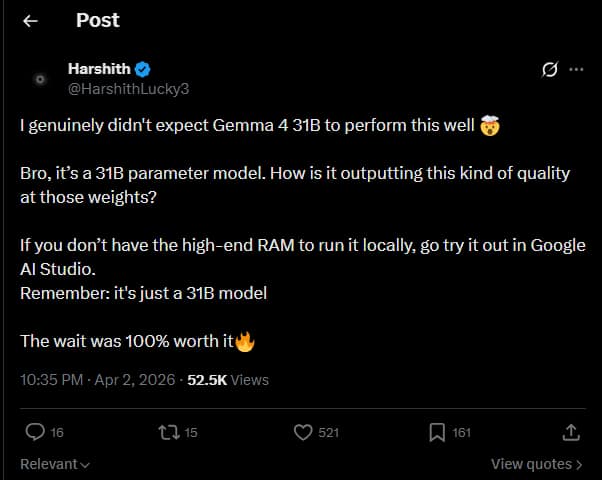
Attention to local deployments also shows that in addition to intelligence, accessibility is increasingly valued. Running Gemma variants on personal computers is called “cheating,” meaning that users find value in locally available computing power.

A more detailed explanation of the performance also mentions architecture. Attention mechanisms, fine-tuning, and curated data are presented as the most crucial factors, which also corresponds to the idea of efficiency over capability.
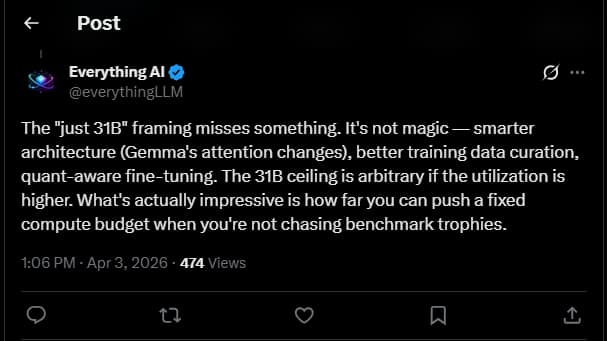
The contradiction lies in the fact that while people value local first solutions, they use AI models for high-stake outputs. Therefore, it is necessary to keep in mind that there is a hallucination horizon for Gemma-4-31B-it that needs careful consideration.
Why It Matters for PG or PhD Students
What is happening here is a significant shift in the usability of AI tools. Previously, a barrier to building research tooling meant access to a supercomputer or a cluster. With Gemma-4-31B-it, the issue is no longer the access to computing power but to management and verification procedures.
For researchers, it is an opportunity to iterate faster, build and discard hypotheses more efficiently, work with large data sets. On the other hand, a researcher needs to implement verification steps within the existing workflows.
On a broader level, it is another step in commoditization of reasoning. From now on, the value added by a model is not in intelligence itself but in safety and efficiency of application.
Extra Takeaways
The fact that Gemma-4-31B-it can process large volumes of information within a single interaction gives rise to another insight: with Thinking Mode the model simulates “research memory.”
It allows for multi-step reasoning based on the previous iterations, however, it also poses another risk. If the first stage contains mistakes, the whole chain of reasoning could be incorrect.
Second insight refers to the economic side. With minimal compute costs and the ability to perform heavy research operations on a laptop, large scale automatization of research becomes possible.
In conclusion, while Gemma-4-31B-it has changed research workflows for good, the task ahead would be managing its hallucination horizon safely.
