Close Menu
GizTimes
    Facebook X (Twitter) Instagram
    Facebook X (Twitter) Instagram
    GizTimesGizTimes
    Source on Google
    • Home
    • Tech News
    • AI
    • Gadgets
    • Cybersecurity
    • Auto
    • Cars
    • Games
    GizTimes
    Home » Why Gemma 4 Brings Agentic AI to Local Devices, People Claimed Gemma 4 26B is Much Faster than Qwen 3.5
    Tech News

    Why Gemma 4 Brings Agentic AI to Local Devices, People Claimed Gemma 4 26B is Much Faster than Qwen 3.5

    Saurabh GuptaBy Saurabh GuptaApril 5, 2026No Comments4 Mins Read
    Facebook Twitter Pinterest Telegram LinkedIn Tumblr WhatsApp Email
    Why Gemma 4 Brings Agentic AI to Local Devices, People Claimed Gemma 4 26B is Much Faster than Qwen 3.5
    Why Gemma 4 Brings Agentic AI to Local Devices, People Claimed Gemma 4 26B is Much Faster than Qwen 3.5
    Share
    Facebook Twitter LinkedIn Pinterest Telegram Email

    ANUPPUR, India (GizTimes) — As demand grows for faster, more private artificial intelligence systems, NVIDIA and Google have introduced Gemma 4, a new family of open multimodal models designed to run across data centers and edge devices. The release combines Google’s model development with NVIDIA’s hardware optimizations. It enables advanced agentic AI abilities such as reasoning and autonomous action directly on local machines. This launch different due to is ability to deliver high-level performance across a wide range of hardware while remaining commercially accessible under an Apache 2.0 license.

    Gemma 4 is built to handle complex, multi-step workflows. It uses native tool and function calling, allowing systems to perform tasks with minimal human intervention. All variants support both text and visual inputs, such as images and video, while smaller models in the lineup also process audio for speech recognition. The flagship 31-billion-parameter model ranks among the top-performing open models globally and reportedly outperforms systems up to 20 times its size on key benchmarks.

    Performance gains are driven in part by NVIDIA’s NVFP4 precision format, which reduces computation costs while maintaining accuracy comparable to higher-precision models. This allows for faster throughput and more efficient deployment, particularly in environments where resources are limited. The models are pretrained on more than 140 languages, with strong support for at least 35 languages out of the box, expanding their usability across global markets.

    The Gemma 4 family includes four variants tailored for different use cases. Smaller dense models, such as the E2B and E4B, are designed for mobile and edge deployments. Larger models like the 26B mixture-of-experts and the 31B dense model target enterprise-scale reasoning tasks. Context windows extend up to 512K tokens in higher-end versions, enabling long-form reasoning and memory-intensive applications.

    Deployment is a central focus of the release. The models are optimized for NVIDIA’s Blackwell and H100 GPUs in data centers, RTX GPUs in workstations, and Jetson Orin Nano devices for robotics and industrial use. Integration with NVIDIA’s NIM microservices and NeMo framework simplifies production deployment and customization, on the other hand compatibility with tools such as vLLM, Ollama, llama.cpp, and Unsloth ensures flexibility for developers. NVIDIA’s NeMo Automodel further streamlines fine-tuning through methods like supervised fine-tuning and LoRA without requiring complex data conversions.

    The broader Gemma ecosystem has already seen significant traction, with over 400 million downloads and more than 100,000 community-created variants. NVIDIA is also offering access to the 31B model through its API catalog, alongside developer resources and tutorials via the Jetson AI Lab.

    This shift toward local AI execution carries clear implications. Running models on-device reduces latency and operational costs while keeping sensitive data on-premises. It is a key requirement for industries such as healthcare, finance, and manufacturing. It also signals a move away from cloud dependency, especially as enterprises seek more control over their AI infrastructure.

    Compared with competing open models like Meta’s Llama series, Gemma 4’s tight integration with NVIDIA hardware gives it an advantage in optimized performance across edge and enterprise environments. While Llama remains widely adopted, Gemma’s hardware-software alignment could appeal to organizations already invested in NVIDIA ecosystems.

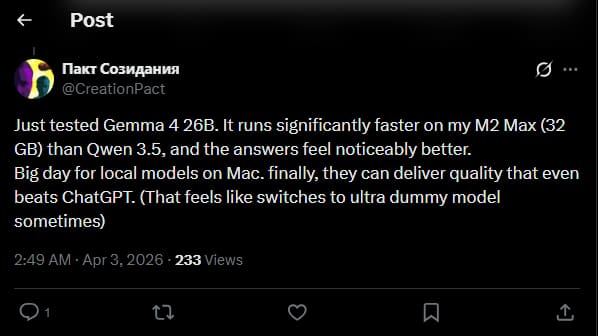
    Public reaction on X (Twitter) has been strongly positive among developers, particularly those testing local deployments on consumer hardware. One user wrote, “Just tested Gemma 4 26B. It runs significantly faster on my M2 Max (32 GB) than Qwen 3.5, and the answers feel noticeably better.” The comment highlights perceived gains in both speed and output quality, showing a broader trend where optimized local models are beginning to rival or exceed expectations set by cloud-based systems.
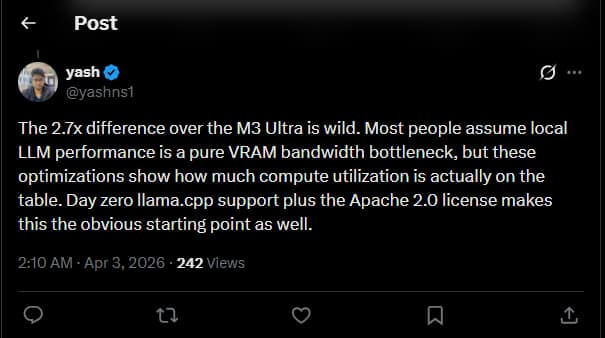
    Another developer pointed to performance scaling, writing that “the 2.7x difference over the M3 Ultra is wild,” suggesting that improvements are not just hardware-bound but also driven by better compute utilization and software optimization.
    The speed advantage of Gemma 4 26B over Qwen 3.5 largely comes from architectural efficiency and hardware-level optimization rather than raw size alone.

    Gemma 4 uses a mixture-of-experts (MoE) design, meaning only a small portion of its parameters—around 3.8 billion—are active during inference, which significantly reduces computation per request compared to dense models like Qwen 3.5 where all parameters are engaged.

    Along with it NVIDIA’s support for low-precision formats such as 4-bit NVFP4 allows Gemma 4 to process more tokens per second with minimal accuracy loss, improving throughput on consumer GPUs and even Apple silicon. Better kernel-level optimizations and early support across inference frameworks like llama.cpp further enhance compute utilization, which explains why users are seeing disproportionately higher performance even on similar hardware configurations.

    The upcoming real-world enterprise deployments will likely determine whether local-first agentic AI becomes a dominant model or remains a niche alternative.

    Read More:

    • Lucid Misses Q1 2026 Delivery Estimates, Raising Fresh Concerns on Demand and Execution
    • Lenovo hikes Legion Go 2 prices by as much as 48% as component shortages continue
    • Vivo launches V70 FE in India at ₹37,999, But Consumers have Criticized the Processor Choice
    Share. Facebook Twitter Pinterest LinkedIn Tumblr Email
    Saurabh Gupta
    • Facebook
    • X (Twitter)
    • LinkedIn

    As the Founder of GizTimes, Saurabh Gupta is a dedicated tech enthusiast, worked 3 years at karekaise.in and further continued his journey as a content writer at Asportsn.com. Beyond his leadership role, Saurabh remains deeply connected to the core of his passion, regularly contributing as an author to share interesting insights to the tech community.

    Related Posts

    Architecting Autonomous Personal Computing: NVIDIA RTX Spark and Windows in the Agentic AI Era

    June 4, 2026

    Bentley Continental GT S: Performance Dialed Through Software, Positioned Through Feel

    May 6, 2026

    Intel Redefines the AI PC Market with a Split Strategy: Affordable Efficiency vs Premium Ambition

    April 17, 2026

    Oppo Find N6 vs Galaxy Z Fold7: Foldable Focusing on Long-Term Capability over Longevity

    April 14, 2026

    Amazon to End Support for Legacy Kindle and Fire Devices on May 20, 20264

    April 10, 2026

    Steam Gaming Now Available on Apple Vision Pro, and It Is Surprisingly Great

    April 9, 2026
    Leave A Reply Cancel Reply

    Latest Post
    Cars

    Cadillac Escalade IQL: Why Cadillac Chose Space Over More Power in the Luxury EV Race

    June 26, 2026

    HYDERABAD, India (GizTimes) —The 2026 Cadillac Escalade IQL represents Cadillac’s latest step toward electrifying its…

    Cars

    Chevrolet Corvette ZR1X: Why Hybrid Power Has Turned America’s Sports Car Into a Hypercar Challenger

    June 20, 2026

    HYDERABAD, India (GizTimes) —The Chevrolet Corvette ZR1X represents the most ambitious performance leap in Corvette…

    Cars

    Rivian R2’s Real Mission: Turning Adventure EVs Into a Mainstream Market Product

    June 16, 2026

    HYDERABAD, India (GizTimes) —The Rivian R2 is more than a smaller version of the company’s…

    Cars

    BMW Vision Neue Klasse X: Why BMW Thinks Software, Not Horsepower, Will Define Electric Performance

    June 14, 2026

    HYDERABAD, India (GizTimes) —The BMW Vision Neue Klasse X and the closely related BMW M…

    Games

    The Infinite Museion vs Lex Imperialis, Which Rogue Trader Expansion Delivers More?

    June 13, 2026

    HYDERABAD, India (GizTimes) — Owlcat Games has expanded Warhammer 40,000: Rogue Trader once again with The…

    AI

    DiffusionGemma 26B-A4B-IT: How Parallel Text Generation Challenges the Autoregressive AI Era

    June 13, 2026

    ANUPPUR, India (GizTimes) — For years, large language models have relied on a single assumption:…

    Cars

    Toyota bZ (2026): Why Toyota’s EV Strategy Is Shifting From Specifications to Ownership Experience

    June 11, 2026

    HYDERABAD, India (GizTimes) —Toyota has significantly reworked its electric SUV strategy with the 2026 Toyota…

    Cars

    Boreham Ford Escort Mk1 RS: Why Lightweight Engineering May Be the Ultimate Performance Luxury

    June 9, 2026

    HYDERABAD, India (GizTimes) —The Boreham Ford Escort Mk1 RS marks the return of one of…

    Games

    Minecraft Dungeons II Launches September 29, Everything Revealed After the New Gameplay Showcase In YouTube Reveal Trailer

    June 9, 2026

    HYDERABAD, India (GizTimes) — Minecraft Dungeons II was officially revealed during Minecraft Live 2026, with its…

    AI

    AI Agents and Their Impact on the Changing Nature of Work via Intelligent Automation

    June 8, 2026

    ANUPPUR, India (GizTimes) — AI systems are about to enter a new era. In contrast…

    GizTimes

    Giztimes is a technology information site that covers tech-related news and specs, but it also concentrates on conveying the impact that technological breakthroughs have on people’s lives. We provide our readers with comprehensive, data-based, and hand-picked information about the latest trends and innovations in the field of artificial intelligence, cybersecurity, gadgets, automobiles, gaming, consumer tech, and digital technology in general. Our goal is to publish high-caliber analytics that will be of use to professionals and regular readers alike.

    Pages
    • Home
    • About Us
    • Contact Us
    • Disclaimer
    • Editorial Ethics
    • Ethics & Standards
    • Our Team
    • Ownership & Funding Disclosure
    • Publication Description
    • Publisher & Founder Profile
    Policy Pages
    • Corrections Policy
    • Community Guidelines
    • DMCA Copyright Policy
    • Diversity & Inclusion Policy
    • Editorial Policy
    • Fact-Checking Policy
    • Privacy Policy
    • Terms and Conditions
    Facebook X (Twitter) Instagram YouTube LinkedIn WhatsApp Telegram RSS
    © 2026 GizTimes. All Rights Reserved

    Type above and press Enter to search. Press Esc to cancel.