

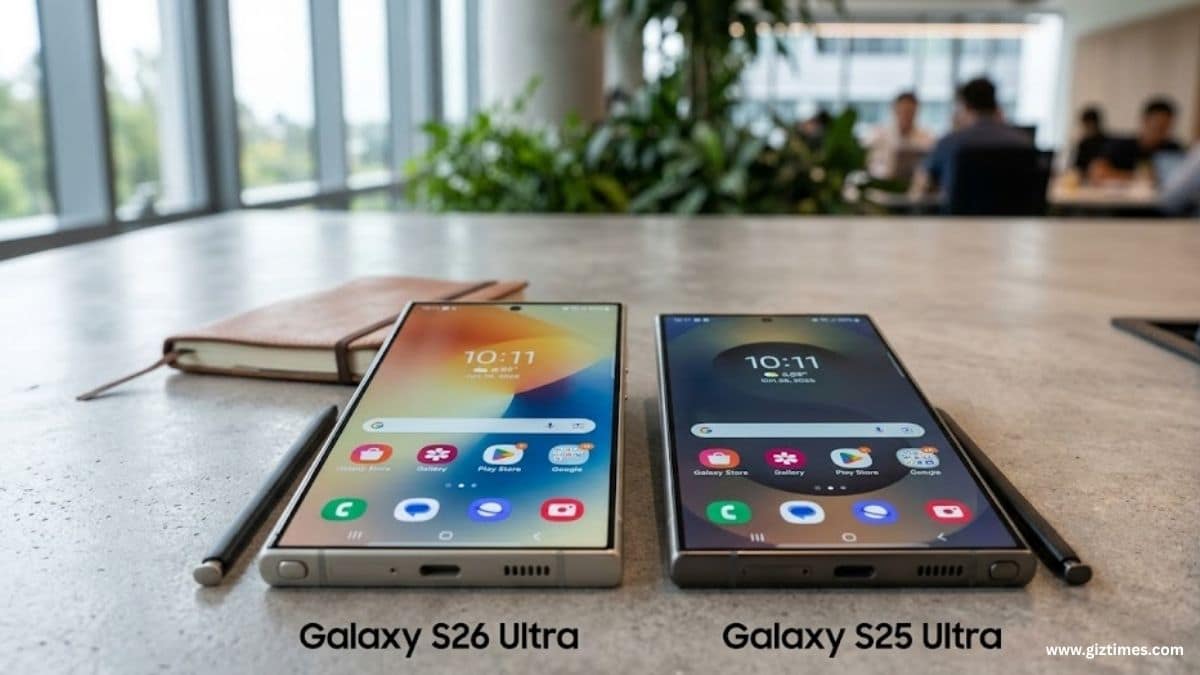
HYDERABAD, India (GizTimes) —The Galaxy S26 Ultra brings several notable engineering upgrades, but the main question remains: is it worth paying more than the S25 Ultra? On paper, the improvements seem significant: a new chipset, better thermal management, faster charging, and refined cameras. In reality, though, this isn’t a dramatic leap forward. Instead, it’s more about fixing previous limitations than redefining what the device can do.
Why This Product Exists
Samsung appears to be addressing issues that became clear in the S25 Ultra. One key change is the move from titanium to Armor Aluminum 2. While titanium gave a premium feel, it wasn’t great for heat management. Aluminum, on the other hand, allows for better heat dissipation, which is crucial during intensive tasks like gaming or recording in 8K.
This shift also improves day-to-day usability. The phone is slightly thinner (7.9 mm) and lighter (214g), but more importantly, it can sustain performance longer thanks to a larger vapor chamber and improved heat distribution.
The processor upgrade follows a similar pattern. The Snapdragon 8 Elite Gen 5 doesn’t dramatically boost peak performance, but it enhances stability and AI processing. While the S25 Ultra already had strong performance with its 3nm chip, the newer model focuses on maintaining that performance over time, especially for AI-driven tasks.
Charging sees a long-overdue bump from 45W to 60W. This isn’t groundbreaking it’s simply catching up with industry expectations.
Overall, the S26 Ultra exists to resolve bottlenecks rather than introduce entirely new capabilities.
Processor Longevity and Update Impact
Both devices already operate at a high level thanks to the 3nm architecture. The S25 Ultra’s chip is still highly capable, handling demanding AI workloads and gaming without issues.
The S26 Ultra builds on this with measurable improvements: CPU performance increases by 19%, GPU by 24%, and NPU by 39%. These gains matter because they extend the device’s ability to handle future workloads, particularly in AI.
Thermal stability also improves from 84% to 92% under sustained load. This is arguably more important than peak speed, since consistent performance over time leads to better long-term usability.
In practical terms, the S26 Ultra will remain “fast enough” for longer, especially as AI features evolve. However, the S25 Ultra is still well above the threshold needed for current tasks, so it’s far from outdated.
Without a clear update roadmap, it’s hard to fully compare long-term support. Still, based on hardware alone, the S26 Ultra has a slight edge in longevity, not a major generational jump.
Comparison
The gap between the S25 Ultra and S26 Ultra is not about capability it’s about thresholds. The S25 Ultra already handles most tasks without stress. The S26 Ultra only starts to justify itself when your usage consistently pushes beyond that comfort zone.
Think of it in terms of intensity, not features.
At low to moderate usage of social media, messaging, casual photography, and short video recording, the two phones behave almost identically. The S25 Ultra rarely hits thermal or performance limits in these scenarios, so the S26 Ultra’s improvements stay hidden.
The shift happens when usage becomes sustained and demanding.
If you regularly game for long sessions, record extended 4K/8K video, or rely on on-device AI tools, the S25 Ultra begins to show its limits through heat buildup and performance drops (84% stability). The S26 Ultra’s improved thermal system (92% stability) keeps performance more consistent, which directly translates into fewer frame drops and less slowdown over time.
The NPU gain (+39%) introduces another boundary. It only becomes relevant if AI is part of your workflow, such as image editing, contextual automation, or heavy on-device processing. Without that, the extra AI headroom doesn’t translate into visible value.
Charging is the only upgrade that cuts across usage types. Moving from 45W to 60W benefits almost everyone, but it alone isn’t enough to justify the upgrade.
| Feature | Galaxy S25 Ultra | Galaxy S26 Ultra | When It Actually Matters |
|---|---|---|---|
| CPU Performance | Baseline | +19% | Only during sustained multitasking or prolonged heavy use |
| GPU Performance | Adreno 830 | Adreno 840 (+24%) | Gaming sessions beyond ~30–40 minutes |
| NPU (AI) | Standard AI | +39% | Frequent AI usage (editing, automation, on-device tasks) |
| Thermal Stability | 84% | 92% | Long workloads where S25 starts throttling |
| Charging | 45W | 60W | Daily convenience, noticeable for frequent top-ups |
| Camera (f/1.7 → f/1.4) | Strong | Improved | Low-light and depth—situational, not constant |
The decision boundary becomes clear when you frame it this way:
If your usage is burst-based (short tasks, quick interactions), the S25 Ultra already operates at full efficiency. You won’t feel the upgrade.
If your usage is sustained and workload-heavy, the S26 Ultra starts to make sense—not because it’s dramatically faster, but because it slows down less over time.
That’s the real upgrade: not peak performance, but performance consistency under pressure.
Public Reaction Analysis
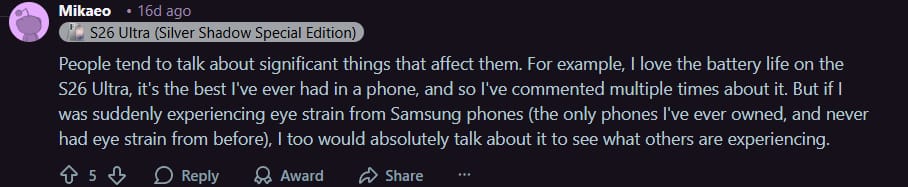
User feedback reveals more than specs alone. Battery life, for example, is widely praised even though capacity hasn’t changed. This suggests efficiency improvements are making a real difference.
At the same time, smaller concerns like eye strain are becoming more noticeable. This reflects how mature smartphones have become: major complaints are no longer about performance or battery, but about subtler aspects of the experience.
 Camera improvements, such as better macro performance, are also being noticed but mainly by specific users. These aren’t universally transformative upgrades.
So there’s a clear contrast: the phone is objectively better, but not everyone experiences those improvements in the same way.
Why It Matters
The S26 Ultra makes upgrade decisions more complicated, not easier.
If you’re coming from an older device, it’s a strong choice, offering a more stable and efficient flagship experience.
If you already own the S25 Ultra, the benefits are less compelling. Most improvements, such as thermals, efficiency, and AI performance, are noticeable over time rather than immediately.
This reflects a broader trend in smartphones. Performance has reached a point where it exceeds most users’ needs, so manufacturers are now focusing on consistency and longevity instead of dramatic upgrades.
Other Takeways
One notable shift is Samsung’s move from premium materials to more practical ones. Replacing titanium with aluminum suggests a focus on performance over aesthetics.
Another key point is the unchanged battery size paired with better battery life. This highlights how optimization, rather than bigger hardware, is driving progress.
The significant boost in NPU performance also signals a growing emphasis on on-device AI, hinting that future relevance may depend more on AI capabilities than raw processing power.
Ultimately, the real value of the S26 Ultra may depend on how future AI features evolve and whether its hardware advantages translate into meaningful everyday benefits.
Read More:
