
Close Menu
GizTimes
    Facebook X (Twitter) Instagram
    Facebook X (Twitter) Instagram
    GizTimesGizTimes
    Source on Google
    • Home
    • Tech News
    • AI
    • Gadgets
    • Cybersecurity
    • Auto
    • Cars
    • Games
    GizTimes
    Home » OpenAI–AWS Partnership’s 2GW Pact: Why AI Competition Is No Longer About Models But Power
    AI

    OpenAI–AWS Partnership’s 2GW Pact: Why AI Competition Is No Longer About Models But Power

    Saurabh GuptaBy Saurabh GuptaApril 14, 2026Updated:April 14, 2026No Comments5 Mins Read
    Facebook Twitter Pinterest Telegram LinkedIn Tumblr WhatsApp Email
    OpenAI–AWS Partnership's 2GW Pact: Why AI Competition Is No Longer About Models But Power
    OpenAI–AWS Partnership's 2GW Pact: Why AI Competition Is No Longer About Models But Power
    Share
    Facebook Twitter LinkedIn Pinterest Telegram Email

    ANUPPUR, India (GizTimes) — The recent OpenAI-AWS partnership represents an inflection point in the dynamics of AI leadership and development. For some years, there has been an implicit understanding that progress in AI revolves around improving the architecture and capabilities of the underlying models. The axis is outdated.

    According to an OpenAI article, with a $50 billion investment commitment, a $100 billion deal for shared infrastructure, and a 2 GW power supply guaranteed with Trainium-based chips, OpenAI is setting new standards: model quality is now limited by access to energy, silicon capacity, and computing power.

    In this article, we will analyze the OpenAI–AWS partnership and explain why compute infrastructure, not model architecture, is becoming the primary driver of AI competition.

    Why OpenAI–AWS Partnership Is Happening

    In the simplest case, it is all about scale. As seen in OpenAI’s recapitalization effort ($122 billion investment and $852 billion company valuation), there was a clear desire to create long-term compute capacity, energy security, and operational flexibility.

    According to OpenAI, they are going to utilize 2 gigawatts of Trainium compute capacity via AWS infrastructure. From that point, the 2 GW power supply becomes a defining move. With such a resource allocation, OpenAI can ensure that enough energy is available to power up next-gen models and keep stateful agent systems running. The latter, by definition, requires much more energy than the former.

    Furthermore, using a single chip architecture carries strategic risks. OpenAI’s transition to Trainium series processors by Amazon (Trainium3 and Trainium4) offers an alternative to NVIDIA’s dominant GPU architecture. According to AWS reports, It is expected 6 times better FP4 performance and 3 times better FP8 performance, combined with increased memory bandwidth, directly target cost/performance efficiency.

    All of the above is supplemented by enterprise customers’ expectations. According to available estimates reported by TOI, up to 40% of OpenAI’s revenue will come from enterprises in 2026 (projected to be equal to consumer revenue). Enterprises care less about novelty in terms of model architectures and more about stability, affordability, and integration into their IT infrastructure.

    The result is a systemic change: instead of choosing the model based on its architecture quality, it becomes vital to pick an architecture that will allow us to actually run it at production scale.

    Comparison

    The move to AWS is much broader than another partnership with the cloud service provider. The following table provides a comparison between current agreements between OpenAI and two cloud providers:

    Dimension OpenAI + Amazon (AWS) Microsoft + OpenAI (Azure)
    Investment Scale $50B Amazon commitment ~$13B Microsoft investment
    Infrastructure Pact $100B over 8 years $100B Stargate project (joint)
    Compute Strategy 2GW Trainium-based capacity Azure GPU supercomputing
    API Model Stateful runtime (AWS Bedrock) Stateless API exclusivity
    Cloud Dependency Multi-cloud (AWS + Google TPU usage) Historically exclusive
    Revenue Control Enterprise platform via AWS Copilot ecosystem integration
    Current Tension Expansion into AWS-native enterprise Legal threats over exclusivity

    One can notice that Microsoft keeps its strong grip on stateless APIs and intellectual property licensing, while Amazon assumes the control over a stateful execution layer – a layer with long-term operation and thus a substantially higher volume of consumed compute resources.

    Public Reactions On The Partnership

    Public reaction to the latest moves by OpenAI can provide useful insights on the nature of ongoing events.
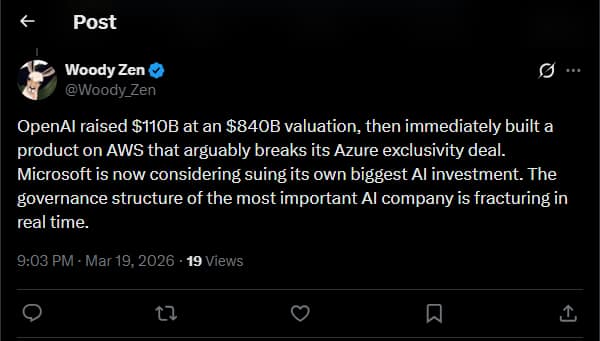
    A pattern that clearly emerges is associated with the perception of the OpenAI move as the breakdown of previous cloud exclusivity. The words like “mutiny,” “fracturing governance,” and “breach” used in public discussions reflect how unusual it seemed to break such a well-established relationship.
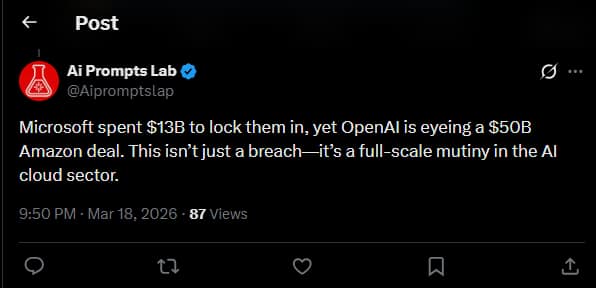
    Interestingly, a second-tier trend has appeared in some public reactions. Some people started looking at it not as a disruption of Microsoft-OpenAI relations, but rather as the emergence of a structural consequence – customers may start asking for multi-cloud solutions in the future.
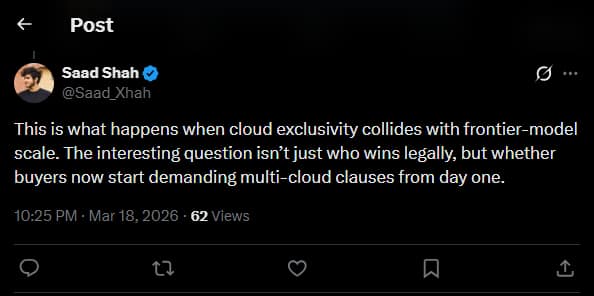
    It is worth mentioning that there seems to be some irony in public opinion towards the latest OpenAI developments: on the one hand, the move is viewed as an act of instability, but on the other hand, the behavior seems to be a natural reaction to scale issues. And, apparently, the governance models created for software vendors do not work well with infrastructure-scale requirements.
    Why It Is Important

    As of 2026, The implications of the latest move go far beyond the scope of OpenAI and Amazon.

    Firstly, compute becomes a bottleneck. The capacity to get gigawatt-scale computing power, custom silicon and infrastructure contracts becomes a key criterion for AI training and serving.

    Secondly, cloud providers evolve from mere hosting companies into AI utilities. The fact that AWS hosts both OpenAI and Anthropic represents a new reality: infrastructure starts playing a similar role to marketplaces, and the concept of exclusive AI ecosystems is weakening.

    Thirdly, competitive advantage becomes a problem of sustainability of the intelligence. Companies compete not only because of model capabilities, but also due to the ability to sustain the provided level of AI quality in the long term.

    Finally, multi-cloud becomes a standard. OpenAI’s ability to leverage both Azure, AWS, and even Google TPU clusters implies that there is always a limit to what a cloud provider can do and we must be flexible with our choices.

    Extra Takeaways

    There is one non-obvious implication of the 2GW deal from Amazon.

    In contrast to stateless APIs, where compute consumption depends on the number of isolated requests, stateful systems need a steady source of compute power because they require constant execution and memory retention. Thus, infrastructure strategy becomes increasingly focused on allocating power rather than buying expensive chips.

    From an economic perspective, Microsoft’s current stance – earning fees for routing requests through their servers – creates a positive feedback effect. As we can see, despite losing exclusivity, companies find ways to monetize the deal in a more sustainable way.

    As long as the partnership allows unlocking huge computing power, the question remains open whether a single company will be able to control enough energy, silicon, and multi-cloud complexity to maintain its AI supremacy.

    Read More:

    • PS5 Pro Pushes Cyberpunk 2077 to Its Limits, Same Game But Completely Different Feel
    • Oppo Find N6 vs Galaxy Z Fold7: Foldable Focusing on Long-Term Capability over Longevity
    • Anno 117: Pax Romana Expands With Prophecies of Ash, While Gamers Debate Its Long-Term Depth
    Share. Facebook Twitter Pinterest LinkedIn Tumblr Email
    Saurabh Gupta
    • Facebook
    • X (Twitter)
    • LinkedIn

    As the Founder of GizTimes, Saurabh Gupta is a dedicated tech enthusiast, worked 3 years at karekaise.in and further continued his journey as a content writer at Asportsn.com. Beyond his leadership role, Saurabh remains deeply connected to the core of his passion, regularly contributing as an author to share interesting insights to the tech community.

    Related Posts

    How Madgicx Is Reshaping Digital Advertising Through AI Automation

    May 31, 2026

    AI Voice Fraud Has Skyrocketed: How Voice Cloning Compromises the Reliability of Voice as a Security Measure

    May 31, 2026

    Smaller Ring but Smartier Ambitions: How Oura Ring 5 Has Redefined Wearable AI

    May 29, 2026

    AI Productivity Bubble Brust, How Companies Have Entered an AI Reality Check In 2026

    May 27, 2026

    Project Glasswing New Update Signals a Bigger Shift: Cybersecurity Is Becoming an AI-Driven Continuous Defense System

    May 23, 2026

    Top 5 GPTs in ChatGPT That Can Actually Transform How Students Study

    May 23, 2026
    Leave A Reply Cancel Reply

    Latest Post
    Tech News

    Architecting Autonomous Personal Computing: NVIDIA RTX Spark and Windows in the Agentic AI Era

    June 4, 2026

    ANUPPUR, India (GizTimes) — For over four decades, personal computers followed a basic rule: humans…

    Cars

    Lotus Emira 420 Sport: Why Lotus Chose Optimization Over Reinvention in Its Fight Against the Porsche GT4 RS

    June 3, 2026

    HYDERABAD, India (GizTimes) — The Lotus Emira 420 Sport arrives as the most focused version of…

    Gadgets

    GIGABYTE AORUS ELITE vs Alienware AW3225QF: The Future-Proof Gaming Monitor vs the Perfect Curved OLED Experience

    June 2, 2026

    HYDERABAD, India (GizTimes) —The premium gaming monitor market is no longer fighting over resolution alone.…

    Cars

    Tesla Model 3 vs BMW i4: Why Software, Range, and Charging Infrastructure Matter More Than Luxury Features

    May 31, 2026

    HYDERABAD, India (GizTimes) — The refreshed Tesla Model 3 arrives with a familiar mission: deliver…

    AI

    How Madgicx Is Reshaping Digital Advertising Through AI Automation

    May 31, 2026

    ANUPPUR, India (GizTimes) — Advertising operations traditionally relied on the involvement of human operators in…

    Gadgets

    Google Fitbit Air vs Oura Ring 4: The Future of Wellness Depends on Where You Wear the Sensor

    May 31, 2026

    HYDERABAD, India (GizTimes) —The wearable market is moving in two completely different directions at once.…

    AI

    AI Voice Fraud Has Skyrocketed: How Voice Cloning Compromises the Reliability of Voice as a Security Measure

    May 31, 2026

    ANUPPUR, India (GizTimes) —Voice has traditionally been the cornerstone of trust when contacting friends or…

    Cars

    How the Hybrid Porsche 911 Carrera 4 GTS Uses Technology to Reinvent Performance Without Losing Its Identity

    May 30, 2026

    HYDERABAD, India (GizTimes) — The arrival of the Porsche 911 Carrera 4 GTS marks one…

    Games

    Modern Warfare 4’s Korean War Story and Current-Gen Focus Signal a Major Shift From MW3

    May 30, 2026

    HYDERABAD, India (GizTimes) — Activision and Infinity Ward have officially revealed Call of Duty: Modern Warfare…

    Cars

    Bugatti W16 Mistral: The Final Combustion Monument Before Hypercars Go Hybrid

    May 29, 2026

    HYDERABAD, India (GizTimes) —The Bugatti W16 Mistral is not simply another limited-production hypercar. It represents…

    GizTimes

    Giztimes is a technology information site that covers tech-related news and specs, but it also concentrates on conveying the impact that technological breakthroughs have on people’s lives. We provide our readers with comprehensive, data-based, and hand-picked information about the latest trends and innovations in the field of artificial intelligence, cybersecurity, gadgets, automobiles, gaming, consumer tech, and digital technology in general. Our goal is to publish high-caliber analytics that will be of use to professionals and regular readers alike.

    Pages
    • Home
    • About Us
    • Contact Us
    • Disclaimer
    • Editorial Ethics
    • Ethics & Standards
    • Our Team
    • Ownership & Funding Disclosure
    • Publication Description
    • Publisher & Founder Profile
    Policy Pages
    • Corrections Policy
    • Community Guidelines
    • DMCA Copyright Policy
    • Diversity & Inclusion Policy
    • Editorial Policy
    • Fact-Checking Policy
    • Privacy Policy
    • Terms and Conditions
    Facebook X (Twitter) Instagram YouTube LinkedIn WhatsApp Telegram RSS
    © 2026 GizTimes. All Rights Reserved

    Type above and press Enter to search. Press Esc to cancel.