

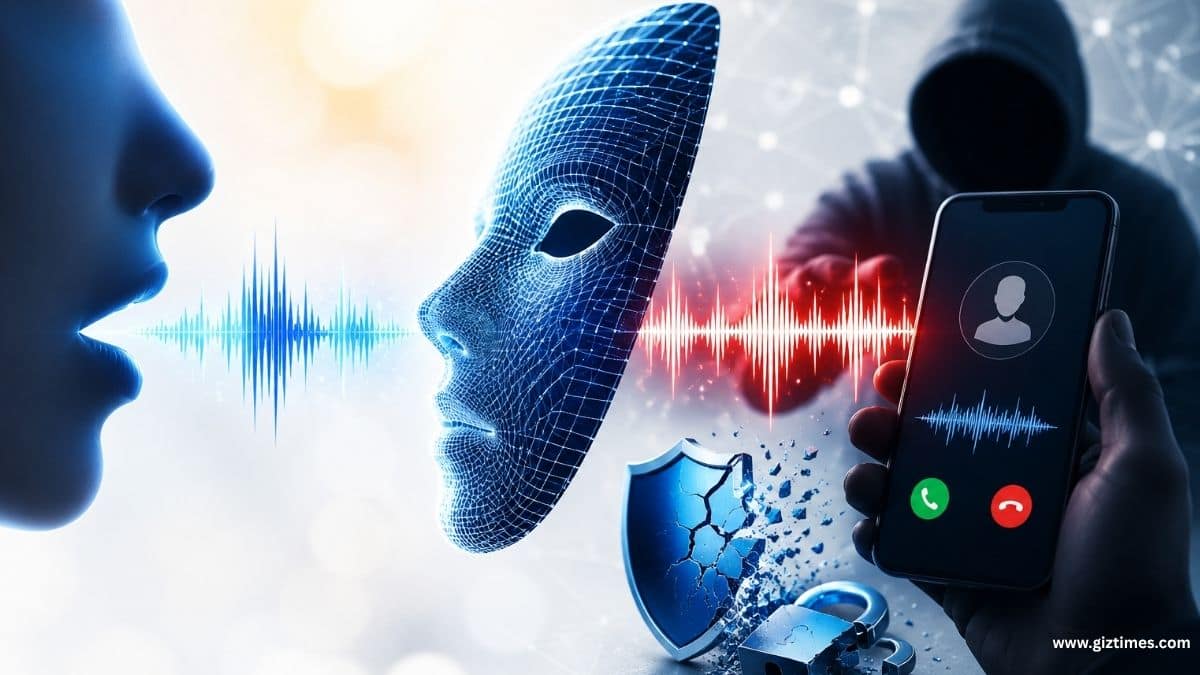
ANUPPUR, India (GizTimes) —Voice has traditionally been the cornerstone of trust when contacting friends or co-workers over the phone. In recent decades, a phone call from a loved one or a superior conveyed the implied guarantee of authenticity. Today, that trust has been severely compromised.
The introduction of generative AI and neural voice cloning technologies makes it easier than ever to engage in fraudulent activity. Where in previous years, a scam call required special skill sets and extensive preparation, today it requires a fraction of a second of audio and access to the relevant tools. As the report shows, only three seconds of audio are required to produce an exact voice clone that matches with 85% accuracy.
It is not just a new approach to scamming that we are looking at here. AI fraud threatens to make trusting voice a thing of the past altogether.
Why there is increase in number of Fraud
Two factors are driving this phenomenon.
Firstly, the current state of voice cloning technology allows for producing highly accurate voice clones based on minuscule amounts of audio. On the flip side, obtaining the necessary amount of audio is now much easier than before due to the abundance of publicly available sources. As it turns out, more than 53% of all adult internet users leave their voice in the public sphere at least once weekly via a variety of social media interactions, video posts, webinars, podcasts, and other means of voice communication.
The low price point and availability are not the only factors that play into making this kind of fraudulent practice easier than ever before. The majority of AI technologies involved do not require any technical knowledge and are completely anonymous. They can be applied at any time without leaving any traces and without any costs incurred in the process.
In effect, we are dealing with an entirely new paradigm when it comes to voice-based scamming.
Traditionally, such activity was associated with high labor costs and required a great deal of preparation and skill on the part of the attacker. AI voice cloning removes all those barriers to entry, creating entirely new possibilities for fraudsters.
Comparison between Traditional Voice Fraud & AI Voice Fraud
One could argue that the primary difference between old and new voice-based scams is the technological advancement used in their implementation.
| Metric | Traditional Vishing (2020–2022) | AI-Enhanced Vishing (2023–2026) |
|---|---|---|
| Core Technology | Human operators, robocalls, caller ID spoofing | Generative AI, neural voice cloning, automated voice bots |
| Audio Requirement | No target audio required | 3 seconds of audio creates an 85% accurate clone |
| Operational Cost | Labor intensive and limited by humans | Near-zero cost and highly automated |
| Targeting Model | Generic mass outreach | Highly personalized targeting |
| Victim Encounter Rate | 59% of Americans received generic scam calls in 2021 | 1 in 4 adults globally encountered AI voice scams in 2025 |
| Success Rate | Approximately 2% compliance in standard phone simulations | 77% of AI voice clone targets reported losing money |
| Fraud Growth | 50% increase in losses from 2020 to 2021 | 1210% increase in AI fraud during 2025 |
| Financial Losses | Average loss of $502 per victim | Individual losses ranging from $500 to $15,000 |
| Future Outlook | Growth limited by human operators | Projected $40 billion in AI scam losses by 2027 |
However, a less obvious yet more interesting observation one can make is that the fundamental logic of such attacks has changed as well.
In the previous paradigm, the core of any successful attack lay in maximum outreach since there was very little hope of persuading a single person. As it turns out, in today’s paradigm, a high success rate is achieved by creating credible scenarios that allow the scammer to interact directly with the victim, rather than trying to reach out to as many people as possible.
Public Reaction on Ongoing AI Voice Fraud
Analysis of public opinions shows that while people become aware of AI voice fraud techniques, their perception of familiar voice as a trustworthy source fades away.
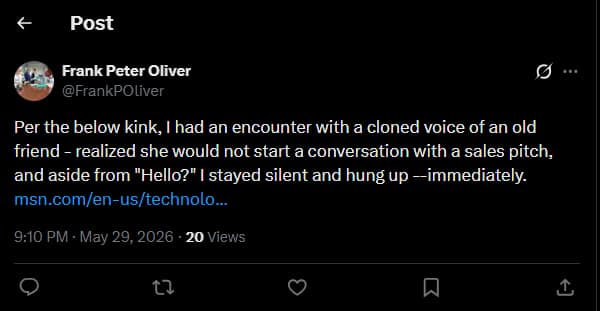
For example, one user told their story when he received a phone call pretending to be an old friend. The reason why the person avoided becoming a victim was the behavioral inconsistency that the scammer demonstrated.
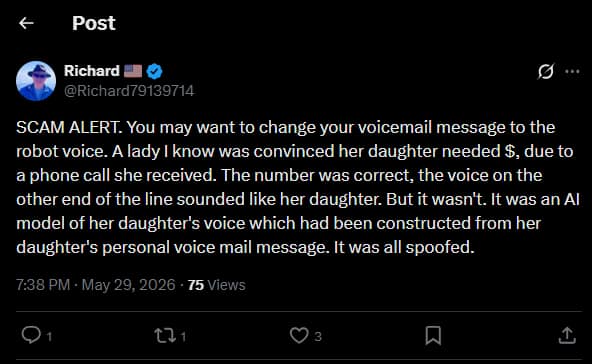
Similarly, a recent case in which the mother was tricked into sending money to the scammer due to the identical sound of the voice of the caller. Apparently, she thought her daughter was calling to ask for help. The scammer cloned the voice of the daughter using a recorded voicemail message.
Finally, a third person called voice-based attack the most sophisticated telephone-based social engineering scam. In their opinion, the use of AI is highly likely in the particular case.
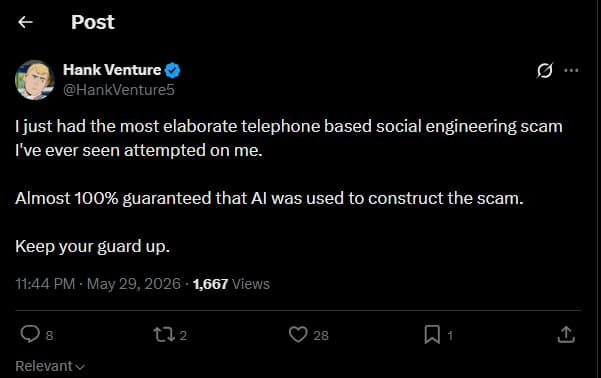
What can be seen from the above examples is that in none of those cases, the victim focused on the voice quality. Rather, they judged the authenticity based on inconsistencies and the overall suspicious context of the situation.
That indicates a subconscious evolution of a natural ability of people to detect deceitful communication.
Why It is a Matter of Security
The sheer financial scale of the problem clearly shows that we are dealing with a serious cybersecurity challenge.
Based on the FTC reports for 2021 to 2024, losses incurred from different types of scams increased from $5.8 billion to $12.5 billion during this period of time. Moreover, the amount of scam-related complaints did not change significantly, which means that the rise in the losses stems from the improvement of techniques used by scammers.
Similar figures can be found in the FBI database. Thus, according to the Internet Crime Complaint Center data, Americans lost $16.6 billion to cyberattacks in 2024, with almost 83% of losses attributable to cyber-enabled scams. In addition, global scam losses are estimated at several hundred billion dollars, with specific AI-driven schemes projected to cause losses in excess of $40 billion by 2027.
Thus, the issue goes far beyond consumer scams. As companies continue to adopt more effective scamming strategies, enterprises find themselves vulnerable to corporate attacks based on AI voice cloning.
As one example, Arup Group reported that the company lost $25.6 million in total after one of its employees transferred a sum of that magnitude to what turned out to be a scam email address containing executives of the company that had been created using voice cloning technology.
FAQs for Prevention of Being a Victim of Voice Fraud by AI
- How could I be sure that the person calling me is actually who he/she claims to be?
I need not just to pay attention to the voice, but to double-check any calls that ask me to act quickly or disclose any information or pay any sum of money.
- Is it necessary for a family to have a secret verification code?
Yes, it is essential to develop some kind of a family passcode that will allow you to check each other in case of emergency situations.
- How can I decrease the risk of having my voice cloned by some fraud?
It will be great to avoid posting videos or audios with my voice on any media because hackers and scammers could clone it using that information from the Internet.
- How should I behave when the caller creates the urgency?
It would be reasonable to ignore the call if it causes panic or urgency because such techniques are used frequently by AI scammers.
- Are businesses under the threat of AI frauds?
Yes, business organizations need to implement some multi-factor verification before executing any transaction or resetting passwords, even if those actions are ordered by company managers.
- Is it safe to use security questions and caller recognition for verification?
In this case, it is reasonable to implement more complicated verification methods since traditional ones are now easily bypassed by modern technologies.
- What should I do when I suspect myself in being a victim of voice fraud?
It is reasonable to avoid giving out any personal data or paying anything until checking the source of this information thoroughly.
Extra Insights
One of the consequences of the problem outlined above that should be considered is related to authentication practices.
For many years, businesses have recommended to their customers to use phones whenever they wanted to verify their identity. Now that AI-based solutions allow anyone to clone anyone’s voice, that practice no longer seems to be the safest option available.
Another interesting observation here is that in recent years, fraud-related activity has been shifting from human- to computer-generated calls. As the data shows, AI technology can now not only clone voices but even write and manage conversations with an automated response system, greatly improving scam efficiency.
Despite the advancements of technology, we are facing the problem of having to develop new methods of authentication in light of voice cloning.
