


ANUPPUR, India (GizTimes) — What made the initial enterprise promise of AI so compelling? Deploy models, automate cognitive labor, alleviate workforce pressures, and enable huge productivity gains. In 2026, however, that promise will increasingly be met by deployment realities, enterprise spending trends, and executive feedback. A new pattern emerges: AI adoption growth coincides with weak returns.
Enterprises are not walking away from AI. The question is whether the AI deployment economics currently support the levels of investment. It marks an important shift. The conversation moves from “How quickly can we adopt AI?” to “Which AI deployments yield a return?“
As a result, enterprises are facing a bottleneck, albeit not in model capabilities alone. The bottleneck lies in converting AI capability into business value – which is getting increasingly expensive.
Why This Is Happening
Adoption rates have soared for enterprise AI. Almost 88% of companies deploy AI in at least one department. However, only 39% can quantify an EBIT impact and 5% have generated transformational value.
It reveals a key misconception that adoption was equated with value creation.
Deployment costs are also higher than anticipated. Preparation of data alone represents 30–50% of the budget, which often exceeds the cost of the software itself. AI expertise, compliance, infrastructure, maintenance, and governance create new layers of expenses.
Scaling is even more costly. While early pilots may involve AI usage subsidized with low pricing, production-level deployment makes things different. Ongoing usage of AI involves continuous inference for each worker, generating repeated token payments that stack up exponentially.
The effect was seen inside large organizations:
Microsoft reportedly redeployed its engineers off the Claude AI platform due to concerns about the token costs against productivity gains. Uber found it had spent its entire yearlong AI budget in just five months as a result of expanded tool availability, prompting executives to wonder if the correlation between AI usage and delivering useful functionality exists.
The less obvious takeaway is that AI may create a new category of expenditures: variable cognitive infrastructure cost. Unlike software licenses where you pay once regardless of usage, AI fees scale with utilization.
The more employees use AI, the higher the cost of AI adoption could become.
Mental Friction Reality
The expectation was reduced friction. Reality often shows friction redistribution.
AI frequently shifts work instead of eliminating it.
A documented example appears in software development. Junior developers generate code faster using AI, but senior engineers spend more time validating outputs, reviewing logic, and identifying hidden vulnerabilities. Initial speed gains are offset by expensive verification work.
Mental Friction Score increases when users must:
- Verify outputs repeatedly
- Manage hallucination risk
- Interpret AI-generated work lacking contextual understanding
- Monitor token consumption
- Rework AI outputs before deployment
Higher output volume does not guarantee lower cognitive load.
Organizations may therefore observe an unusual paradox: employees appear faster while workflows become harder to trust.
The productivity bottleneck becomes confidence, not generation speed.
Comparison Between Expected Result and Real Result
The core mismatch is between expected economic outcomes and observed deployment realities.
| Dimension | Expected Result From AI Adoption | Real Result Observed |
|---|---|---|
| Productivity | 10X productivity gains | Gains highly context-dependent; often offset by verification and rework |
| Operational Costs | Lower costs than human labor | Rising token costs and deployment expenses; some suggest competent employees may be cheaper in certain cases |
| ROI | Rapid measurable returns | 72% report break-even or negative ROI |
| Revenue Impact | Higher revenue growth | 56% of CEOs report no revenue increase or cost reduction |
| Enterprise Adoption | Broad adoption would equal value creation | 88% adoption, only 39% measurable EBIT impact |
| Project Success | Most pilots scale into production | 42% abandon most AI initiatives before production |
| Labor Impact | Immediate workforce reduction | Jobs more likely to be reshaped than replaced |
| AI Costs | Stable software expenditure | Enterprise AI spending rising despite falling token prices due to volume growth |
Public Reaction on AI Reality Check In 2026
The reactions reveal an emerging divide in how AI value is perceived.
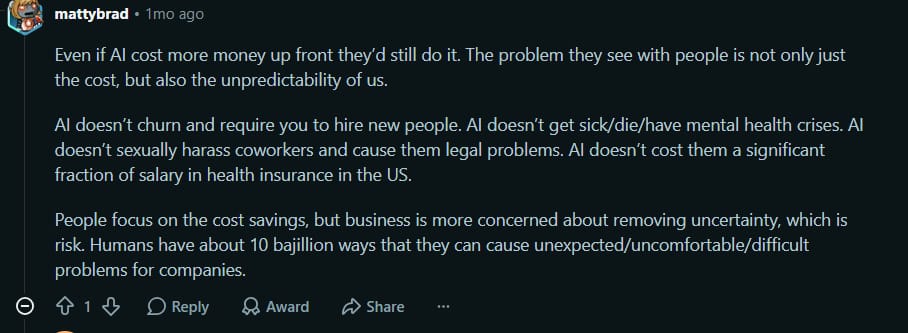
One group views AI less as a cost-saving tool and more as a risk-management system. Their argument is that AI removes human unpredictability: turnover, health issues, interpersonal conflict, and operational inconsistency. In this interpretation, AI’s value is stability rather than productivity.
The second group focuses on trust degradation. Senior developers report becoming reviewers of AI output instead of builders. Work accelerates at lower levels but slows at approval layers. The result resembles bureaucratic expansion rather than automation.
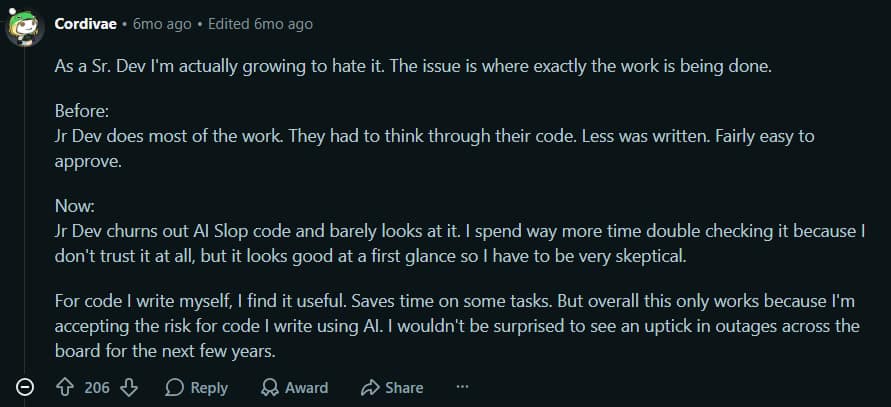
The third pattern is skepticism toward speed itself. Faster output loses value when users need to validate information twice.

Together these reactions suggest something larger: enterprises may have underestimated verification labor. AI does not simply automate work; it can generate new categories of supervision work.
Why It Is a Concern For AI Companies
The biggest risk to the AI economy is not weak models.
It is weak monetization relative to infrastructure spending.
Industry estimates suggest hyperscalers are investing hundreds of billions into AI infrastructure while ecosystem revenue generation remains far below required levels, creating a structural deficit between spending and realized value.
If enterprises continue deploying AI without proving business outcomes, pressure will intensify around pricing models, procurement scrutiny, and project cancellation rates.
The next competitive advantage may belong less to companies using the most AI and more to those identifying where AI should not be used.
Extra Insights
The organizations succeeding with AI share a pattern. They focus narrowly on a few high-value use cases, redesign workflows around AI, and invest heavily in people rather than models alone. High performers allocate roughly 70% of AI resources toward people and organizational processes.
That implies AI maturity may increasingly become an organizational discipline problem rather than a technology problem.
While AI continues expanding enterprise capability and adoption, the real challenge will be proving that increasing intelligence can produce sustainable economic value rather than compounding operational cost.
Read More:
