


ANUPPUR, India (GizTimes) —The latest update from Project Glasswing changes the conversation around AI in cybersecurity. The important development is not that AI models can discover software vulnerabilities. That capability already existed. The more significant shift lies in what happens after vulnerabilities are discovered. AI systems are increasingly taking part in verification, prioritization, patch generation, and security workflows that once depended on slow, manual coordination between teams.
Early results from Project Glasswing point to a broader transition: cybersecurity is beginning to move away from periodic, reactive reviews and toward continuous, AI-assisted defense cycles.The pressure point is no longer vulnerability discovery. It is everything that comes afterward.
Why This Shift Is Happening
Project Glasswing reports that roughly 50 partners collectively identified more than 10,000 high- or critical-severity vulnerabilities within a month using Claude Mythos Preview, with several organizations increasing bug discovery rates by over 10x.
The bottleneck has shifted.
Historically, security teams struggled to uncover vulnerabilities fast enough. Now AI accelerates that process so dramatically that verification, disclosure, and remediation become the limiting factors. Anthropic states this directly: software security progress is increasingly constrained by how quickly humans can verify and patch findings rather than discover them.
This pattern appears repeatedly in the data:
Cloudflare reportedly found 2,000 bugs with 400 categorized as high or critical severity. Mozilla discovered and fixed 271 Firefox vulnerabilities while testing Mythos Preview, over 10 times higher than earlier model performance. Palo Alto Networks increased patch volumes by more than 5x. Microsoft expects patch releases to continue growing.
The implication is larger than productivity gains. Vulnerability discovery is becoming abundant. Human attention remains scarce.
That changes cybersecurity economics.
Previously, finding a severe vulnerability was valuable because discovery was difficult. In an AI-driven environment, value migrates toward triage systems, exploit validation, prioritization, and automated remediation. OpenAI’s Daybreak architecture reflects the same assumption, emphasizing exploitability validation and patch testing instead of raw detection alone.
Mental Friction Reduced
Mental Friction Score measures how much human effort is required between problem detection and action.
Traditional cybersecurity: High friction.
Teams manually scan code, validate findings, rank severity, write reports, coordinate patches, deploy updates, and monitor impact.
Project Glasswing reduces friction in early stages but reveals new friction elsewhere.
The evidence is visible in open-source maintenance. Maintainers reported capacity constraints and even requested slower disclosure rates because they lacked bandwidth to process incoming findings. On average, high- or critical-severity bugs discovered by Mythos Preview require around two weeks to patch.
This creates a paradox.
Lower detection friction increases overall ecosystem friction if remediation capacity does not scale proportionally.
The non-obvious insight is that successful AI cybersecurity systems may eventually be judged less by how many vulnerabilities they discover and more by how effectively they compress the entire response loop:
Discovery → Validation → Prioritization → Patch Generation → Deployment → Monitoring
Whoever minimizes friction across this chain gains defensive advantage.
Project Glasswing’s significance lies in suggesting this transition has already started.
Comparison Between Project Glasswing and OpenAI Daybreak
Project Glasswing and OpenAI Daybreak approach the same emerging problem differently: how to operationalize AI-native cyber defense at scale.
| Dimension | Project Glasswing (Anthropic) | OpenAI Daybreak |
|---|---|---|
| Deployment philosophy | Restricted consortium model | Broader trusted access model |
| Discovery results | >10,000 high/critical vulnerabilities found by partners | GPT-5.4-Cyber contributed to >3,000 fixes before Daybreak |
| Workflow emphasis | Discovery, disclosure, patch acceleration | Threat modeling → validation → patch generation → regression testing |
| Open-source findings | Estimated 6,202 high/critical vulnerabilities from 1,000+ projects | Focus on enterprise repository workflows |
| Exploit generation benchmark | 157 successful exploits in ExploitGym | 120 successful exploits in ExploitGym |
| Strategic risk | Restricted access due to safeguard concerns | Controlled tiered access through governance programs |
Both systems converge toward the same architecture: continuous AI-assisted security rather than episodic human review.
Public Reaction on Latest Update from Project Glasswing
The reactions expose a divide over what cybersecurity progress should mean.
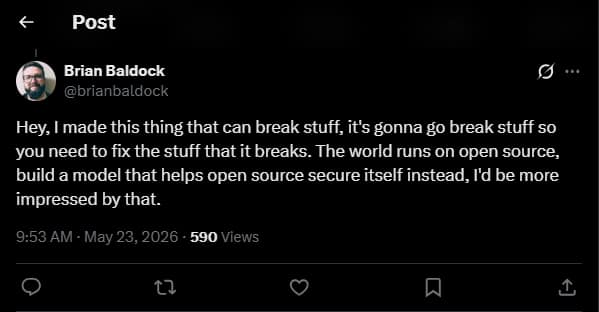
One perspective argues that discovering vulnerabilities faster is insufficient if open-source maintainers remain overloaded. This criticism aligns closely with Glasswing’s own acknowledgment that maintainers struggle with disclosure volume and patch capacity.
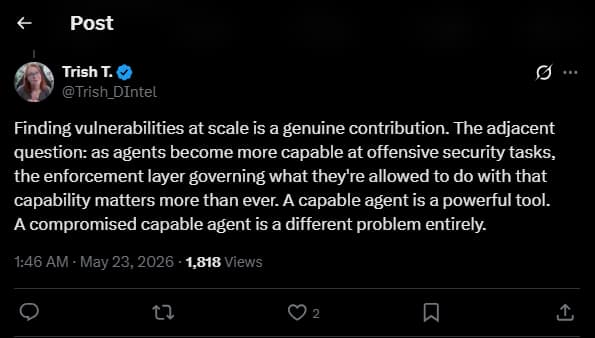
Another reaction highlights governance risk: powerful defensive agents become dangerous if compromised. This mirrors concerns surrounding controlled access to Mythos-class systems and OpenAI’s multi-tier governance structures.
The third reaction may be the most important.
If AI floods teams with vulnerabilities, then triage becomes the scarce resource.
Interestingly, Glasswing’s data independently validates this concern. The steep drop between discovered vulnerabilities, verified findings, disclosures, and patches reflects increasing human effort requirements at each stage.
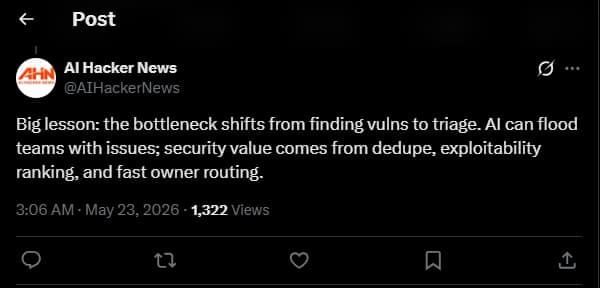
Public skepticism is not rejecting AI security. It is questioning whether AI has moved the bottleneck instead of eliminating it.
Why It Matters
The cybersecurity industry has spent decades optimizing detection.
Project Glasswing suggests the next competition will be response speed.
Organizations relying on quarterly audits, delayed patch cycles, or fragmented remediation pipelines may face structural disadvantages against systems capable of continuous scanning and increasingly autonomous patch generation. The historical 90-day vulnerability disclosure model also becomes harder to sustain if exploit generation accelerates faster than remediation.
This does not necessarily mean safer software immediately.
The transition period could increase risk because AI compresses offensive and defensive timelines simultaneously.
Extra Takeaways
A notable signal is emerging outside vulnerability detection itself: AI is beginning to assist in adjacent security operations. Project Glasswing cites an instance where Mythos Preview helped prevent a fraudulent $1.5 million wire transfer after account compromise and spoofed communications.
That suggests future cyber defense systems may expand beyond code security into broader operational risk monitoring.
The boundary between software security, fraud detection, and autonomous incident response could weaken over time.
While Project Glasswing demonstrates that AI can dramatically accelerate vulnerability discovery and defensive workflows, the real challenge will be preventing remediation capacity, governance systems, and human oversight from becoming the new weakest links.
