

ANUPPUR, India (GizTimes) — For a long time, the canonical pipeline architecture for AI systems has followed the standard pattern – gather the input data, pass it through an AI model and then add some form of moderation. OpenAI’s release of the open-weight Privacy Filter represents a fundamental paradigm shift for that flow.
The actual architecture of the model is fairly modest – 1.5B parameter bidirectional token-classification model with 50M active parameters during inference and a 128k-token context handling capacity – but its significance in terms of architectural positioning is greater than its performance.
Privacy Filters have been created specifically to detect and mask out potentially sensitive information prior to processing by other AI systems.
The reason it should matter more than any benchmark is the growing understanding of what prevents enterprises from using AI solutions extensively – and it turns out, the lack of ability to safely process proprietary data within existing privacy constraints is often the critical bottleneck.
Tonic.ai 2026 enterprise survey finds that 46.6% of organizations rank privacy/compliance as their main concern regarding AI, while 69.8% of respondents note that current privacy regulations inhibit their innovation capabilities.
The result is clear – the emergence of new architectures:
data → privacy/security layer → AI Model → Moderation
as opposed to:
data → AI Model → Moderation
Why There is a Rise of Pre-LLM Security
Big AI systems reached their commercial viability faster than the corresponding enterprise privacy infrastructure did. The result was an emerging asymmetry which has become increasingly dangerous over time.
Modern LLMs are able to memorize and reconstruct sensitive information from datasets, and perform membership attacks with a stunning 97% success rate. Even the gradients in federated learning scenarios have been leveraged to rebuild original images.
All this changes the privacy threat model dramatically. For decades, enterprises considered privacy a database management problem. Now, with the advent of LLMs, privacy became a question of model behavior after it ingested potentially sensitive training data and began producing context-rich output.
That is why the architecture of OpenAI Privacy Filter is important regardless of its performance – the model is built specifically to filter out sensitive information on the ingestion level and intercept data before any further training or inference takes place.
Design-wise, the model demonstrates the following optimization choices, supporting the above assertion:
- Context handling for 128k tokens without chunking
- Single-pass token classification
- Sparse Mixture of Experts architecture optimized for lightweight inference
- Ability to execute on-device, in browsers and laptops
It is clearly not optimized as a best-performance model. It is optimized as infrastructure.
And that is indicative of a larger trend unfolding in the industry – AI systems are no longer competing for the best reasoning and multimodal skills. Enterprises now care if they can use their proprietary data in their systems safely at all.
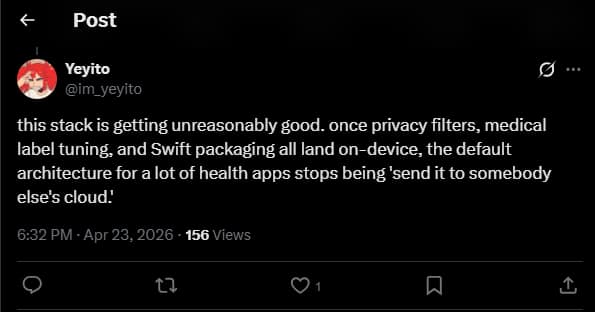
The evidence for that lies in the areas of healthcare applications and enterprise workloads. As a recent user comment put it:
“Once privacy filters, medical label tuning, and Swift packaging all land on-device, the default architecture for a lot of health apps stops being ‘send it to somebody else’s cloud’.”
Comparison between OpenAI Privacy Filter and Tonic.ai
In a way, the contrast between OpenAI Privacy Filter and Tonic.ai provides a great example of two contrasting approaches to building an effective enterprise-level privacy infrastructure.
While OpenAI focuses on lightweight, generalized privacy filters which can easily be integrated into AI systems, Tonic aims for a more robust infrastructure with specialized privacy detection mechanisms tailored to particular domains.
Comparing the two approaches, the most interesting insight that emerges from them is the fact that privacy infrastructure is less of a model benchmarking problem and more of an architectural decision.
| Feature | OpenAI Privacy Filter | Tonic Textual |
|---|---|---|
| Main Philosophy | Open weight privacy filter | Enterprise privacy stack |
| Core Focus | Generalized detection | Domain-specialized |
| Detection Classes | 8 categories | More than 26 entities |
| Architecture Goal | Lightweight inference | Full-stack orchestration |
| Design | On-device, browser, laptop | Enterprise pipeline integration |
| Approach | Redaction-only | Redaction+replacement |
| Core Optimization | Throughput and accessibility | Recall |
In other words, the design choices each approach makes show quite distinct architectural positions – OpenAI prioritizes the ability to run on the edge, while Tonic focuses on achieving maximal privacy compliance coverage.
What is even more telling is the benchmark results released by Tonic.ai in April 2026 showing quite weak recall of OpenAI’s Privacy Filter on particular enterprise datasets such as web crawl, EHR, legal, and ASR transcripts.
| Domain | OpenAI Privacy Filter Recall | Tonic Textual Recall |
|---|---|---|
| Web Crawl | 0.18 | 0.92+ |
| EHR Notes | ~0.38 – 0.65 | 0.95+ |
| Legal Documents | ~0.40 – 0.60 | 0.96+ |
| ASR Transcripts | ~0.30 – 0.50 | 0.94+ |
It may even seem like the design priorities for both solutions are different – while OpenAI’s privacy filter focuses on minimizing over-redaction, which is very important for maintaining the usefulness of downstream models, Tonic’s Privacy Filter aims for full privacy compliance recall at the cost of potentially aggressive masking.
That could be indicative of the emerging split in the AI market.
Public Reaction on OpenAI Privacy Filter
As it turns out, the public discourse around OpenAI Privacy Filter does not focus on it as a safety feature of AI systems. Rather, people see it as unlocking a new set of potential deployments.
Several comments mentioned the fact that due to 24–33 times MLX acceleration the model now makes HIPAA-compliant on-device AI usage possible. Another one pointed out the fact that many innovations in the healthcare sector have been hindered because the ethics committees and top clinicians do not trust centralized models.
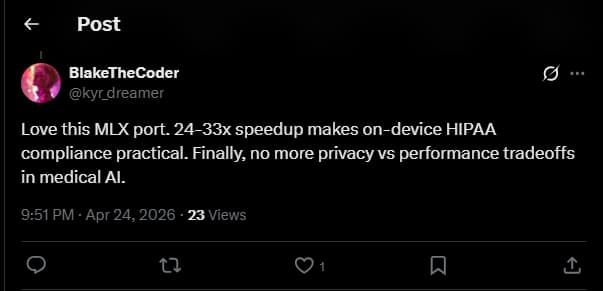
And here we can see the shift in the perspective – instead of seeing privacy tooling as a burden slowing down the product launch, people view it as an unlock feature making certain deployment options feasible.

Moreover, there is an implicit assumption that privacy filters are necessary for ensuring that sensitive data is not leaked, rather than that cloud systems are trusted and safe enough.
What this indicates is a move towards:
- On-device inference
- Edge-based preprocessing
- Federated learning
- Secure enclaves
- Privacy-first ingestion
The core emotion which dominates these reactions is not “AI became safer”.
The dominating emotion is “AI became deployable”.
Why This Shift in Industry Matters
The industry is reaching a point where access to proprietary corporate data becomes more important than internet-scale datasets.
In other words, enterprises already have all the data they need for running efficient AI, but current tools and practices often prevent them from using those datasets safely. Tonic.ai survey results indicate that 52.1% of organizations note that privacy issues regularly slow down AI development. Also, manual data redaction limits progress for 33.6% of organizations.
The result is another layer in the AI infrastructure stack – and it might turn out that it won’t be a mere model provider anymore.
OpenAI Privacy Filter release is significant precisely because it repositions privacy filtering as a crucial layer in AI systems, not an optional component. Multiple mentions in the architecture documents of smart checkpoints throughout the pipeline illustrate the emerging architectural paradigm.
At the same time, new legislation imposes increasing pressure on companies to adopt privacy-by-design architecture, and the following regulatory requirements emerge:
- GDPR Article 25: Data Protection by Design
- HIPAA – Protected Health Information
- India’s DPDP Act – Data Minimization and Safeguards Requirement
- Liability concerns for training data exposure
Practically, what this implies is that future evaluation criteria for enterprise AI solutions will include not the model capability alone, but:
- What data do they avoid ingesting
- How much info they keep off devices
- Pre-filtering layers before AI inference
and so forth.
Extra Takeaways
An often-overlooked aspect of this solution is the fact that OpenAI chose Apache 2.0 license for Privacy Filters.
This makes sense in light of the emerging trends – privacy infrastructure benefits much more from wide acceptance than closed source implementation.
Secondly, the fact that model is fairly small, only 50M active params during inference, and uses sparse MoE architecture indicates that OpenAI expects its privacy filter to become a ubiquitous element of inference stack.
And finally, the most implicit takeaway here – the companies may start competing not on having the biggest AI models, but the safest data pipelines.
While OpenAI’s Privacy Filter significantly advances the cause of privacy-preserving AI deployment, the key challenge will always remain to find a balance between strong security and preservation of contextual richness.
