

ANUPPUR, India (GizTimes) — DeepSeek-V4-Pro enters the frontier model space with a different proposition: not just matching top-tier reasoning, but doing it with significantly lower computational cost and radically larger context handling. In contrast, Claude Opus 4.6 represents a highly optimized, balanced system with strong performance across coding, reasoning, and agent workflows. The tension is clear—can DeepSeek deliver comparable or superior reasoning capability while redefining efficiency and usability for engineers?
Why DeepSeek-V4-Pro is Better
The key difference starts at the architectural level. Claude is built as a balanced, highly optimized system that performs strongly across coding, reasoning, and agent workflows. DeepSeek, on the other hand, uses a Mixture-of-Experts (MoE) design, where only 49B of its 1.6T parameters are active during inference, significantly reducing compute requirements.
Its hybrid attention system further cuts inference cost—lowering FLOPs by 27% and KV cache usage by up to 90%. This makes large-context processing far more practical, allowing DeepSeek to handle up to 1 million tokens in a single pass. That means entire repositories, research papers, or complex document pipelines can be processed without chunking.
Claude still stands out in benchmark performance, achieving around 80.8% on SWE-bench and 91.3% on GPQA, reflecting strong reasoning and coding ability at the frontier.
So the distinction isn’t just about capability—it’s about how efficiently that capability is delivered and how much context each model can realistically use.
Hallucination Horizon
Claude Opus 4.6 operates near the peak of current reasoning accuracy, but DeepSeek performs closely behind on many benchmarks. For instance, it reaches 90.1% on GPQA Diamond, just under Claude’s 91.3%, suggesting Claude still has a slight edge in highly complex scientific reasoning.
Where DeepSeek pulls ahead is in long-context consistency. Its performance on LongBench-V2 (51.5%) shows stronger reasoning across extended inputs, making it more reliable when dealing with large-scale data.
The takeaway is straightforward: Claude pushes the ceiling of reasoning precision, while DeepSeek expands how far that reasoning can stretch across massive contexts.
DeepSeek-V4-Pro Vs. Claude Opus 4.6
Both models operate at the frontier, but their strengths diverge in measurable ways.
| Capability Area | DeepSeek V4-Pro Max | Claude Opus 4.6 |
|---|---|---|
| MMLU-Pro | 87.5 | 89.1 |
| GPQA Diamond | 90.1 | 91.3 |
| LiveCodeBench | 93.5 | 88.8 |
| SWE-bench Verified | 80.6 | 80.8 |
| Terminal Bench 2.0 | 67.9 | 65.4 |
| MRCR (1M context) | 83.5 | 76% @ 1M |
| Context Length | 1M tokens | 1M tokens |
| Long-context efficiency | Reduced FLOPs (27%), KV cache (10%) | High reliability |
| Architecture | MoE (49B active) | Dense frontier model |
This comparison shows a pattern:
DeepSeek often matches or exceeds Opus in coding and long-context reasoning, while Opus maintains a slight advantage in pure scientific reasoning benchmarks.
Public Reaction on DeepSeek-V4-Pro Price
Reactions highlight a gap between technical performance and market perception.
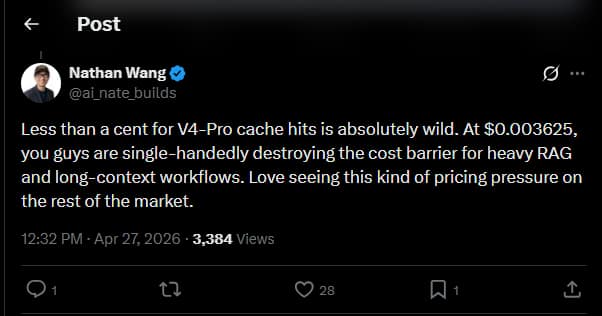
One major theme is skepticism around pricing. DeepSeek’s extremely low costs—sometimes fractions of a cent—raise questions about long-term sustainability and strategic intent.

Another theme is accessibility. Developers point out that lower costs and large context windows make advanced experimentation feasible for smaller teams, students, and startups. The focus shifts from beating every benchmark to achieving most tasks at a fraction of the price.
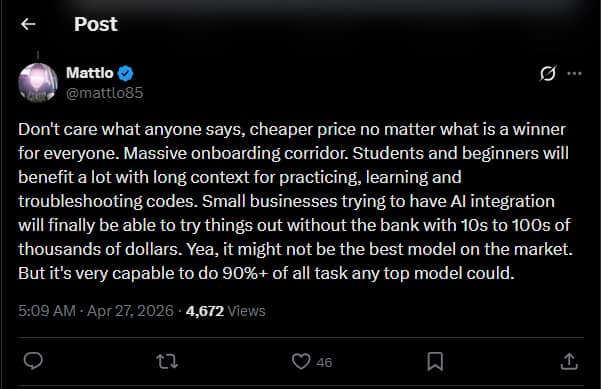
There’s also a clear link between cost and workflow innovation. Cheaper inference enables use cases like large-scale RAG systems and full-repository debugging—things that were previously limited by cost constraints.
The key tension: even if DeepSeek isn’t strictly better, it changes what “good enough” looks like in real-world applications.
Why It Matters
This represents a structural shift, not just a model upgrade.
DeepSeek reframes value around three factors: context size, cost efficiency, and scalable reasoning. For engineers, that translates to fewer limitations when working with large codebases or complex research tasks.
Claude, meanwhile, represents the peak of the current paradigm—high accuracy, reliability, and balanced performance.
DeepSeek challenges the assumption that top-tier reasoning must be expensive, introducing a new kind of competition: not just better models, but more affordable intelligence at scale.
Extra Takeaways
One subtle but important shift is how cost changes the usefulness of long context. A 1M-token window only matters if it’s affordable to use—and DeepSeek makes that practical.
Another is the distinction between total and active parameters. With only 49B active out of 1.6T, DeepSeek hints at a future where efficiency—not sheer size—defines model competitiveness.
DeepSeek V4-Pro pushes the boundaries of cost-efficient, large-scale reasoning—but the real test will be whether it can maintain reliability as efficiency begins to outpace precision.
