

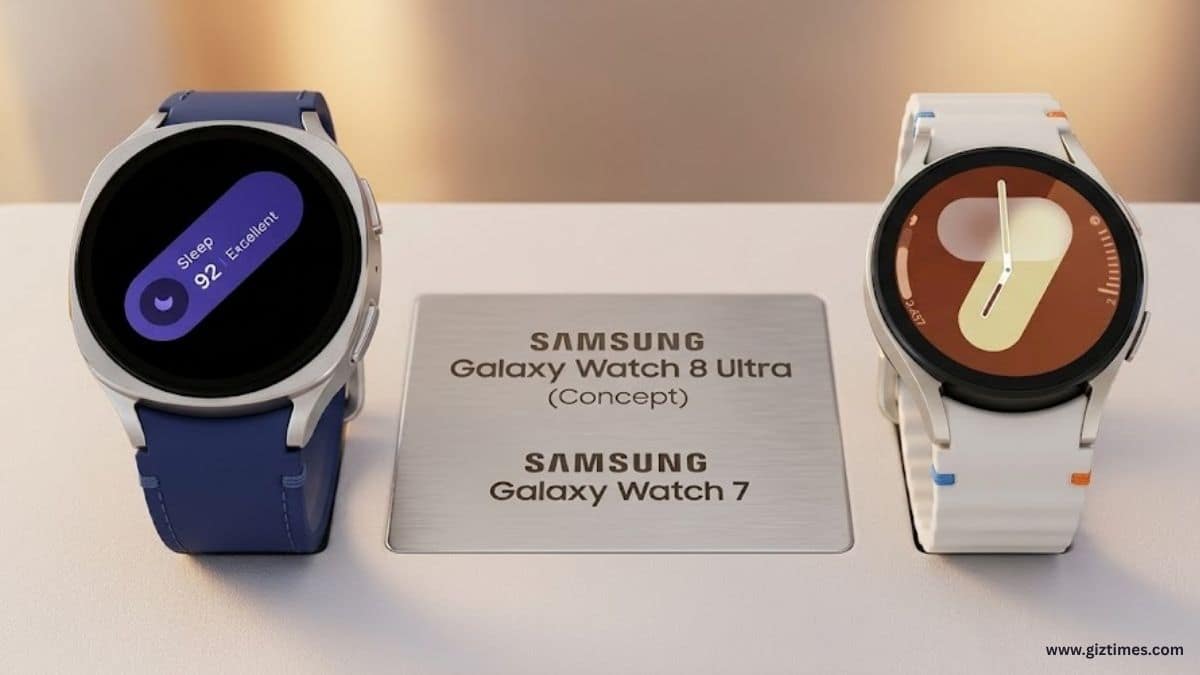
HYDERABAD, India (GizTimes) —The Samsung Galaxy Watch 8 comes in with two big headline features: a much brighter 3,000-nit display and Gemini AI built right into Wear OS 6. On paper, it sounds like a major leap forward, like a proper next-gen upgrade. In reality, it shares the exact same 3nm Exynos W1000 processor as the Samsung Galaxy Watch 7, which immediately raises a practical question: is this a real upgrade or just a refined version of the same experience with a ₹10,000 premium attached?
This comparison isn’t about specs. It’s about whether those differences change how you actually live with the watch.
Why This Product Exists
Samsung didn’t completely reinvent the Watch 8, and honestly, it didn’t have to. The Watch 7 had already nailed one of the toughest challenges: delivering smooth, reliable performance with its 3nm chip. Even in 2026, that foundation still feels fast enough for everything most people do scrolling through the UI, tracking workouts, or running apps in the background without hiccups.
So instead of chasing bigger performance numbers, the Watch 8 takes a more practical approach. It focuses on how people actually use a smartwatch day to day. The brighter 3,000-nit display, for example, isn’t just a spec upgrade; it makes a real difference when you’re out in the sun, whether you’re running, cycling, or checking directions.
Then there’s the addition of Gemini AI, which tries to make interacting with the watch feel more natural. Instead of tapping through layers of menus, you can just say what you want and get things done faster.
This kind of update reflects a product that’s reached a certain level of maturity. When the core performance is already “good enough,” improvements stop being about raw power and start being about making everyday use simpler and more intuitive.
Longevity Is Already Solved
Both watches run on the same Exynos W1000, a 3nm chip designed for efficiency and sustained responsiveness. That matters more than peak performance because wearables operate in a constant low-power, always-on state.
From a processor longevity standpoint, there is no meaningful difference between the two. Both devices are equally “future-proof” for the typical smartwatch lifecycle. App launches, health tracking, and UI navigation will feel nearly identical over time because they are driven by the same silicon architecture.
The only meaningful divergence is software timing. The Watch 8 ships with Wear OS 6 out of the box, while the Watch 7 reaches it via updates. In practice, this is a short-term advantage, not a long-term one. Once both are on the same software version, the experience converges again.
This creates a critical insight: the Watch 8 is not buying you more years of usability, it’s buying you earlier access to features you will eventually get anyway.
Comparison
At a hardware level, this is one of the rare cases where two generations are almost identical in core capability. The difference is not performance; it’s how and where the watch feels better.
| Aspect | Galaxy Watch 7 | Galaxy Watch 8 |
|---|---|---|
| Processor | Exynos W1000 (3nm) | Exynos W1000 (3nm) |
| Peak Brightness | 2,000 nits | 3,000 nits |
| Software at Launch | Wear OS 5 (updated to 6) | Wear OS 6 |
| AI Integration | Limited Galaxy AI features | Gemini AI with natural commands |
| Core Performance | Identical | Identical |
| Price Positioning | Lower (discounted in 2026) | ₹10,000 higher |
The takeaway is simple: the Watch 8 doesn’t outperform the Watch 7; it just extends usability into specific scenarios.
Public Reaction Analysis
User feedback consistently reinforces the idea that the Watch 8 feels like a refinement, not a leap.
One user describes the Watch 7 as “90% the same,” highlighting only minor differences in battery and niche features like the antioxidant sensor. That sensor itself becomes a pattern: technically advanced, but practically irrelevant unless you’re actively tracking your diet. This suggests Samsung is experimenting with future-facing health tech, but current utility remains limited.
Another user praises the Watch 8’s comfort and fast charging, but notes battery life closer to 1.5 days, again aligning closely with Watch 7 expectations. There’s no dramatic shift in endurance despite the newer model.
At the same time, a different perspective shows where the Watch 8 does matter: clinical use cases. ECG detection of atrial fibrillation is described as genuinely useful, even life-impacting. But here’s the contradiction: the Watch 7 already provides similar health infrastructure.
The pattern is clear:
- Casual users see minimal difference
- Power users notice incremental improvements
- Specialized users (health tracking) benefit, but not uniquely from the Watch 8
Why It Matters
This is where the buying decision becomes clearer.
If your usage is indoors, notification-driven, and fitness-focused, the Watch 7 delivers nearly identical value at a significantly lower price. The processor parity removes any concern about performance aging, and software updates close the feature gap over time.
The Watch 8 only starts to justify itself in two scenarios:
First, outdoor-heavy usage where 3,000 nits materially improves visibility. This is not a small upgrade it directly affects readability during runs or navigation under harsh sunlight.
Second, AI-driven workflows where voice commands and contextual actions replace manual interaction.
For everyone else, the extra cost doesn’t translate into a proportional lifestyle improvement.
Other Takeaways
There’s a subtle but important strategic signal here. Samsung is no longer using performance to differentiate generations; it’s using context. That means future upgrades will likely continue in this direction: more sensors, more AI, more situational advantages.
Another overlooked detail is LTE feedback. Users report significant battery drain up to 10% per hour, making LTE variants less practical for most people. This weakens one of the premium upsell points across both models.
The next major Wear OS and AI feature rollout will likely determine whether Samsung’s shift toward context-driven upgrades actually delivers real-world value or remains a premium-layer experiment.
