

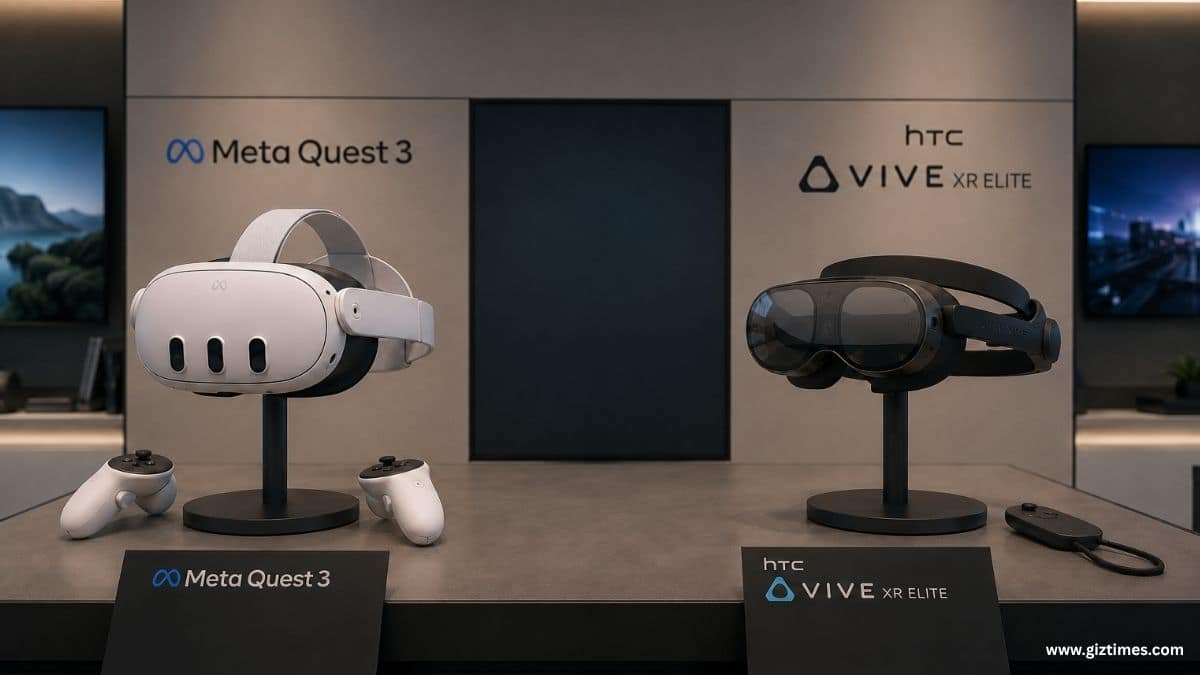
HYDERABAD, India (GizTimes) —The standalone VR market has quietly shifted from a display race into a silicon longevity battle. On paper, the HTC VIVE XR Elite looks like the more premium device. It launched at $1,099, offers a modular glasses-style design, includes hot-swappable batteries, and targets both enterprise and enthusiast users. The Meta Quest 3 entered the market at a much lower price point while focusing heavily on raw compute upgrades through Qualcomm’s Snapdragon XR2 Gen 2 platform.
That difference completely changes the long-term value equation. The XR Elite sells the idea of premium hardware flexibility. The Quest 3 sells architectural headroom. In spatial computing, the second one ages far better.
Why These Headsets Exist
The HTC VIVE XR Elite was clearly designed as a transitional product. HTC attempted to merge lightweight wearable mixed reality glasses with a full standalone VR headset. The detachable battery cradle, glasses-mode conversion, built-in diopter dials, and hot-swappable battery architecture all point toward portability and enterprise flexibility rather than raw rendering power.
The problem is that HTC paired this ambitious physical design with Qualcomm’s older Snapdragon XR2 Gen 1 processor. Even at launch, this chip was already approaching architectural maturity. By 2026, it now sits behind the newer XR2 Gen 2 platform used in the Quest 3, which delivers roughly double the GPU performance.
Meta approached the Quest 3 differently. Instead of chasing premium materials or modularity, the company invested aggressively in compute scaling, depth sensing, and mixed-reality infrastructure. The Quest 3 exists because Meta needed a platform capable of surviving an unusually long product cycle after the Quest 4 delay into late 2026 or 2027.
That decision matters more than the retail price.
A VR headset is not like a television, where hardware quality stays mostly static after purchase. Spatial computing platforms improve through software complexity. As games, MR environments, hand tracking, and scene reconstruction evolve, older silicon loses relevance extremely fast. The Quest 3 was built for that future workload. The XR Elite was built for physical versatility.
The Processor Gap Is the Entire Story
The Snapdragon XR2 Gen 2 inside the Quest 3 fundamentally changes the lifespan outlook of the headset. Meta’s platform delivers a 2.5× GPU compute increase over the previous Adreno 650-class graphics architecture and introduces significantly stronger AI acceleration.
HTC’s XR Elite still relies on the first-generation XR2 chip. That becomes increasingly problematic because standalone VR software is now finally moving beyond Quest 2-era optimization limits. Developers spent years targeting weaker hardware because of the massive Quest 2 install base. That bottleneck is now slowly breaking.
This creates a non-obvious but important market shift.
The Quest 3 is arriving exactly when developers are beginning to scale software upward again. The XR Elite arrived just before that transition started. So even though both headsets technically belong to the same generation of standalone VR products, their software aging curves are completely different.
That is the “premium mirage.”
The more expensive headset already sits near the ceiling of its standalone capability, while the cheaper one is only beginning to access software that fully utilizes its hardware.
Update Roadmap and Platform Stability
Meta’s ecosystem advantage is not only about software quantity. It is about updating continuity.
The Quest 3 has already transitioned from Android 12.1L toward Android 14-based Horizon OS infrastructure. Meta is actively evolving the operating system architecture, spatial APIs, passthrough frameworks, and MR tooling.
HTC’s XR Elite runs a customized Android environment centered around Viveport and VIVERSE. While functional, the ecosystem remains substantially smaller and more fragmented.
This matters because future headset usefulness increasingly depends on platform-level support rather than raw hardware survival. Spatial computing devices require ongoing optimization for tracking models, passthrough reconstruction, hand interactions, and wireless streaming stability. Meta is spending aggressively to maintain that infrastructure because Quest hardware is its primary consumer platform.
HTC’s enterprise focus changes its priorities. The company built an adaptable headset. Meta built a long-term software ecosystem.
That distinction heavily favors the Quest 3 for buyers trying to maximize usable lifespan per dollar.
Comparison
The comparison between these devices ultimately comes down to a simple tradeoff: modular engineering versus future-proof compute architecture. HTC delivers better physical flexibility and enterprise-oriented features, but Meta delivers the stronger technological runway at a significantly lower price point.
| Feature | HTC VIVE XR Elite | Meta Quest 3 |
|---|---|---|
| Retail Price (2026) | $900 | $600 |
| Launch Price | $1,099 | $499 |
| Processor | Snapdragon XR2 Gen 1 | Snapdragon XR2 Gen 2 |
| GPU Performance Position | Baseline XR2 | ~2× XR2 Gen 1 GPU power |
| RAM | 12 GB | 8 GB |
| Display Resolution | 1920×1920 per eye | 2064×2208 per eye |
| Lens System | Single-element pancake | Dual-element pancake |
| Refresh Rate | 90 Hz | 72–120 Hz |
| Weight | 625g / 273g glasses mode | 515g |
| Eye & Face Tracking | Optional $200 add-on | Not included |
| Battery Design | Hot-swappable | Internal battery |
| Mixed Reality Sensors | RGB camera + depth sensor | Dual RGB + active IR depth projector |
| Platform Focus | Enterprise + modular VR | Consumer spatial computing |
Public Reaction Analysis
The reactions surrounding the Quest 3 reveal something more important than simple satisfaction. Users are repeatedly describing the headset as a generational leap rather than an incremental upgrade.
One reaction specifically highlights the jump from Quest 2 to Quest 3 as “huge,” focusing on the smaller form factor, improved passthrough, and pancake lenses. Another directly recommends buying the headset, even after the price increase, for its standalone software ecosystem and wireless PCVR capabilities.

 What stands out is that users rarely justify the purchase through premium aesthetics or luxury positioning. They justify it through capability density. That is extremely important in VR because consumers increasingly understand that platform strength matters more than isolated hardware features.
Interestingly, the reactions also indirectly expose HTC’s problem. Nobody talks about modularity or detachable battery systems as defining purchase reasons anymore. The conversation has shifted toward software ecosystems, passthrough quality, and compute longevity. HTC optimized for a category priority that the market is slowly moving away from.
Why It Matters
The Quest 3 changes the buying logic of premium VR hardware.
Traditionally, consumers associated higher pricing with better future-proofing. The XR Elite breaks that assumption. Despite costing substantially more, its older processor architecture creates a shorter standalone relevance window. That makes the Quest 3 one of the rare cases where the cheaper device is also the safer long-term investment.For budget-conscious buyers, the recommendation becomes straightforward:
If the primary goals are long-term standalone VR gaming, support for mixed reality software, and future application compatibility, the Quest 3 is the smarter purchase, even after its 2026 price increase.
The XR Elite still makes sense for a narrower audience prioritizing lightweight ergonomics, enterprise workflows, or high-end wireless PCVR streaming flexibility. But those are specialized priorities, not mainstream value advantages.
Other Takeaways
The most revealing detail in this comparison is that HTC had to bundle ergonomic correction accessories through the Deluxe Pack after launch.
That suggests the company initially over-prioritized compactness and modularity at the expense of baseline comfort and stability. Meta, meanwhile, focused less on experimentation and more on scaling a reliable consumer platform.
Another subtle advantage for the Quest 3 is developer momentum. Since Quest software dominates the standalone VR ecosystem, developers naturally optimize there first. That creates a compounding effect where stronger hardware attracts better software, which then extends hardware relevance even further.
The upcoming Quest 4 launch window will likely determine whether Meta’s compute-first strategy permanently reshapes consumer expectations around VR value.
