

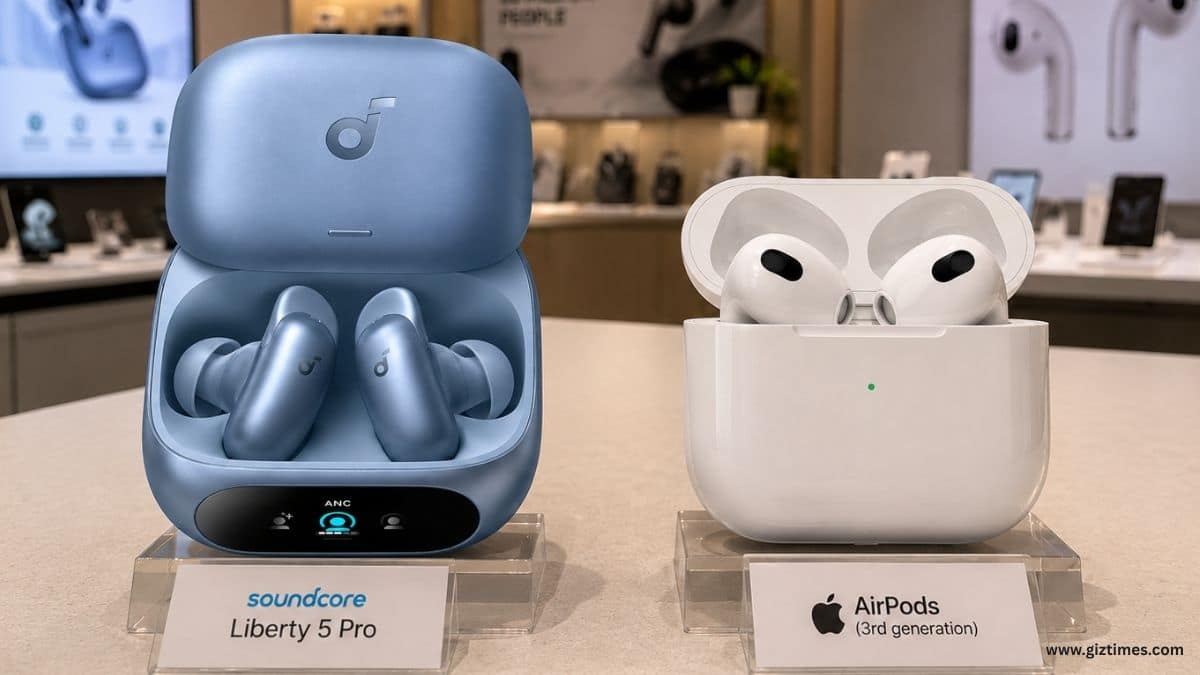
HYDERABAD, India (GizTimes) —The premium wireless earbud market is no longer just about sound quality. It has become a battle between ecosystem integration and feature saturation. Apple’s third-generation AirPods built their identity around seamless device switching, lightweight open-ear comfort, and computational audio deeply tied to iOS. Anker’s new Soundcore Liberty 5 Pro series takes the opposite route. Instead of simplifying the experience, it expands it aggressively with AI processing, adaptive ANC, integrated displays, transcription tools, translation systems, and enterprise-grade voice features.
What makes this comparison interesting is that these products are solving entirely different problems while targeting overlapping buyers. Apple treats earbuds as an extension of its ecosystem. Anker increasingly treats them like standalone computing devices.
The result is a larger question about long-term value. Does ecosystem cohesion still justify Apple’s premium positioning when competitors now offer denser hardware and software stacks at similar or lower prices?
Why This Product Exists
The AirPods 3 were designed to solve a very specific weakness in Apple’s lineup. Earlier AirPods were convenient but acoustically limited. Apple responded by redesigning the shell around a shorter stem and more contoured open-ear fit inspired by the AirPods Pro, while preserving the loose, silicone-free comfort that many users prefer for long listening sessions.
That design philosophy reveals Apple’s priorities immediately. The AirPods 3 are not built for isolation or feature experimentation. They are built to disappear into daily life. Adaptive EQ, automatic device switching, Personalized Spatial Audio, and tight iCloud integration all exist to reduce friction rather than increase control.
Anker’s Liberty 5 Pro series exists for the opposite reason. Instead of minimizing user interaction, Soundcore is maximizing capability density. The Liberty 5 Pro Max case alone behaves more like a miniature wearable computer than a charging dock, adding a 1.78-inch AMOLED screen, AI recording tools, local transcription, translation features, and enterprise security certifications.
This reflects a broader market shift. Premium audio brands are no longer competing only on tuning and ANC. They are trying to own productivity workflows, AI utilities, and communication tasks. Soundcore appears to understand that consumers increasingly judge earbuds the same way they judge smartphones: by software versatility and computational intelligence.
The non-obvious implication is that Soundcore is indirectly challenging Apple’s “it just works” philosophy by overwhelming it with optionality. Apple reduces decision fatigue. Anker embraces it.
Performance Longevity
Apple’s AirPods 3 rely on the H1 chip launched years earlier, paired with Bluetooth 5.0 and limited codec support through AAC and SBC. While Apple’s optimization remains excellent inside its own ecosystem, the platform is clearly aging. The absence of newer connectivity standards, UWB precision tracking, and modern adaptive wireless features places the AirPods 3 closer to maintenance mode than future-ready hardware.
The Liberty 5 Pro series feels architected for a much longer feature lifecycle. The THUS AI compute-in-memory chip processes neural workloads locally instead of relying heavily on cloud-side computation. That matters because it reduces dependency on smartphone hardware upgrades. Features like offline voice commands, adaptive ANC processing, AI sound enhancement, and real-time speech separation are handled directly on the earbuds themselves.
This creates an unusual advantage. Most earbuds become obsolete when the companion app support slows down, or phones evolve beyond them. Anker is trying to shift more intelligence onto the audio hardware itself, which potentially extends relevance longer than traditional accessory-focused designs.
Feature Set Depth
Apple’s feature strategy remains intentionally narrow. The AirPods 3 focus on convenience features like automatic switching, Audio Sharing, Spatial Audio, and skin-detect sensors. These features work exceptionally well inside Apple’s ecosystem but lose value outside it.
Anker’s approach is far broader. The Liberty 5 Pro lineup combines adaptive ANC processing, customizable DSP presets, AI transcription, translation across 100 languages, multipurpose smart cases, wake-word-free voice commands, customizable EQ systems, and enterprise-grade encrypted storage.
The interesting trade-off is cognitive load. Apple’s ecosystem hides complexity. Soundcore surfaces it. For power users, that flexibility becomes value. For casual listeners, it risks turning earbuds into another device requiring constant configuration.
Value Positioning
The Liberty 5 Pro launches at $169.99 while the Pro Max reaches $229.99. Apple launched the AirPods 3 at $179 and later introduced a stripped Lightning-only variant at $169.
On raw hardware density, Apple’s value proposition becomes difficult to defend objectively. The AirPods 3 lack ANC entirely, use older wireless standards, offer limited customization, and carry no advanced AI features or display integrations.
But Apple is not selling hardware density. It is selling frictionless continuity. The real premium is the ecosystem itself.
That distinction matters because the value equation changes depending on user behavior. Inside Apple’s ecosystem, AirPods 3 still feel cohesive. Outside it, their limitations become much harder to justify.
Comparison
The Liberty 5 Pro series and AirPods 3 represent two opposite interpretations of premium audio design. Apple prioritizes invisible integration and ergonomic simplicity. Anker prioritizes computational expansion and hardware versatility.
| Feature | Apple AirPods (3rd Gen) | Soundcore Liberty 5 Pro | Soundcore Liberty 5 Pro Max |
|---|---|---|---|
| Launch Price | $179 | $169.99 | $229.99 |
| Design Philosophy | Open-ear, unsealed comfort | Sealed ergonomic fit with fins | Same as Pro |
| ANC | No ANC | Adaptive ANC 4.0 | Adaptive ANC 4.0 |
| Chipset | Apple H1 | THUS AI Chip | THUS AI Chip |
| Connectivity | Bluetooth 5.0 | Bluetooth 6.1 | Bluetooth 6.1 |
| Audio Customization | Adaptive EQ | HearID 5.0, DSP presets | HearID 5.0, DSP presets |
| Translation Features | None | 100-language translation | 100-language translation |
| Smart Case | Standard charging case | TFT smart display | AMOLED smart display + recorder |
| Single-Charge Playback | Up to 6 Hours | Up to 6.5 Hours ANC On | Up to 6.5 Hours ANC On |
| Ecosystem Strength | Deep Apple integration | Cross-platform feature focus | Cross-platform productivity focus |
| Repairability | 0/10 iFixit | Information Missing | Information Missing |
Public Reaction Analysis
The public reactions surrounding the Liberty 5 Pro series reveal a growing divide in consumer expectations around premium audio. Some users are increasingly exhausted by AI-centric features, especially transcription systems that feel unnecessary for earbuds. One reaction explicitly argues that the AI functionality likely inflates pricing while solving problems already handled by smartphones. That frustration is less about the feature itself and more about perceived value allocation.


 At the same time, other reactions focus heavily on practical reliability rather than headline features. Questions around side-sleeping comfort, wind resistance, multipoint stability, transparency effectiveness, overnight battery endurance, and fit security suggest consumers still prioritize physical usability over AI expansion.
This creates an interesting contradiction. Brands are racing toward AI productivity ecosystems while buyers continue evaluating earbuds primarily through comfort, battery consistency, and stability under movement. The market conversation remains surprisingly grounded despite increasingly futuristic hardware.
The strongest insight here is that advanced features no longer guarantee excitement. They now create skepticism unless they directly improve daily usability.
Why It Matters
This comparison exposes a major transition in the premium earbud market. Apple’s strategy relies on ecosystem gravity. The more Apple devices a user owns, the stronger the AirPods experience becomes. Outside that environment, the hardware increasingly feels conservative.
Anker is betting on the opposite future. Instead of depending on ecosystem lock-in, it is trying to win through aggressive hardware and software accumulation.
That strategy has risks. Feature-heavy products can age poorly if software support weakens or if users stop engaging with advanced tools. But it also creates a stronger perception of ownership value because buyers can immediately see and use the added functionality.
The broader implication is that premium audio is shifting toward computational wearables. ANC quality alone is no longer enough. Earbuds are becoming communication hubs, productivity tools, and AI endpoints.
Other Takeaways
The Liberty 5 Pro’s shift from dual-driver systems to a single optimized dynamic driver is particularly revealing. Soundcore sacrificed specification complexity to free power and thermal headroom for its AI processing architecture.
Apple’s AirPods 3 reveal the opposite compromise. The unsealed architecture improves comfort but fundamentally limits passive isolation and bass consistency. Apple accepted acoustic limitations to preserve wearability. Both companies are making engineering trade-offs based on entirely different assumptions about what users value most.
The upcoming expansion of the next-generation AI audio ecosystem will likely determine whether feature-dense wearable computing succeeds or fails.
