

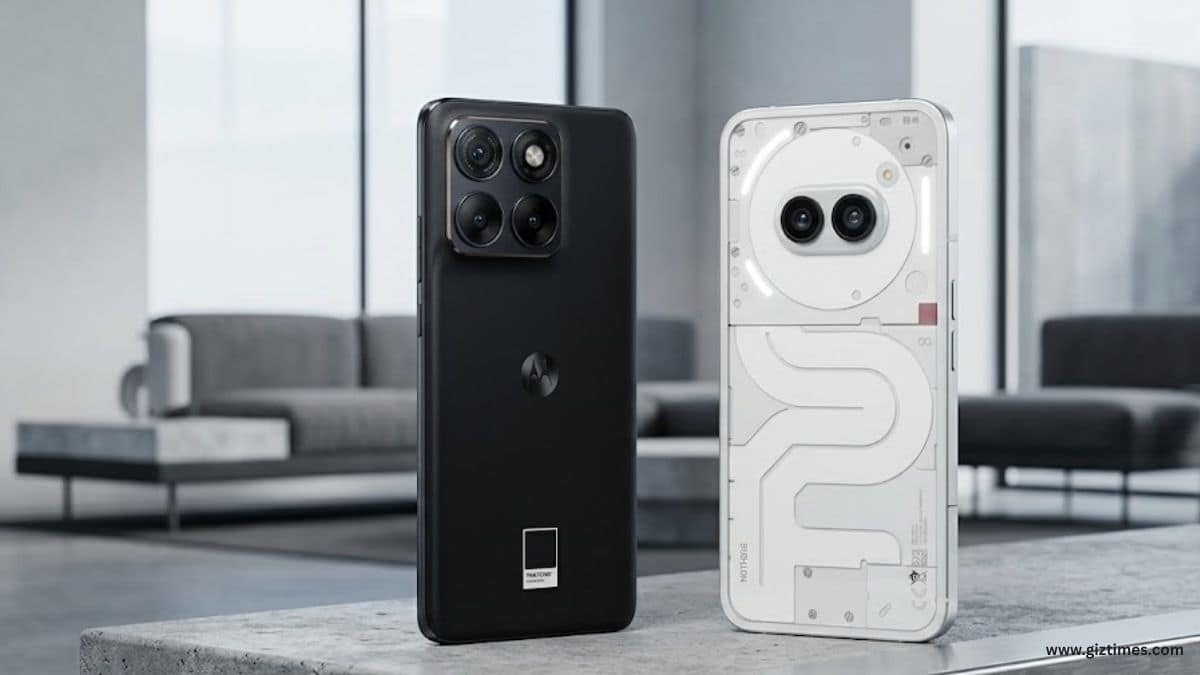
HYDERABAD, India (GizTimes) —For the last few years, Nothing built its mid-range identity around restraint. Clean software, intentional design, symmetrical hardware, and the absence of bloat became its biggest selling points in a segment overloaded with aggressive specifications and forgettable software experiences. The Nothing Phone (2a) succeeded because it felt curated instead of crowded.
The Motorola Edge 70 Fusion changes that equation. Instead of competing through software minimalism, Motorola attacks the problem physically: a 7000 mAh Silicon-Carbon battery inside a sub-8 mm chassis, a 5200-nit curved display, IP69 durability, and long-term software support that stretches to 2031.
The important shift here is not that Motorola has better specs. Mid-range phones have chased spec sheets for years. The shift is that Motorola is now packaging those specifications inside hardware that no longer feels compromised or bulky. That directly threatens the reason many buyers tolerated weaker hardware in exchange for Nothing’s cleaner ecosystem.
Why This Product Exists
The Nothing Phone (2a) was designed around behavioral experience. Its Glyph Interface, centered camera layout, symmetrical bezels, and monochrome software aesthetic all reinforce the idea that smartphones should feel calmer and more intentional.
That philosophy worked because most competing mid-range devices still carried obvious trade-offs. Bigger batteries meant thicker bodies. Curved displays often came with poor software polish. Aggressive hardware usually introduces thermal instability, bloatware, or inconsistent long-term usability.
Motorola’s Edge 70 Fusion exists specifically to erase those compromises. The phone is engineered to prove that endurance-focused hardware no longer requires a heavy, awkward chassis. The 7000 mAh Silicon-Carbon battery sits inside a 7.99 mm body weighing 193 grams, substantially lighter than several other large-battery competitors.
That matters because ergonomics is used to protect software-first devices like the Phone (2a). Buyers accepted smaller batteries or weaker hardware because the alternatives felt clunky. Motorola is attempting to remove that psychological compromise entirely.
Even the material choices reflect this strategy. The textured fabric-inspired rear panel improves grip and disguises fingerprints, while the quad-curved display pushes the phone visually closer to premium flagships. Meanwhile, Nothing still leans heavily on transparent polycarbonate aesthetics and the Glyph Interface to maintain visual differentiation.
The non-obvious implication is that Motorola is no longer competing on raw value alone. It is competing for emotional appeal territory that Nothing previously occupied, almost uncontested in this segment.
Processor Longevity and Battery Lifecycle
On paper, the Snapdragon 7s Gen 4 inside the Edge 70 Fusion is the clear performance advantage. Its AnTuTu score crosses 1.14 million, while the Dimensity 7200 Pro inside the Phone (2a) stays around the 684K–701K range.
The raw number gap matters less today than it will three years from now.
Right now, both phones comfortably handle social media, multitasking, streaming, and mainstream gaming. But long-term processor aging behaves differently in mid-range devices than in flagships. Once software updates become heavier and AI features become more integrated into Android workflows, storage and memory bandwidth begin affecting perceived speed more aggressively than launch-day benchmarks.
That is where the Phone (2a) starts showing age earlier.
Nothing still relies on LPDDR4X RAM and UFS 2.2 storage. Sequential read speeds are already substantially behind newer UFS 3.1 implementations. Initially, users may not notice this during casual usage. Over multiple Android generations, however, slower app installs, delayed background reloads, and heavier multitasking become harder to hide through software optimization alone.
Motorola’s use of LPDDR5X and UFS 3.1 gives the Edge 70 Fusion more breathing room for long-term responsiveness. Even if the Snapdragon 7s Gen 4 is not positioned as a gaming-focused processor, its newer memory architecture creates a stronger longevity foundation for daily usage.
Battery engineering creates an even larger separation.
Nothing’s 5000 mAh lithium-polymer cell remains efficient and well optimized, delivering roughly one-and-a-half to two days of mixed usage. The battery is also rated to retain 90% capacity after 1000 charge cycles, which is important for long-term health.
Motorola, however, changes the endurance conversation entirely with Silicon-Carbon chemistry.
The practical advantage is not merely “more battery life.” The larger capacity fundamentally changes charging behavior over a multi-year lifespan. Because the 7000 mAh cell requires fewer complete charge cycles for equivalent daily usage, battery degradation should progress more slowly in real-world conditions. Someone charging the Edge 70 Fusion every two days instead of daily effectively reduces long-term cycle stress.
That creates a subtle but important shift in ownership experience. Three years later, the Motorola may still feel dependable primarily because its battery reserve started so high.
Ironically, this makes Motorola’s hardware-heavy approach feel more sustainable in practice than Nothing’s minimalist philosophy.
Comparison
The difference between these phones is no longer “clean software versus cheap specs.” Both are now relatively refined products. The real decision is whether buyers value software elegance more than physical endurance and future-proofing.
| Category | Motorola Edge 70 Fusion | Nothing Phone (2a) |
|---|---|---|
| Processor | Snapdragon 7s Gen 4 (4nm) | Dimensity 7200 Pro (4nm) |
| Benchmark Performance | 1,149,292 AnTuTu | ~684K–701K AnTuTu |
| RAM & Storage | LPDDR5X + UFS 3.1 | LPDDR4X + UFS 2.2 |
| Battery | 7000 mAh Silicon-Carbon | 5000 mAh Li-Polymer |
| Charging | 68W wired | 45W wired |
| Thickness | 7.99 mm | 8.55 mm |
| Weight | 193 g | 190 g |
| Display | 6.78-inch 1.5K curved AMOLED, 5200 nits | 6.7-inch flexible AMOLED, 1300 nits peak |
| Refresh Rate | Up to 144Hz | Adaptive 30–120Hz |
| Durability | IP68 + IP69, MIL-STD-810H | IP54 |
| Software Commitment | 3 OS upgrades + 5 years security | 3 OS upgrades + 4 years security |
| Design Identity | Curved premium hardware aesthetic | Transparent Glyph-centered identity |
Public Reaction Analysis
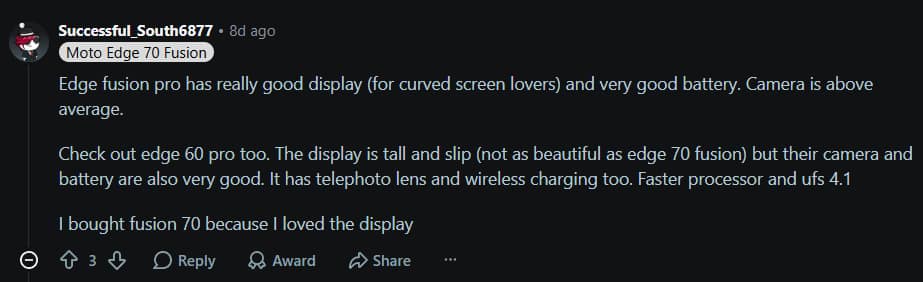
The reactions around the Edge 70 Fusion reveal something interesting: users are talking about the hardware emotionally rather than technically.
One user explicitly chose the Fusion because of the display, despite acknowledging better processors elsewhere in Motorola’s lineup. Another praised the durability after multiple accidental drops without scratches. At the same time, complaints around Wi-Fi instability show how fragile trust becomes when software reliability slips even slightly.


Nothing has built its reputation largely on consistency and software reliability. Motorola historically struggled in that exact area. If Motorola’s hardware ambition continues improving faster than its software reputation, it risks creating a strange split identity: phones that look premium and feel advanced, but occasionally undermine confidence through inconsistent optimization.
Meanwhile, Nothing’s public perception remains unusually stable because its expectations are narrower. Buyers already understand they are choosing refinement over maximum specifications. That creates less disappointment tolerance around Motorola because the company is now promising a more complete flagship-like experience.
The most revealing pattern is that users rarely discuss the Nothing Phone (2a) in terms of raw specifications. They discuss how it feels to live with. Motorola users increasingly discuss tangible hardware experiences — brightness, durability, battery endurance, charging behavior, curved displays.
That indicates the market itself is shifting away from software-centric differentiation toward physical utility again.
Why It Matters
The Edge 70 Fusion signals a dangerous moment for software-first mid-range brands.
For years, thoughtful software acted as compensation for weaker hardware compromises. Consumers accepted smaller batteries, slower charging, weaker durability, or older storage standards because the overall experience felt cleaner and calmer.
Motorola is now demonstrating that hardware-focused phones do not necessarily need to feel cheap, oversized, or chaotic anymore.
The 7000 mAh battery inside a relatively slim body is the real disruption here, not the benchmark score. It changes consumer expectations about what mid-range engineering should deliver physically.
That pressure nothing in a difficult way. Its identity depends heavily on design intentionality and software polish. But if competitors begin matching that polish while simultaneously delivering materially better endurance, brightness, durability, and charging flexibility, aesthetic differentiation alone becomes harder to sustain.
Nothing still wins in interface cohesion and visual identity. The Phone (2a) remains one of the few mid-range devices that feels deliberately designed rather than assembled from trend checklists.
But the hardware gap is no longer small enough to ignore.
Other Takeaways
Motorola’s inclusion of IP69 alongside MIL-STD-810H certification is unusually aggressive for this price segment and subtly pushes the device closer to “rugged premium” territory rather than traditional mid-range positioning.
Nothing’s sustainability narrative remains stronger and more coherent. The company’s use of recycled aluminum, recycled copper foil, and reduced manufacturing emissions gives the Phone (2a) a clearer environmental identity than most competitors in this category.
The Edge 70 Fusion also shows how rapidly display brightness inflation has accelerated across the industry. Moving from 1300 nits peak on the Phone (2a) to Motorola’s quoted 5200 nits fundamentally changes perceptions of outdoor usability, especially for HDR playback and sunlight readability.
The upcoming generation of software optimization and AI-assisted Android features will likely determine whether Nothing’s design-first philosophy can still compete against hardware-focused mid-range phones that no longer feel compromised.
Read More:
- How Personalized AI Voices Could Become OpenAI’s Next Competitive Layer After the Weights.gg Acquisition
- Claude Code vs ChatGPT Codex: Why Autonomous Execution Has Become the New Coding Benchmark
- Sony REON POCKET PRO Plus and RANVOO AICE 3: The Future of Invisible Cooling and Immersive Climate Wearables
