

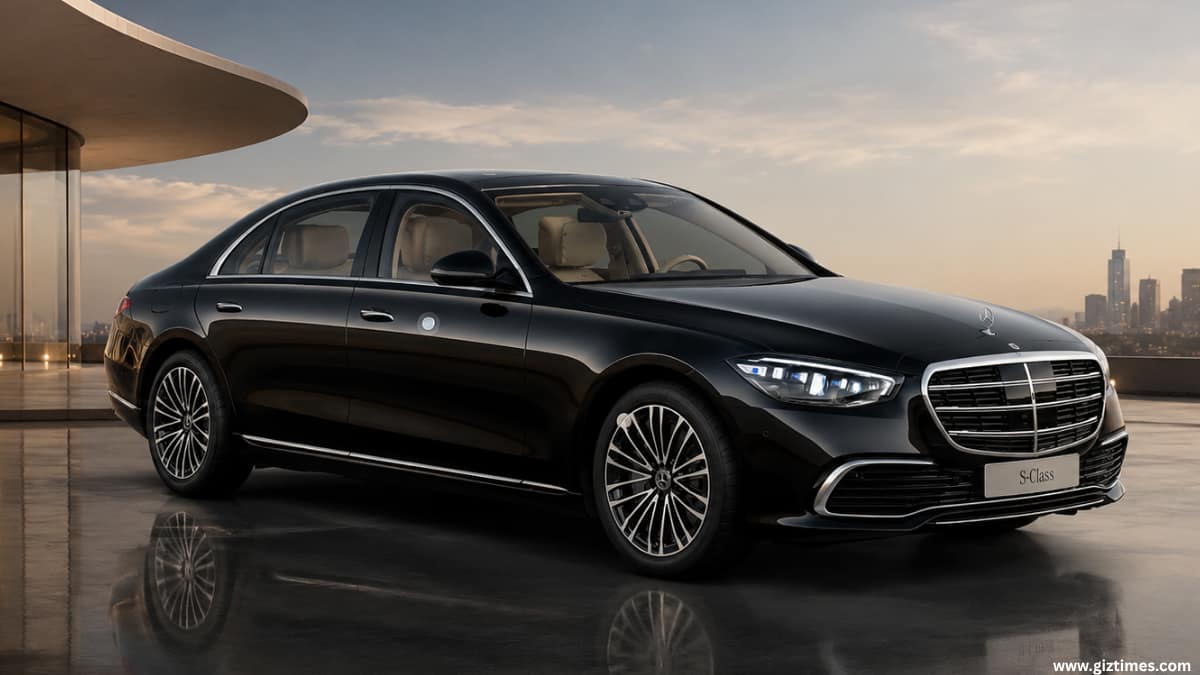
HYDERABAD, India (GizTimes) —The latest Mercedes-Benz S-Class continues to occupy a unique position in the Indian luxury sedan market. While many flagship vehicles now compete through horsepower, screen size, or electrification, Mercedes has maintained a different philosophy. The S-Class remains focused on delivering the most refined luxury experience possible, particularly for rear-seat occupants.
This approach places it directly against the BMW i7 M70 xDrive, BMW’s most powerful electric luxury sedan. On paper, the BMW dominates performance metrics. Yet the competition between these two cars is less about acceleration and more about what luxury buyers actually value when spending at the top end of the market.
The central question is simple: Does luxury mean maximum performance, or maximum comfort?
Why This Vehicle Exists
The S-Class exists because Mercedes views flagship luxury differently from many competitors. Instead of treating performance as the primary objective, the company has engineered the vehicle around passenger comfort, refinement, and long-distance usability.
The long-wheelbase configuration offered in India highlights this philosophy. Features such as electrically adjustable rear seats, massage functions, heating and ventilation systems, advanced climate control, and rear entertainment options transform the cabin into a workspace and relaxation environment rather than simply a means of transportation.
The powertrain strategy follows the same logic. Mercedes uses six-cylinder engines with mild-hybrid technology, with the integrated starter-generator improving efficiency and smoothness. The goal is not to deliver neck-snapping acceleration but to eliminate harshness, vibration, and unnecessary noise.
This is a deliberate engineering decision. For many executive buyers, a seamless journey matters more than outright speed.
Framework Integration: Where Luxury Meets Software-Defined Mobility
The S-Class demonstrates how modern luxury increasingly depends on software integration rather than mechanical specifications alone.
At the center of the experience is the second-generation MBUX system, combining an OLED touchscreen, digital instrumentation, augmented-reality navigation, voice control, biometric authentication, wireless smartphone connectivity, and over-the-air updates into a unified ecosystem.
What makes this significant is not the presence of individual technologies but their integration. Mercedes allows vehicle functions, entertainment, navigation, comfort settings, and personalization features to operate through a single digital architecture.
The biometric authentication system illustrates this shift particularly well. Instead of merely unlocking features, it enables personalized settings that follow the user throughout the vehicle experience. This transforms the car from a static machine into a responsive digital environment.
At the same time, Mercedes continues using the S-Class as its technology incubator. Many safety innovations that later become industry standards first appear in the S-Class. Adaptive cruise control, lane-keeping assistance, blind-spot monitoring, advanced braking systems, parking assistance, and an extensive sensor network collectively demonstrate how the vehicle operates as a development platform for future Mercedes products.
A less obvious insight emerges here. While the BMW i7 M70 represents the industry’s push toward electrification and performance, the S-Class focuses on reducing friction in everyday ownership. Mercedes appears to be optimizing the experience around the journey itself rather than around headline specifications. This may explain why the S-Class remains influential despite increasing competition from technologically advanced rivals.
Comparison
The S-Class and BMW i7 M70 target similar buyers but prioritize fundamentally different outcomes. BMW attempts to combine sports-car performance with limousine comfort. Mercedes concentrates on maximizing luxury, refinement, and passenger well-being.
| Category | Mercedes-Benz S-Class | BMW i7 M70 xDrive |
|---|---|---|
| Primary Focus | Luxury, comfort, refinement | Performance and luxury |
| Powertrain | Six-cylinder mild-hybrid powertrain | Dual-motor electric powertrain |
| Power Output | Not specified | Up to 660 hp |
| Torque | Not specified | Up to 1,100 Nm |
| 0–100 km/h | Not specified | Approximately 3.7 seconds |
| Drivetrain | Mild-hybrid configuration | All-wheel drive (xDrive) |
| Driving Range | Not specified | Up to approximately 560 km (WLTP) |
| Rear Seat Focus | Executive rear seating package, massage, ventilation, heating | Executive Lounge seating, rear entertainment |
| Infotainment | Second-generation MBUX with OLED display | BMW Operating System 8.5 with Curved Display |
| Navigation | Augmented reality navigation | Augmented reality navigation |
| Software Updates | Over-the-air updates | Over-the-air updates |
| Personalization | Biometric authentication | Digital Key Plus and connected services |
| Chassis Focus | Ride comfort and refinement | Dynamic handling and agility |
| Market Position | Traditional luxury benchmark | High-performance electric flagship |
The comparison reveals that BMW wins the measurable performance battle. Mercedes, however, focuses on qualities harder to quantify: ride quality, passenger comfort, cabin serenity, and overall refinement.
Public Reaction Analysis
The reactions reveal an interesting challenge facing Mercedes.
One criticism describes the vehicle as looking “generic,” while another targets the Hyperscreen-style digital design approach, arguing that competitors offer more visually unusual screen implementations.

These reactions suggest that some luxury buyers increasingly evaluate flagship vehicles through the lens of visible technology rather than classic luxury attributes. In an era where screens have become status symbols, refinement alone may not generate the same excitement it once did.
Yet these comments also expose a divide within the luxury market. One group values visual innovation and dramatic technology displays: another values comfort, craftsmanship, and understated refinement.

Mercedes appears to be betting that long-term luxury customers still prioritize the latter. The criticism therefore is not necessarily a rejection of the S-Class philosophy but evidence that luxury expectations are evolving.
Why It Matters
The S-Class remains noteworthy because it continues to shape the direction of premium luxury vehicles.
The automotive industry is rapidly moving toward software-defined vehicles, electrification, connected ecosystems, and advanced driver-assistance technologies. The S-Class demonstrates how these innovations can be integrated without sacrificing comfort and usability.
Its influence extends beyond Mercedes. Features introduced in the S-Class often appear across the wider industry years later. The vehicle, therefore, serves not only as a flagship product but also as a preview of future luxury-car development.
Against increasingly performance-oriented rivals, the S-Class also preserves an alternative vision of luxury, one centered on reducing stress, enhancing comfort, and improving the quality of travel.
Final Takeaways
The exceptionally low aerodynamic drag coefficient contributes to more than efficiency. Reduced wind noise directly supports the vehicle’s luxury mission by creating a quieter cabin environment.
The mild-hybrid system also reflects a practical transition strategy. Rather than pursuing outright electrification like the i7 M70, Mercedes uses electrified assistance to improve refinement while maintaining the familiar characteristics many traditional luxury buyers prefer.
The S-Class’s strongest competitive advantage may not be any single feature. It is the way comfort, safety, software, and refinement operate together as one cohesive system.
Much of the debate now centers on the balance between technological spectacle and genuine luxury, which could define the future direction of flagship premium sedans.
Read More:
- HP ZBook 8 G2a vs Lenovo ThinkPad P14s Gen 5: Why AI-First Workstations Are Replacing Traditional Mobile Powerhouses
- Unreal Engine 6 at Rocket League RLCS: Everything Announced, Why Epic Skipped UE5, and the Hardware Arms Race Ahead
- Galaxy Watch8 and Pixel Watch 4 Represent Two Completely Different Futures of Smartwatches
