

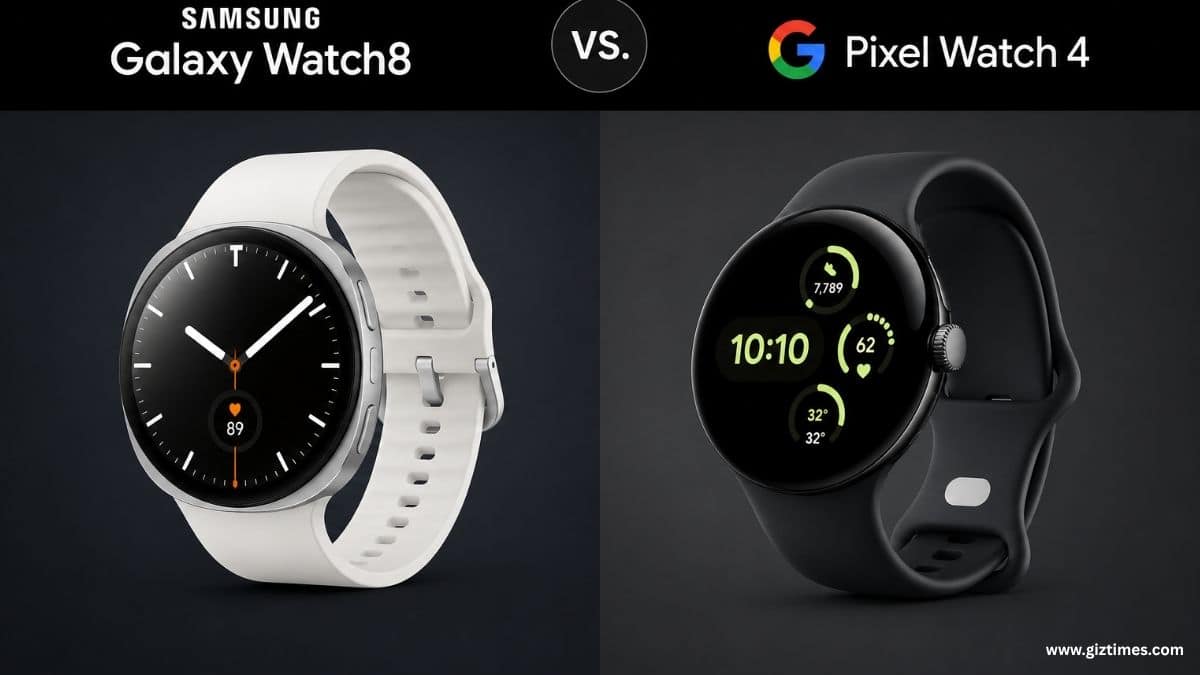
HYDERABAD, India (GizTimes) —The modern smartwatch market has quietly split into two completely different categories. One side is trying to become a continuous wellness laboratory for daily optimization. The other is evolving into an autonomous survival device that works when your phone, network, and even consciousness fail.
That divide is exactly what defines the battle between the Samsung Galaxy Watch8 and the Google Pixel Watch 4.
Samsung’s strategy revolves around long-term health behavior. The Galaxy Watch8 introduces the industry’s first smartwatch-based Antioxidant Index sensor, designed to measure carotenoid levels tied to oxidative stress and dietary quality. Google takes a radically different direction. The Pixel Watch 4 focuses on emergency readiness through standalone satellite SOS and FDA-approved Loss of Pulse Detection, capable of automatically contacting emergency services during catastrophic cardiovascular events.
These are not competing gimmicks. They represent two opposing visions of what wearable technology should prioritize.
What Samsung and Google Are Actually Building
Samsung built the Galaxy Watch8 around the idea that modern health problems are gradual, invisible, and behavioral. The company is trying to shift wearables away from reactive fitness tracking into preventative aging management. That explains why its biggest innovation is not a faster processor or brighter display, but a biochemical sensor that estimates antioxidant levels inside the body using multi-wavelength spectroscopy.
The practical goal is simple: make poor nutrition visible enough that users change their behavior before long-term damage accumulates.
Google approached the problem from the opposite direction. The Pixel Watch 4 is engineered around worst-case scenarios. Its satellite infrastructure, pulselessness detection system, and emergency escalation pipeline are all designed for moments where smartphones become useless.
That changes the entire value proposition of the device. The Pixel Watch 4 is less concerned with optimizing your week and more concerned with whether you survive a remote hiking accident, sudden cardiac arrest, or rural network dead zone.
The interesting part is that both companies are technically chasing “health,” but one treats health as daily maintenance while the other treats it as crisis mitigation.
Hardware Versatility and Ecosystem Integration
Samsung’s hardware versatility is centered on biological sensing complexity. The Galaxy Watch8’s BioActive sensor uses multiple wavelengths of light to isolate carotenoid absorption beneath the skin while compensating for melanin and blood-flow interference. That is significantly more specialized than conventional smartwatch telemetry.
The sensor itself is impressive, but the bigger story is how Samsung integrates it into a broader wellness loop. The Antioxidant Index connects with Vascular Load tracking, sleep metrics, ECG monitoring, SpO2 readings, and Samsung Health’s dietary guidance system.
This creates a highly interconnected health ecosystem where nutrition, cardiovascular stress, sleep quality, and recovery are interpreted together rather than separately.
Google’s hardware versatility is fundamentally telecommunications-oriented. The Pixel Watch 4 combines dual-frequency GPS, advanced satellite radio systems, emergency routing infrastructure, and continuous multi-stage cardiovascular verification algorithms.
Its ecosystem strategy also differs sharply from Samsung’s.
Samsung gives the most advanced health features without subscription fees. Google places some of its deeper AI coaching and analytical systems behind the Google Health Premium subscription.
That distinction matters because Samsung’s model feels more like an all-inclusive health platform, while Google’s ecosystem increasingly behaves like a service layer built around recurring AI personalization.
The Non-Obvious Difference: Behavioral Health vs Situational Safety
The biggest separation between these devices is not actually hardware. It is a psychological design.
Samsung’s watch constantly pressures users toward incremental lifestyle correction. The strictness of the Antioxidant Index is part of that strategy. Many users report unexpectedly low scores despite believing they eat well, which creates frustration but also forces repeated engagement with nutrition habits. The Galaxy Watch8 behaves almost like a persistent wellness coach that never fully validates you.
Google’s watch does the opposite. Most of its defining features remain invisible until disaster happens. Satellite SOS and Loss of Pulse Detection may never activate during the device’s lifespan, but their existence changes how secure the wearer feels in remote environments.
That means Samsung delivers visible daily utility, while Google sells invisible reassurance. One constantly modifies behavior. The other quietly reduces fear.
Comparison
Both watches represent the most advanced direction of Wear OS hardware, but they prioritize completely different kinds of intelligence.
Samsung invests heavily in preventative biometric interpretation and ecosystem cohesion. Google invests in autonomous emergency infrastructure and repairability. Neither approach is objectively superior without understanding the user’s actual lifestyle.
| Feature | Samsung Galaxy Watch8 | Google Pixel Watch 4 |
|---|---|---|
| Processor | Exynos W1000 (3nm) | Snapdragon W5 Gen 2 + Cortex M55 |
| Display Brightness | 3,000 nits | 3,000 nits |
| Unique Hardware Feature | Antioxidant Index Reader | Satellite SOS + Loss of Pulse Detection |
| Health Philosophy | Preventative wellness optimization | Emergency physiological intervention |
| Battery | 325mAh to 590mAh, depending on model | 325mAh (41mm) / 455mAh (45mm) |
| Repairability | Traditional sealed smartwatch design | iFixit 9/10 repairability |
| GPS | Dual-band L1 + L5 | Dual-frequency GNSS |
| AI Integration | Google Gemini via the Samsung ecosystem | Gemini is deeply integrated with Google Health |
| Subscription Dependency | Core health tools free | AI Health Coach behind subscription |
| Ecosystem Strength | Samsung Health integration | Fitbit + Google Health ecosystem |
| Emergency Satellite Connectivity | Not available | Built-in on LTE models |
| Durability Focus | Sapphire Crystal + MIL-STD durability | Gorilla Glass 5 with repair-focused architecture |
Public Reaction Analysis
The reactions around the Galaxy Watch lineup reveal an important contradiction.
Users consistently praise comfort, thinness, and software sophistication, but battery anxiety still dominates the ownership experience. One user described the device as technologically advanced while simultaneously warning that improper battery settings can prevent it from lasting a full day. Another praised the comfort and recharge speed while accepting roughly a day-and-a-half endurance as normal.
That tells you something critical about premium Android smartwatches in 2026: consumers are increasingly willing to tolerate charging friction if the software and health features feel meaningfully advanced.
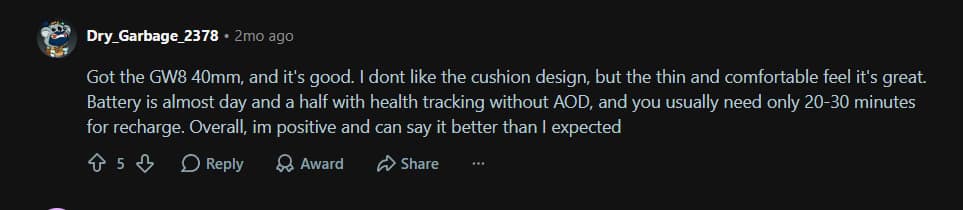
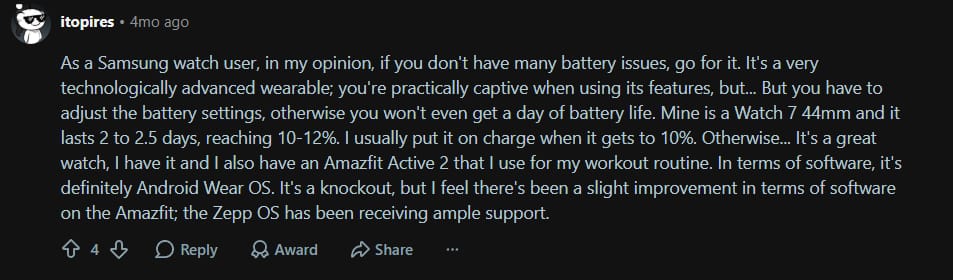
The comments also expose another market reality. Even satisfied Samsung users are comparing the experience against specialized fitness ecosystems like Amazfit’s Zepp OS during workouts. That suggests Wear OS watches are still perceived primarily as intelligent lifestyle devices first, dedicated athletic tools second.
Google faces a different challenge entirely.
The Pixel Watch 4’s safety-first features are technologically remarkable, but many users may never directly experience their value. A smartwatch that tracks your antioxidant intake produces daily feedback. A watch that might call emergency services during cardiac arrest operates on hypothetical trust.
That makes Samsung’s value easier to emotionally understand during everyday ownership, even if Google’s features are arguably more consequential in life-threatening situations.
The Shift in Smartwatch Priorities
These two watches reveal where the entire wearable industry is heading.
The Galaxy Watch8 suggests that future wearables will increasingly behave like preventative health companions capable of translating invisible biological processes into behavioral guidance. Samsung is effectively trying to normalize biochemical monitoring for ordinary consumers.
The Pixel Watch 4 points toward another future entirely, one where smartwatches become independent safety infrastructure capable of functioning without smartphones, cellular towers, or even user consciousness.
For buyers, the decision becomes surprisingly practical.
If your daily life revolves around stress management, nutrition tracking, sleep optimization, recovery monitoring, and long-term wellness awareness, the Galaxy Watch8 delivers more visible day-to-day value.
If you frequently travel alone, commute long distances, hike in remote areas, cycle in isolated areas, or simply prioritize emergency preparedness, the Pixel Watch 4 becomes a more important device.
Other Takeaways
Google’s decision to make the Pixel Watch 4 highly repairable may become more important than its satellite features over time. Most smartwatches are effectively disposable after battery degradation, but the Pixel Watch 4’s screw-based internal architecture radically extends usable lifespan.
Samsung’s strict Antioxidant Index scoring may initially frustrate users, but that harsh calibration likely prevents short-term “health gamification.” The system appears intentionally resistant to quick fixes.
There is also a regional limitation that changes the equation entirely in some markets. Pixel Watch 4 LTE and satellite functionality remain unavailable in regions like India, which significantly weakens its defining advantage there.
The upcoming expansion of wearable AI and satellite infrastructure will likely determine whether emergency-first smartwatches become mainstream necessities or remain niche survival tools.
Read More:
