

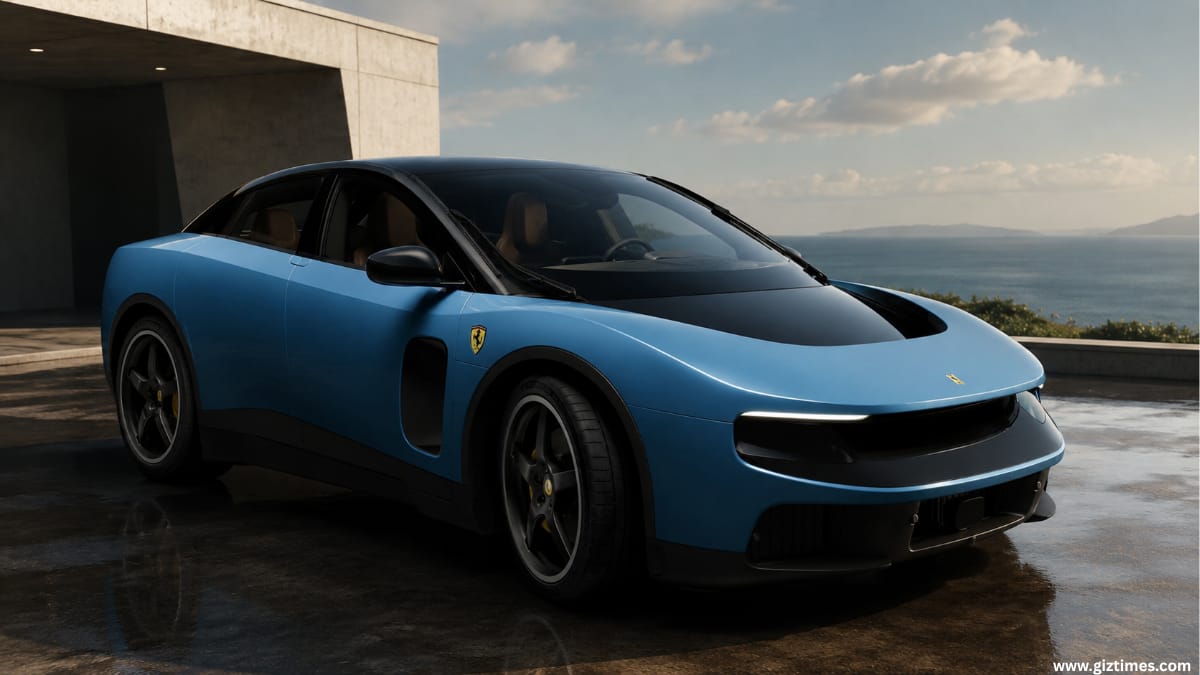
HYDERABAD, India (GizTimes) — The Ferrari Luce is one of the most important vehicles ever launched by Ferrari. As the brand’s first fully electric production car, it enters a segment that many traditional performance manufacturers have approached cautiously. Instead of adapting an existing model, Ferrari has created an entirely new four-door, five-seat grand tourer built on a dedicated EV platform.
What makes the Luce interesting is not simply its 1,035–1,050 hp output or its ability to reach 100 km/h in 2.5 seconds. The real challenge is whether Ferrari can translate decades of driver-focused, emotion-driven engineering into an electric vehicle without relying on the traditional V8 and V12 engines that have shaped its identity.
Why This Vehicle Exists
The Luce exists because Ferrari sees electrification as an evolution of its portfolio rather than a replacement strategy. While many EVs in the luxury segment prioritize either outright speed or sustainability, Ferrari is targeting customers who want performance, long-distance usability, and everyday practicality in a single package.
The decision to use a quad-motor all-wheel-drive system and a 122-kWh battery reflects this goal. One motor per wheel allows Ferrari to distribute power with greater accuracy while maintaining the performance expected from the brand. Combined with more than 530 km of range and 350 kW charging capability, the vehicle is designed to function both as a high-performance machine and a long-distance grand tourer.
A less obvious insight emerges from the specifications themselves. Ferrari did not make its first EV a low-volume two-seat halo supercar. Instead, it created its largest vehicle ever, with four doors, five seats, and the biggest luggage capacity in company history. This suggests Ferrari sees growth in expanding how customers use a Ferrari rather than simply making another faster sports car.
Framework Integration
The Luce combines a dedicated EV architecture with a technology philosophy that deliberately avoids extreme digital dependence.
From a vehicle architecture perspective, Ferrari’s dedicated electric platform enables the integration of four electric motors and a large battery pack while supporting the company’s lowest drag coefficient ever. The smooth shell-like surfaces and floating aerodynamic wings are not merely styling exercises; they contribute to efficiency and high-speed stability, both critical for an EV capable of exceeding 310 km/h.
The technology story becomes even more interesting inside the cabin. Many modern EVs have moved toward large touchscreen-centric interiors. Ferrari chose the opposite direction. The Luce uses OLED displays and a rotating center screen, but places equal importance on physical steering-wheel controls, machined aluminum switches, and dedicated buttons.
This approach aligns technology with usability rather than making technology the centerpiece. Ferrari’s decision suggests that reducing interaction complexity may become just as important as increasing computing power in future software-defined vehicles.
The proprietary sound system follows the same philosophy. Rather than simply generating artificial engine noise through speakers, Ferrari integrates mechanical audio elements from the electric drivetrain. The goal is not to imitate a combustion engine but to preserve driver engagement in an electric environment.
Comparison
Although both the Ferrari Luce and Porsche Taycan Turbo GT operate in the high-performance EV segment, they pursue different engineering priorities. Ferrari focuses on combining extreme performance with practicality and passenger accommodation, while Porsche emphasizes track capability, repeatable performance, and record-setting lap times.
| Specification | Ferrari Luce | Porsche Taycan Turbo GT |
|---|---|---|
| Power Output | 1,035–1,050 hp | Up to 1,034 PS |
| Drivetrain | Quad-Motor AWD | Dual-Motor AWD |
| Battery Capacity | 122 kWh | 105 kWh |
| 0–100 km/h | 2.5 sec | 2.3 sec (2.2 sec Weissach) |
| 0–200 km/h | 6.8 sec | 6.6 sec |
| Top Speed | Over 310 km/h | 290 km/h (305 km/h Weissach) |
| Range | More than 530 km | Up to 555 km WLTP / 605 km ECE |
| Charging | Up to 350 kW | 800V architecture, 10–80% in approximately 18 minutes |
| Seating | Five passengers | Rear seats removed in Weissach Package |
| Vehicle Concept | Four-door grand tourer | Track-focused performance sedan |
| Unique Feature | Ferrari acoustic engagement system | Formula E-inspired Attack Mode |
| Design Philosophy | Physical controls with digital integration | Motorsport-focused driving systems |
The comparison reveals that Ferrari is prioritizing versatility and customer expansion, while Porsche remains focused on maximizing track performance and chassis sophistication.
Public Reaction Analysis
Public reaction shows a frequent tension between innovation and heritage.
One theme centers on design identity. Some observers question why modern EVs increasingly adopt futuristic styling rather than evolving established design language. The criticism is not directed solely at Ferrari but reflects a broader concern across the industry. Buyers often associate brand authenticity with visual continuity, especially in performance vehicles.

Another pattern involves authorship and brand ownership. Concerns about LoveFrom’s involvement suggest that some enthusiasts believe Ferrari’s first EV should have emerged entirely from traditional internal design processes. Interestingly, the criticism is aimed less at technology and more at perceived cultural distance from Ferrari’s historical roots.

The reactions also reveal an important contradiction. While some commenters describe the design as surprising or unconventional, they simultaneously acknowledge visual references to older Ferraris. This suggests resistance may be driven less by the vehicle’s actual appearance and more by the fact that it represents Ferrari’s first electric chapter. Expectations surrounding the brand are shaping perceptions as much as the design itself.
Why It Matters
The Luce demonstrates a different path for luxury EV development.
Many electric vehicles compete through acceleration figures, screen size, or software features. Ferrari is attempting to compete through emotional engagement, tactile interaction, and brand-specific driving character. That distinction could influence how other performance manufacturers approach electrification.
The project also signals that software-defined vehicles do not necessarily require minimalist interiors dominated by touchscreens. Ferrari’s combination of digital displays and physical controls suggests a future where technology becomes more integrated into the driving experience rather than replacing it.
At the market level, the Luce expands Ferrari into a category that previously did not exist within its lineup. By targeting affluent families and long-distance users, Ferrari is broadening its customer base while maintaining a performance-focused identity.
Final Takeaways
The Luce introduces several historic firsts simultaneously: Ferrari’s first production EV, first four-door model, first five-seat Ferrari, first dedicated EV platform, first quad-motor Ferrari, and the first Ferrari developed with extensive involvement from Love From.
Another notable detail is that Ferrari’s largest vehicle ever is also the company’s most technologically transformative vehicle. This pairing suggests Ferrari views practicality and electrification as complementary rather than conflicting objectives.
Much of the discussion now centers on preserving Ferrari’s emotional identity in an electric world, which could define the success of Ferrari’s transition into the next era of performance mobility.
Read More:
- Mercedes-Benz S-Class vs BMW i7 M70: Why Mercedes Still Defines Luxury While BMW Chases Performance
- HP ZBook 8 G2a vs Lenovo ThinkPad P14s Gen 5: Why AI-First Workstations Are Replacing Traditional Mobile Powerhouses
- Unreal Engine 6 at Rocket League RLCS: Everything Announced, Why Epic Skipped UE5, and the Hardware Arms Race Ahead
