

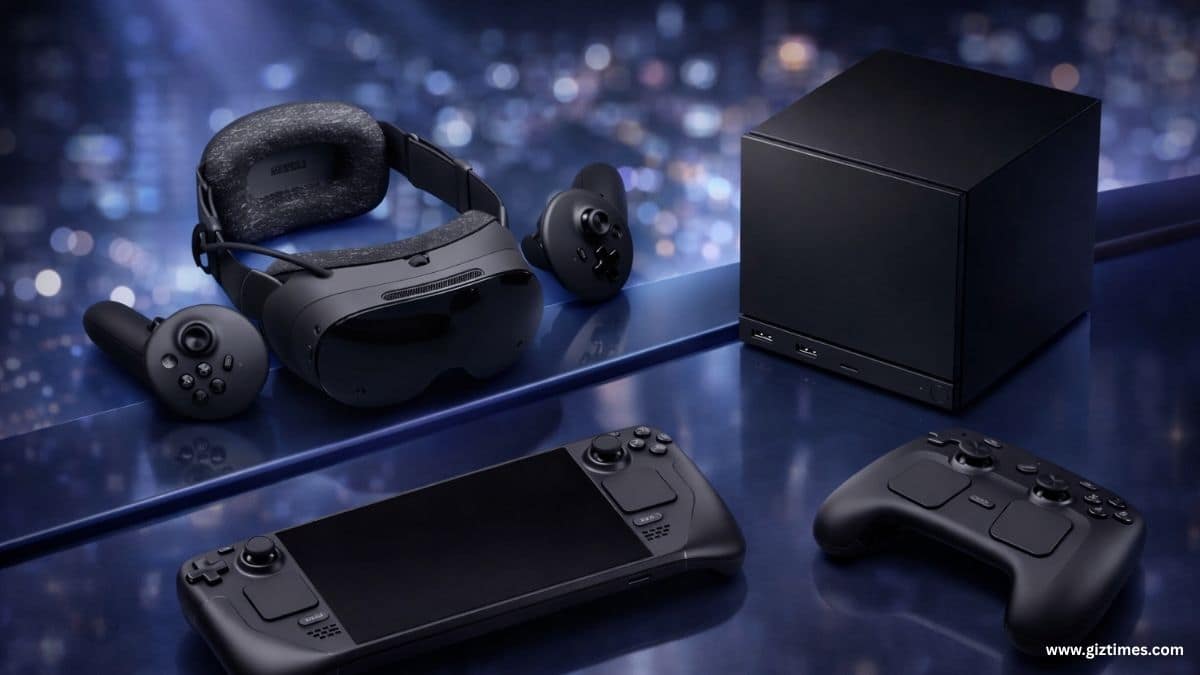
HYDERABAD, India (GizTimes) — The Valve Corporation’s 2026 announcement of its Steam Machine represents a smart return to the living room market, but this time accompanied by solid hardware design and optimized software. In comparison with Valve’s earlier fragmented attempts in 2015, this release features a well-planned design with Zen 4 and RDNA 3, and advanced Proton-based software support with an optimized Linux operating system.
PlayStation and Xbox, on the other hand, are currently at the top of their hardware development and rely on Zen 2 processors with mid-cycle updates (e.g., PS5 Pro). This creates a stark difference because Valve is clearly focused on the way performance is implemented, sustained, and scaled.
This article will shed light on the transition that Valve made in terms of their 2026 Steam Machine, along with reviewing the machine’s performance figures.
Why This Is Important for Game Performance
Even though the latest consoles have a clear advantage in GPU throughput, gameplay performance no longer depends solely on GPU capabilities. Rather, the modern CPU design, frame pacing, and optimization play crucial roles in the process of achieving higher gameplay performance.
According to Valve’s official Announcement, It move towards the Zen 4 architecture is critical precisely due to these reasons. Higher instruction-per-clock ratio, together with increased clock speed, results in improved performance in tasks such as open world streaming, physics calculations, and AI routines. In turn, this allows players to enjoy smoother gameplay and stable frame rate, even in complex simulations.
In other words, the Steam Machine is designed with the goal of creating a consistent 1080p frame rendering with an upscale to 4K. This stands in stark contrast with consoles whose performance is based on artificial techniques such as PSSR AI upscaling to keep 60 fps.
Performance Assessment
It should be noted that in terms of GPU performance, Valve’s Steam Machine is inferior compared to PS5 and XBox. For example, PS5 Pro offers up to 16.7 TFLOPs, whereas Valve’s machine relies on only ~8.9 TFLOPS. At the same time, Xbox Series X relies on Zen 2 with fixed frequency in comparison with Zen 4 used in the Steam Machine.
These architectural differences allow Valve to achieve better performance due to the following three aspects:
- CPU modernization. As previously mentioned, Zen 4 is capable of delivering more instructions per clock cycle than Zen 2.
- Memory design. While current consoles have unified GDDR6/DDR5 memory, Valve’s machine features two memory types: 16GB DDR5 and 8GB GDDR6.
- Upgradability. Valve’s design allows changing the amount of installed storage and system RAM, which increases performance in the future.
Therefore, it is safe to assume that consoles offer superior performance initially, but over time it deteriorates, and performance gaps appear. Valve‘s system, on the other hand, is built in a way that enables future scalability.
Performance Comparison
As was said above, current gaming hardware offers higher initial performance but is unable to sustain high performance levels over time. In contrast, Valve offers a flexible solution with a different performance model:
| Component | Steam Machine (2026) | PlayStation 5 Pro | Xbox Series X |
|---|---|---|---|
| CPU | 6-core Zen 4 | 8-core Zen 2 | 8-core Zen 2 |
| GPU | RDNA 3 (28 CUs) | RDNA 3/4 Hybrid (60+ CUs) | RDNA 2 (52 CUs) |
| RAM | 16GB DDR5 + 8GB GDDR6 | 16GB GDDR6 + 2GB OS DDR5 | 16GB GDDR6 |
| Storage | NVMe SSD (Upgradeable) | NVMe SSD | NVMe SSD (Expandable) |
| Performance | Upscaled 1080p to 4K | AI upsampling (PSSR) | Dynamic resolution + FSR |
| Hardware architecture | Semi-modular architecture | Fixed architecture | Fixed architecture |
Herein, the main distinction is that Valve’s solution relies on horizontal scaling through software, whereas console manufacturers choose vertical one.
Public Reactions to This Change
Public opinion on this matter is divided. Some people see this as a smart move by Valve, whereas others question the viability of the company’s plans. There are a few key points of disagreement:
First, some gamers claim that no level of optimization is able to compensate for low assets. This creates an impression that Valve will experience performance bottlenecks even in its highly-optimized games.
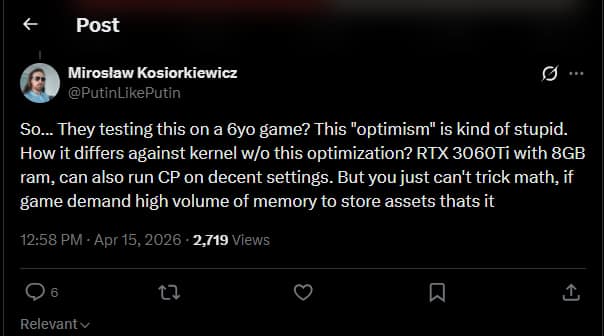
Second, many gamers doubt the benefits of optimization and upscaling. There is a common belief that developers tend to rely excessively on optimizations to mask flaws in the game itself.

Third, however, there is also a viewpoint that this represents the next step in gaming and shows a potential future. According to this viewpoint, SteamOS and Proton optimization layers could help in reducing the need for Windows.
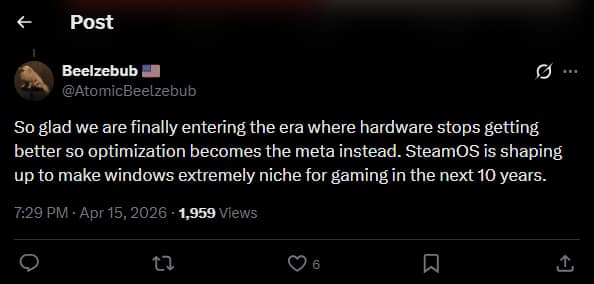
Thus, it is possible to say that while players demand optimization and upscaling, they do not trust developers in it. Valve steps right into this gap.
Why Is It Important?
This move by Valve represents a serious challenge to consoles’ main competitive advantage: fixed hardware optimization.
In previous decades, console manufacturers had a significant advantage in comparison with PC because developers could optimize software for particular hardware. However, as hardware became more complex, optimization efforts started to yield smaller effects.
This leads to a situation where it is easier to achieve performance improvement with software. In such cases, Valve could have a competitive advantage because its design is aimed at increasing performance by software layers.
In addition, this move could put additional pressure on PlayStation and Xbox. Namely, Valve would offer both better hardware optimization and greater game selection through SteamOS.
Extra Takeaways
The most non-intuitive aspect of this change could be the choice of CPUs. Namely, Valve’s machine uses 6-core CPUs compared with 8-core ones offered by Sony and Microsoft. Herein, it could be implied that CPU performance matters more than core count.
If Valve succeeds, then performance will be based on software optimization and hardware flexibility, not on pure hardware.
Read More:
