

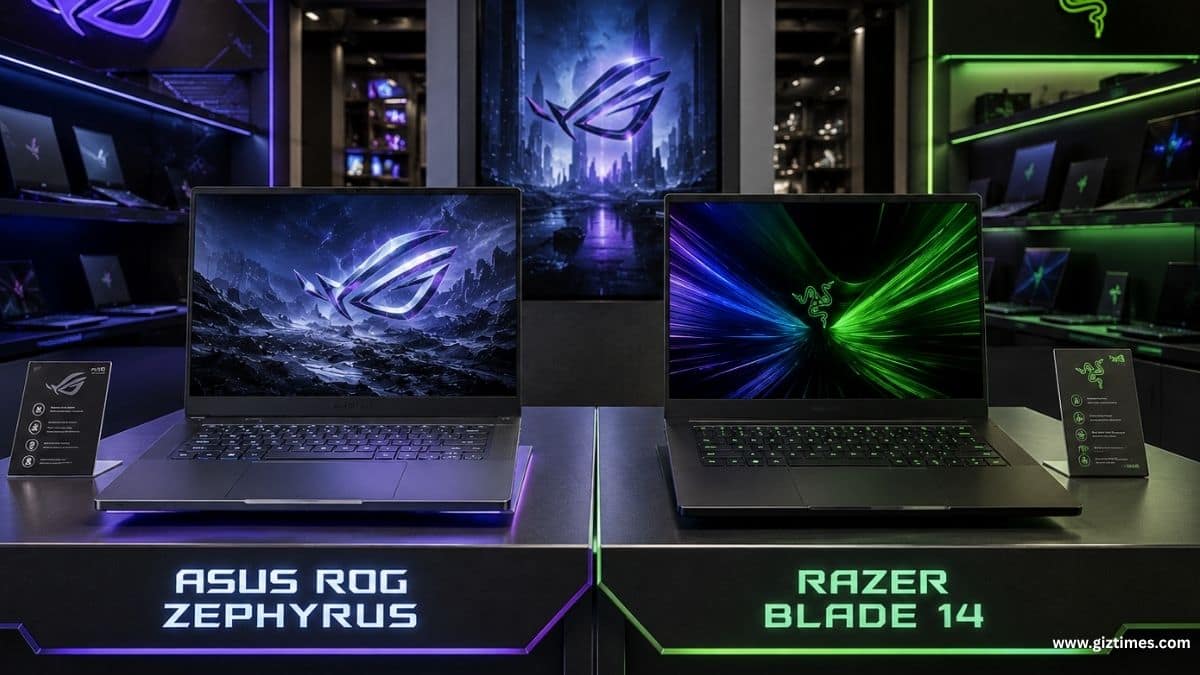
HYDERABAD, India (GizTimes) -14-inch gaming laptops have always existed in trade-offs. Smaller dimensions meant limited cooling, suboptimal GPU power budgets, loud fans, and decreased durability. Gaming laptops had been seen more as traveling devices than reliable workstations.
The game is changing now. Today’s 14-inch laptops come equipped with RTX 5070 and RTX 5080 GPUs, OLED screens, AI-optimised CPUs, and top-tier colour fidelity – all packed in extremely thin enclosures that are thinner than some business ultrabooks.
Today, the question is not whether 14-inch laptops have enough power to get things done. The question is about the nature of the product that is being sold to buyers.
The ASUS ROG Zephyrus G14 and the Razer Blade 14 stand on entirely different grounds in this respect. While ASUS focuses on building a dense package of power in a minimalistic design, Razer concentrates on creating a luxury piece of engineering that is good at gaming at the same time.And this contrast plays a significant role in the decision-making process.
What Purpose do These Machines Serve?
The ASUS ROG Zephyrus G14 is there because ASUS understood that people no longer consider their gaming laptops separately from other work tasks. The G14 aims to combine maximum gaming performance in a machine that could also handle everyday work tasks.
This means that modern Zephyrus G14 emphasizes efficient cooling solutions, high GPU power budgets, OLED screens, and flexibility in software configurations. Even the change in design principles in 2024 shows that the company aims to make the machine usable in professional environments.
On the contrary, the Razer Blade 14 targets users who need both an elegant business machine and reliable gaming laptop. In fact, the company positions its Blade as a high-end ultrabook that comes with the gaming capabilities built-in.
This may sound like semantics, but Razer is actually targeting users who would normally be interested in the MacBook Pro 14 but want to use gaming apps too.The intriguing thing is that ASUS has gradually evolved its own product toward a similar goal. This results in the main contradiction between these products.
The New Era of Multi-purpose Workflows
The most crucial shift for 14-inch gaming laptops does not concern GPU capabilities. It concerns behavior.
Today, people buy these laptops because they want one device to perform both professional and gaming workflows. The new focus explains why both ASUS and Razer concentrated on sleek aluminum designs, OLED screens, low-noise behavior, and charging via USB-C.
However, different philosophies lead to slightly different approaches to the multi-purpose workflow optimization.The ASUS machine assumes that gaming performance is the primary task and tries to make it presentable in the office space. Razer focuses on usability as the base and adds gaming to this experience.
This subtle point is best observed in technical parameters.
The ASUS ROG Zephyrus G14 makes a considerable effort to maximize GPU power capabilities. The company enables the RTX 5080 Laptop GPU to consume up to 130W in Manual Mode. The machine implements highly efficient cooling technology such as liquid metal interfaces and complex ventilation systems.Razer reduces GPU budget to 115W to ensure better performance under light load and lower temperatures. The 2025 design of the Blade is also slightly thicker, which means higher efficiency.
And these decisions result in different user experiences.The G14 is more about maximum efficiency and performance in a relatively thin enclosure. The Blade 14 feels like a luxury ultrabook that suddenly becomes a powerful gaming machine when connected to AC power.
Processor Capabilities and Future Outlooks
Processor technologies play a crucial role here as well.The 2026 ASUS ROG Zephyrus G14 implements the newest Intel Panther Lake Core Ultra 9 386H CPU with special Low-Power Efficient cores and enhanced NPU supporting 50 TOPS operations.
Similarly, Razer implements the newest AMD Ryzen AI 9 365 CPU with hybrid Zen 5 and Zen 5c architectures and a powerful NPU reaching 50 TOPS.The two technologies look equally promising for AI-optimized applications and future Copilot+ technologies of Windows OS.
However, the two manufacturers utilize these processors in different ways.ASUS tries to implement efficient cooling systems to enable maximum performance during long sessions. Razer aims to maintain the machine’s usability and portability through efficient scaling of power consumption.
The implication of the above is clear.ASUS believes that users expect to see performance as the primary characteristic of a gaming laptop. Razer thinks that today users focus on experience, rather than performance.
Consequences of Minimizing the Design
The design change in both machines leads to the same outcome.
Starting from the latest version, the ROG Zephyrus G14 features fully soldered LPDDR5X memory. As a result, users should configure the amount of installed RAM at the stage of purchasing since any future upgrades will be impossible.
For some time, Razer tried to offer users a possibility to extend the RAM capacity through upgradeable SO-DIMM modules. But the 2025 Blade 14 has returned to a fully soldered LPDDR5X memory design.This implies that in 2025, premium gaming laptops are similar to smartphones – buyers have to pre-configured their machines for all possible needs because future upgrading is not an option anymore.
Considering the above, it becomes even clearer which machine is more affordable.The G14 starting from the RTX 5070 Ti variant costs $3,599.99 and has more powerful options for over $4,700.The Blade 14 with RTX 5070 GPU goes for $2,699.99 and costs $2,999.99 with the flagship 64GB memory.In other words, the so-called luxury machine becomes the cheaper one in some cases.
Comparison
The G14 and Blade 14 are no longer separated primarily by gaming performance. They are separated by what kind of ownership experience they prioritize.
| Category | ASUS ROG Zephyrus G14 | Razer Blade 14 |
|---|---|---|
| Core Philosophy | Democratized high-performance utility | Premium lifestyle-focused performance |
| GPU Power Strategy | Aggressive wattage scaling up to 130W | Efficiency-focused 115W ceiling |
| Chassis Direction | Minimalist unibody redesign with gaming-first thermals | Luxury CNC aluminum ultrabook aesthetic |
| Display | 3K 120Hz OLED Nebula HDR | 2.8K 120Hz OLED |
| Cooling Approach | Liquid metal, advanced ventilation, aggressive airflow engineering | Vapor chamber cooling with balanced acoustics |
| Memory Design | Fully soldered LPDDR5X | Fully soldered LPDDR5X in 2025 redesign |
| Software Ecosystem | Armoury Crate or lightweight G-Helper alternative | Synapse ecosystem |
| Weight Focus | Around 1.5 kg class portability | 1.63 kg to 1.84 kg depending on configuration |
| Target Buyer | Performance-focused hybrid gamer/creator | Premium productivity user who also games |
| Pricing Direction | Extremely premium in high-end trims | Expensive but comparatively more controlled |
Public Reaction Analysis
If we look into comments of buyers, we can notice a peculiar phenomenon regarding ASUS and Razer.
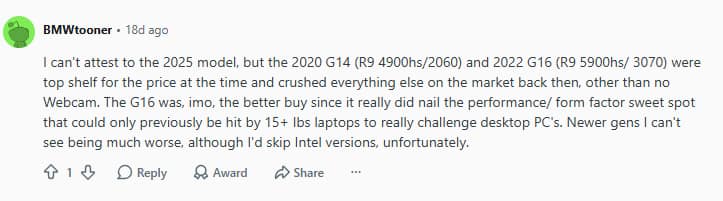
On the one hand, users are impressed with the balance between performance and form factor in the ROG ecosystem. According to several buyers, the G16 reached a balance of gaming performance and form factor that could be seen previously only in larger machines. This comment shows that ASUS succeeded in its primary strategy.
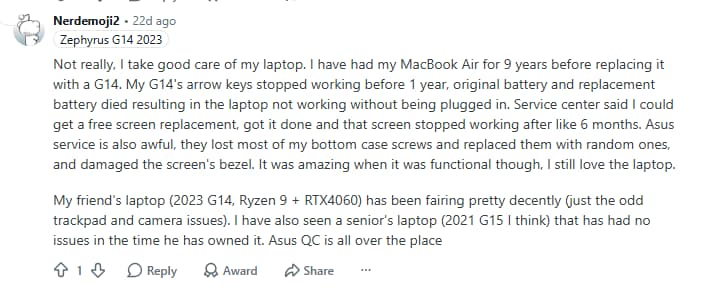

On the other hand, a user complained about the quality control problems such as battery issues, keyboard errors, damaged repair services, and unpredictable support programs. However, this buyer still noted that he enjoyed using the machine as long as it worked.And these comments suggest an intriguing insight.
While consumers perceive ASUS as the manufacturer of machines with excellent performance characteristics, they still doubt the stability of its products.Users love ASUS technologies and are willing to overlook minor issues. But the lack of reliability becomes obvious when the machine breaks.The case with Razer is quite the opposite. Users assume that Razer sells premium machines with high prices. And they carefully consider the cost-to-benefit ratio when purchasing Razer products.
Why Does It Matter
Modern premium gaming laptops are becoming more versatile. Consumers want to buy one expensive device and replace all others with it. The combination of professional and gaming capabilities increases demands on usability.
Thus, today people measure value in terms of efficiency. It is no longer about FPS per dollar. Buyers evaluate how easy it is to use the machine in multiple environments.ASUS managed to achieve it with Zephyrus G14. Although Razer Blade 14 is a more polished and luxury product, ASUS has managed to build its machine with better gaming performance.
In addition, ASUS offers better gaming capabilities without compromising on the usability aspect.The surprising conclusion is that today ASUS succeeds in selling its product even though Razer is better in marketing terms.
Other Keytakeaways
The recent trend to create lightweight utility programs such as G-Helper for ROG ecosystem indicates a shift in attitudes toward gaming laptops. Enthusiasts do not need heavy tools; they want efficient software without any unnecessary layers.
Razer still uses its Synapse ecosystem for controlling Blade, and that shows the difference in companies’ visions.OLED display adoption also changes the industry. Now gaming machines implement OLED screens to deliver better visual experience to creators. Gaming displays are gradually evolving.
The following year may show us how gaming laptops will adapt to the new GPU generation.
