


ANUPPUR, India (GizTimes) — For over four decades, personal computers followed a basic rule: humans tell the machines what to do, the software does the task, and the OS manages everything. Users sort of directed the show between different apps and tools. Now, the Agentic AI PC is shaking things up fundamentally.
NVIDIA’s RTX Spark and updates to Microsoft Windows represent more than just a standard hardware boost. These advancements signify a big shift towards a smarter computing platform. This new tech isn’t just about boosting speed; it’s about creating PCs that can reason, plan, recall info, use tools, and carry out jobs on their own – all in the service of the user. Personal computers are becoming less about strict command-following and more about understanding goals and figuring out how to reach them.
To make this possible, several key tech pieces fit together. We’ve got foundational models, multi-sensory AI, smart local processing, neat memory setups, agent systems, and OS-driven management. All these combined provide the groundwork for our computers to act more autonomously.
Why This Is Happening
Traditional software architectures shine when the workflows are predictable. Apps show off preset functions, users give clear instructions, and results are straightforward. This worked great during the personal computing era because many tasks followed fixed steps.
But issues crop up for knowledge-heavy work like research or coding. Those tasks don’t stick to set paths; they involve collecting info, adapting, and jumping between tools.
Large language models showed us the flaw—and offered a fix. These models understood intentions through natural language, not just commands. So once AI grasped our aims, people asked, “If software gets the big picture, why do we still need to run all the workflows?“
Agentic AI is trying to address that, by moving from just executing commands to actually completing goals. Systems would handle coordinating apps themselves instead of making users do all the work. Thanks to RTX Spark and Windows, this tech’s becoming more normal in day-to-day computing.
Foundation Models Become Computing Infrastructure
The first generation of generative AI focused on creating foundation models for conversational interfaces. These could generate text, answer questions, and summarize info, but agentic systems need more.
In the Agentic AI PC architecture, foundation models work as key computing elements. Llama Nemotron Nano, Gemma, Mistral, Llama, ChatGLM3, CLIP, and Whisper each handle specific tasks like reasoning, vision understanding, and speech rec. They’re not just apps anymore, but parts you can use to build other things. Cool, right?
It’s like how operating systems developed. Back then, OSes started managing hardware for apps; now, foundation models are doing similar, but for smart systems. This makes smarts a basic part of the setup instead of some extra add-on.
The Rise of Multimodal Intelligence
When it comes to dealing with computers, people usually manage text, images, audio, and video in different ways. Docs are for text, galleries for pics, and comm apps for calls, and so on.
But now, AI handles all that together. With CLIP and Whisper integrated, machines get a grasp of all these through one framework. So the AI can check text, pics, audio, videos in one go.
Before, a computer would treat info like separate pieces of a puzzle. Now, thanks to multimodal systems, it links stuff through shared meanings. Whether an image or a voice command, an AI-driven tool can understand and connect everything, much like we do.
Computers finally see info the way we think about knowledge—linked up by meaning instead of just stuck in separate folders.
Memory Becomes the New Persistence Layer
The big shift in agentic computing is all about moving from storage-focused systems to those built around memory. Traditional apps only fetch data when told, but smart systems need constant info, keeping track of earlier chats and understanding past context.
To deal with this, RTX Spark uses huge memory pools, going up to 128GB, which means big foundation models and really long context windows stay local. This setup supports models with over 120 billion parameters and can handle up to a million tokens.
Now, memory isn’t just a short-term area; it acts as a permanent brain. Large context windows mean agents can look at full codebases, personal messages from years back, giant document sets, and more, all without needing to reset context. This brings real continuity, making AI responses smarter because they use all past info.
Retrieval-Augmented Generation and Personalized Intelligence
For personalization, relying solely on model settings falls short. Agentic systems must draw on fresh, changing info from outside. Enter Retrieval-Augmented Generation (RAG). It lets models check external data banks first, then make replies.
In practice, ChatRTX shows off this tech by connecting files like docs, PDFs, and media transcripts straight to search paths. Now your device works like a mini-smart system, pulling data from personal info stores without sending stuff online.
The kicker? Effective intelligence hinges on more than just the model’s strength—it needs good memory and strong retrieval methods too. As these AI things grow, who’ll lead? Those with the best memory systems, not just the biggest models.
From Prediction Engines to Reasoning Systems
Large language models are basically prediction engines; they figure out what comes next based on the text or context before it. But autonomous agents need more – they need extra thinking abilities.
These reasoning systems take it up a notch. Instead of just spitting out one answer, they plan, check if their steps will lead to the goal, and loop back for improvements if needed. This lets us shift from having conversations with bots to using them for real tasks.
The key point here is agency, not just smarts. A chatbot can answer questions all day long, yet an agent takes action toward a target. That’s why folks developing AI now zero in on building these reasoning structures rather than just making the models larger.
Planning, Decomposition, and Autonomous Execution
A big part of being autonomous is planning. You hardly ever solve complex tasks in one shot – you’ve got to research, organize your moves, choose tools, execute, verify results, and adjust as things change. Because of this, these advanced systems split goals into doable parts, and then they assess, prioritize, and keep an eye on those tasks through loops of feedback.
The biggest change is that these tasks aren’t set in stone anymore. Old-school programs followed strict paths written by devs. But these new agentic systems make their own way as they go, depending on what the user wants, the environment they’re in, the tools around, and anything else that pops up.
This switch means computers become way more involved in solving problems, moving past just doing tasks to actually participating actively in finding solutions.
Tool Use and Environment Interaction
Reasoning alone can’t create useful independence. An agent only proves its worth when it interacts with the outside world.
The RTX Spark ecosystem supports integration with LangChain, CrewAI, Flowise AI, Langflow, LM Studio, AnythingLLM, and AI Toolkit for VS Code through NVIDIA NIM microservices. These frameworks allow agents to call upon tools, manage workflows, keep track of memories, and coordinate efforts.
With these systems, agents get to use apps, files, APIs, databases, coding tools, web browsers, and enterprise software. This marks an important shift in how software functions and evolves.
Traditionally, features were built right into programs. But now, agentic computing is moving those abilities outside, letting reasoning systems choose and blend them as needed. So, apps are becoming more like tools we draw upon instead of fixed stops we visit.
Why Local Inference Changes Everything
This change is big because it makes things more flexible and powerful. Plus, running stuff locally on devices can fix many issues that come from depending too much on the cloud, like delays and privacy concerns.
The RTX Spark setup uses a Grace CPU, Blackwell GPU, Copilot+ compatible NPU, and unified memory system to crunch massive amounts of AI data right there on your device. No need to send everything offsite.
Local processing means smarter operations that happen quicker and safer, all while respecting user privacy. It lets personalization grow deeper without risking confidential info. Kinda like how we went from mainframe computers to personal PCs, the bulk of the number-crunching now happens right where you are, making everything faster and more personal.
Windows Becomes an Orchestration Layer
The operating system traditionally handles hardware resources, memory allocation, storage access, and application execution. Now, with agentic computing, it takes on a new role: orchestration.
Thanks to Windows ML, ONNX Runtime, DirectML, and TensorRT integration, Windows now directs AI tasks among CPUs, GPUs, and NPUs. This shift shows a more significant underlying change; OSes aren’t just overseeing software anymore—they’re handling intelligence too.
With AI becoming constant players in the system, the OS now directs reasoning, memory, and retrieval, all while accessing tools, keeping secure, and determining where tasks happen. Soon enough, we might see OSes as orchestration platforms rather than just software managers.
The Security and Governance Challenge
Security poses a huge issue with this evolution. The handier an AI gets, the more permissions it needs. But giving it more power also means dealing with bigger risks. These smart systems read files, make code, use apps, get into different environments, and do all sorts of stuff that old security measures weren’t built to manage.
That’s why Microsoft and NVIDIA are creating shields like MXC and OpenShell. These tools isolate processes, separate sessions, and control everything via strict policies and identity checks. This paints a picture: for agentic computing to thrive, we’ll need top-notch governance frameworks almost as much as we need intelligent models themselves. In the end, what might decide how widely this tech is used is really about trust, not its brainpower.
The Architectural Stack of the Agentic AI PC
The Agentic AI PC follows a layered architectural design.
Its hardware includes the Grace CPU, Blackwell GPU, NPU, and unified memory. Sitting above is the runtime layer, housing Windows ML, ONNX Runtime, DirectML, TensorRT, and NIM microservices. Then there’s the memory layer, which uses context windows, retrieval systems, document repositories, and persistent knowledge stores. Next up is the agent layer, dealing with reasoning, planning, decomposition, reflection, and orchestration. The tool layer lets users interact with apps, APIs, files, browsers, and enterprise systems. Security is managed through a layer dedicated to permissions, containment, auditing, and trust boundaries. Finally, interaction happens via natural language, voice, multimodal inputs, and conversation flows.
All together, the layers look more like a brain than a traditional computer setup. This distinction might be the key thing coming out of this technology shift.
So, why does this matter?
Well, it’s way bigger than just new hardware. For people doing knowledge work, it means software that keeps context going no matter the project. Developers get assistants that deal with code in big databases. Researchers get help making sense of mountains of info. And creators get tools for handling intricate tasks right on their device.
What stands out about this architecture is how it simplifies the workload for users. With unified memory, data moving becomes less of a hassle. Search gets easier thanks to retrieval systems. Planning systems mean less time managing your workflow. And automatic tool coordination means you spend less time switching between apps.
This all adds up to something pretty cool for the future. It’s not just about having smarter software; it’s about eliminating humans as the main coordinators in tech tasks gradually.
Public Reaction on NVIDIA RTX Spark
Public reaction to the Agentic AI PC shows that the real bone of contention isn’t really with artificial intelligence. Instead, it’s about the drastic changes needed in computer design to make these AI systems work well.
People are pretty down on old x86 systems. There’s a strong feeling that this tech has gotten too sluggish from years of updates and now it’s slowing everything down. So when the RTX Spark came out with its new Arm-based setup, it made a big statement by turning away from the usual PC building norms. Clearly, they think breaking some old molds is what tech needs right now.

Yet there’s another group up in arms, worrying about being able to fix or improve their machines later on. With CPUs, GPUs, NPUs, and memory all jammed together, these folks feel future devices might be more like cell phones—where you’re stuck with what you’ve got when something breaks or gets outdated.
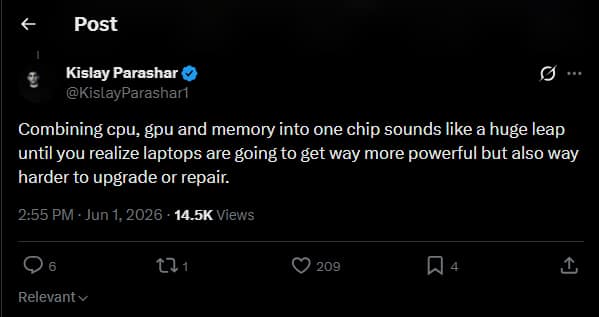
This pits two very different ideas about computer design against each other. For a long time, building PCs meant you could tinker and update pieces over time. But the trend these days is toward systems that squeeze every ounce of efficiency from tightly linked parts, sometimes at the cost of flexibility. Gamers, for example, tend to hit back at this since they usually care first about easy upgrades and classic measures like raw processing speed.

Looking closer, though, you notice that most critiques aren’t attacking AI altogether. They’re more bothered by what it takes to house these smart systems. That implies users can get behind the cool abilities of AI but aren’t ready to board ship on completely new types of machines just yet.
Past shifts in tech, say from tubes to transistors, needed trading old perks for new ones. Now, the talk around these new PCs is boiling down to whether folks will hand over the freedom to tweak hardware in exchange for these powerful, always smart devices.
Extra Insights
The most significant innovation in the Agentic AI PC isn’t about the model, GPU, or even the OS. Rather, it’s how previously separate technologies have been joined into one big brain, so to speak.
Large language models handle reasoning. Retrieval systems take care of memory. Multimodal architectures give us perception. Agent frameworks allow for action. Local inference boosts autonomy. And governance systems ensure trust.
Each one on its own is pretty cool. But when you put them all together? That’s what makes this new computing era possible.
However, while having local AI, unified memory, and self-reliant agents pushes personal computing towards actual collaboration, the bigger issue is making sure these super smart systems stay dependable, secure, open, and trustworthy enough for real-world choices.
Read More:
- Lotus Emira 420 Sport: Why Lotus Chose Optimization Over Reinvention in Its Fight Against the Porsche GT4 RS
- GIGABYTE AORUS ELITE vs Alienware AW3225QF: The Future-Proof Gaming Monitor vs the Perfect Curved OLED Experience
- Tesla Model 3 vs BMW i4: Why Software, Range, and Charging Infrastructure Matter More Than Luxury Features
