

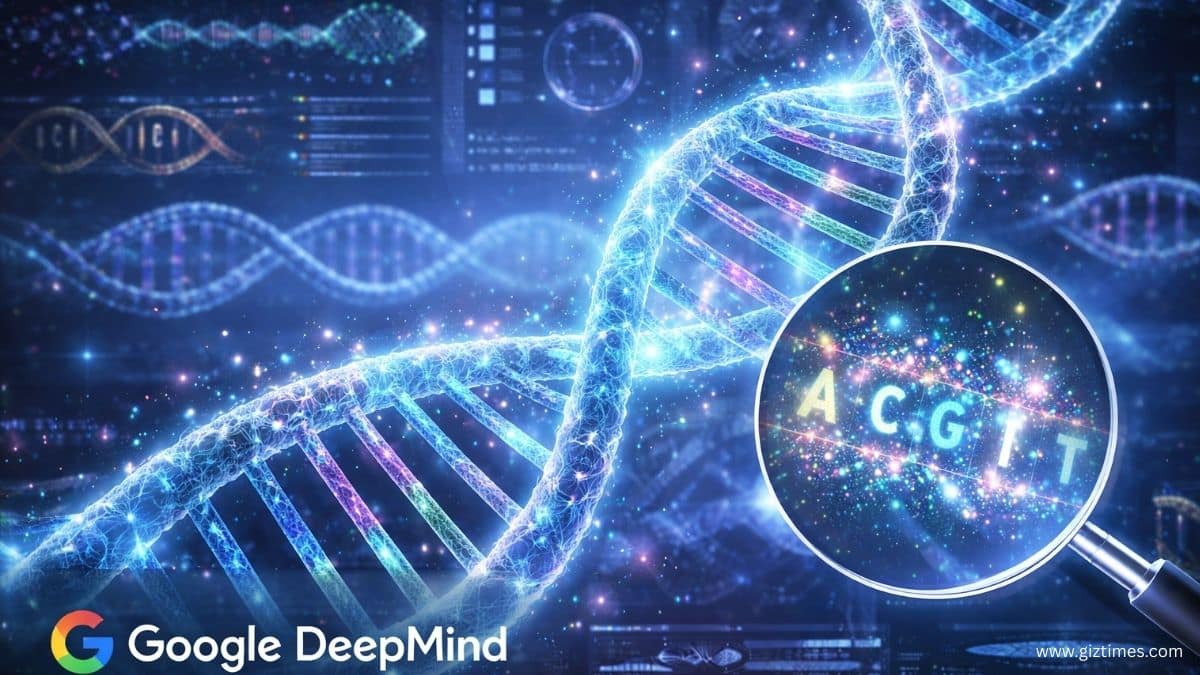
Google DeepMind has created AlphaGenome, an AI system that can understand the hidden parts of human DNA. About 3 billion letters make up human DNA.—A, C, G, and T. Only about 2% of this DNA directly makes proteins that keep us alive. Scientists already know a lot about this small part. The remaining 98% is often called the “dark genome.” It does not make proteins, but it controls when, where, and how genes turn on or off. This part of DNA is much harder to understand, but it plays a big role in health and disease.
Our breakthrough AI model AlphaGenome is helping scientists understand our DNA, predict the molecular impact of genetic changes, and drive new biological discoveries. 🧬
Find out more in @Nature ↓ https://t.co/jvBLRXYzdj pic.twitter.com/WEL4Ptdv06
— Google DeepMind (@GoogleDeepMind) January 28, 2026
AlphaGenome helps scientists read and interpret this dark genome. By doing this, it can give new clues about genetic diseases, why some genes misbehave, and how small DNA changes can lead to health problems. In simple terms, AlphaGenome shines a light on the most mysterious part of our DNA, helping researchers understand diseases better and, in the future, improve treatments.
AlphaGenome scans 1 million letters at a time. It finds genes and shows what the dark parts do, like turning genes on/off or mixing proteins. It even predicts what happens if one letter changes—super helpful for spotting disease causes.
Natasha Latysheva from DeepMind says it helps us understand life’s code faster. It could solve rare diseases, obesity, diabetes, and cancer. Doctors might use it to find drug targets or design gene fixes. It’s in Nature journal and free for scientists (3,000 already using it). Dr. Gareth Hawkes tests it on obesity genes in the dark genome. “Big step forward,” he says. It helps plan lab tests and new medicines. Experts praise it as a huge win in DNA AI, but it’s not perfect yet.
DeepMind won a Nobel for AlphaFold (protein shapes). Leader Pushmeet Kohli says AI will spark big science wins, especially in the UK. AlphaGenome doesn’t work like ChatGPT, guessing the next word. It connects changes in DNA to real biological effects in the body. It was trained using data from human and mouse cells, so it learns how DNA actually behaves in living organisms.
Users’ reactions on X (Twitter) to DeepMind’s AlphaGenome announcement reflected a mix of optimism, humor, and thoughtful caution.
A user welcomed the tool as a clear positive for the scientific community, Will help in practical and powerful aid for genetic researchers.
https://x.com/el_thib_ai/status/2016572650177327190
Another user with tech-savvy humor, comparing AlphaGenome to a “linter” for nature’s legacy code—suggesting that, much like software debugging, the AI might finally help identify why the human body begins to “malfunction” with age, such as chronic back pain after 30.
https://x.com/thecsguy/status/2016559159563735517
One more user struck a cautionary note, emphasizing that while AI models can identify patterns and generate predictions, the real challenge lies in knowing when those predictions should be trusted.
https://x.com/ClearThinkinAi/status/2016562786533593212
However, it still has some limits. It finds it hard to understand gene controls that act from far away on the DNA. It also struggles because the same DNA can behave differently in different body parts—for example, brain cells and heart cells use the same DNA in different ways.
Even though it needs more improvement, AlphaGenome is already making a big impact on medical research and has the potential to change how diseases are studied and treated.
Read More:
- Virtual Boy Games Are Coming to Nintendo Switch Online This February: See Which Games Are Included
- Terraria gets 1.4.5 Bigger and Boulder update on its 15th anniversary: See What Community Discussion Says
- Highguard launches as a free-to-play hero shooter with a surprise release at The Game Awards on January 26
