

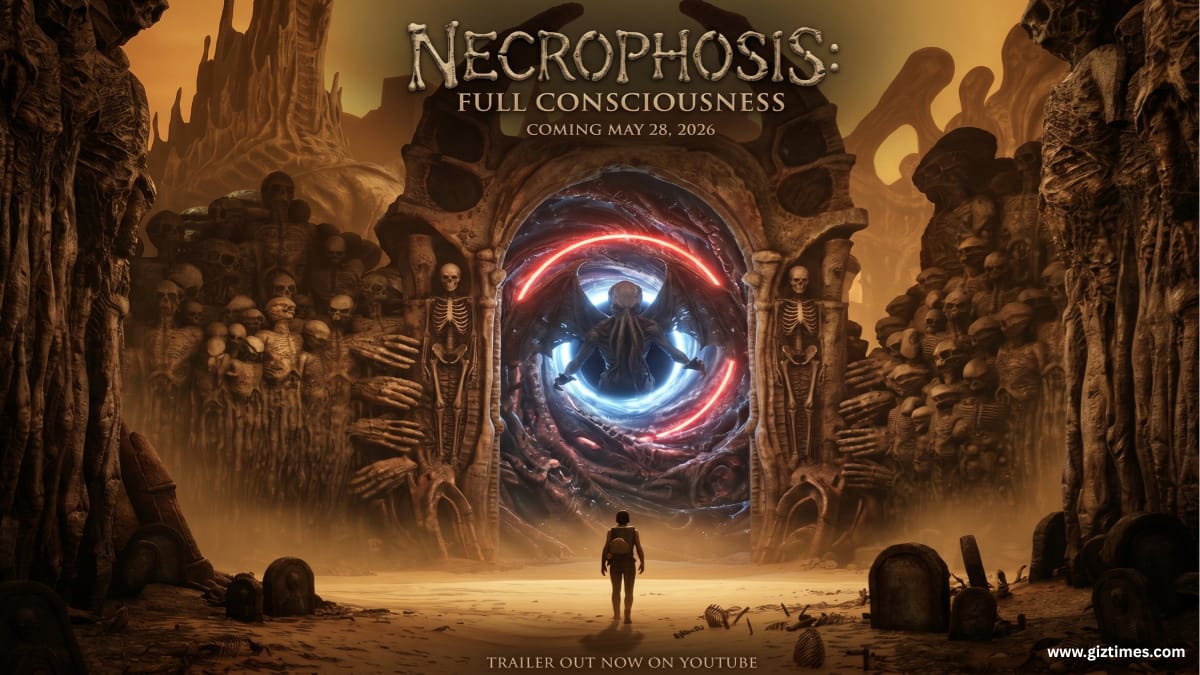
HYDERABAD, India (GizTimes) —Necrophosis: Full Consciousness will be releasing on May 28, 2026, and what seems different about this one is that it isn’t treated as any other game. Since the trailer is coming out on April 14 on YouTube, it is clear right off the bat what kind of experience we can expect; that is, a horror without weapons and psychological puzzles.
The tension is immediate. This isn’t just another indie horror project, it’s stepping into territory already shaped by Scorn, a game that showed both how compelling and how limiting this design approach can be. The real question isn’t whether Necrophosis looks distinct, it clearly does but whether it can avoid the same gameplay friction that held Scorn back.
Why This Matters in Gameplay
Necrophosis boils game mechanics down to exploration, solving puzzles, and decoding the story.
There are no battles, survival elements, or secondary mechanics.
This drastically affects player interactions in Necrophosis. All actions depend on environment and puzzle timings, without any safety valves such as resistance, management of resources, or decision-making under pressure.
The Game Cycle is extremely straightforward:
Observation → Decoding → Puzzle solving → Movement → Looping.
On one hand, the game might benefit from the immersive effect. On the other hand, it increases the risk of failure. The absence of diversity means that only the timing and quality of the story will keep the player engaged.
Issues & Performance Analysis
Necrophosis enters the market built around two big ideas: a pure, focused identity and a complete package that includes its “Subconsciousness” DLC from day one. Both are strengths but both also introduce risk, especially when compared to Scorn.
From a gameplay standpoint, Necrophosis goes even further than Scorn by removing combat entirely. Scorn at least offered biomechanical weapons and moments of strategic tension through limited resources. Necrophosis eliminates that layer, relying fully on psychological pressure and puzzle design.
From a development perspective, Necrophosis arrives as a finished product, unlike Scorn’s long and fragmented development cycle. That signals a clear, unified vision but also removes the opportunity to evolve based on player feedback over time.
The real issue isn’t technical capability, it’s experiential density. Scorn used combat and interaction to break up monotony. Necrophosis removes that option, increasing its dependence on pacing, audio design, and puzzle creativity.
The less obvious takeaway is that Necrophosis isn’t just competing with Scorn, it’s deliberately discarding one of the few systems that helped Scorn stay engaging. That’s bold, but it’s also risky.
Comparison
Necrophosis and Scorn share clear DNA, but their design philosophies diverge in execution depth rather than concept.
| Feature | Necrophosis: Full Consciousness | Scorn |
|---|---|---|
| Core Gameplay | Exploration + puzzles only | Exploration + puzzles + limited combat |
| Combat System | None | Biomechanical weapons with resource management |
| Narrative Style | Abstract, poetic, fragmented | Abstract, environmental, no dialogue |
| World Design | Cosmic decay, eldritch themes | Biomechanical, Giger-inspired horror |
| Player Guidance | Minimal | Minimal |
| Structure | Definitive edition with DLC included | Originally fragmented, later unified |
| Engine | Not specified | Unreal Engine 4 |
| Performance Target | Not specified | 4K / 60 FPS on capable systems |
The key difference is not aesthetic, it’s interaction. Scorn gives players something to do when tension peaks. Necrophosis asks players to sit with it.
Gamers Reactions
Early reactions from the community follow a clear pattern: cautious skepticism.

Many players are directly comparing Necrophosis to Scorn, raising concerns about originality and polish. This goes beyond visuals, it reflects a worry that the game may repeat Scorn’s structure without improving its weaknesses.

There’s also sensitivity around pricing and perceived value. Including DLC in the base package, instead of being seen as a bonus, is viewed by some as unnecessary or even suspicious. That points to a disconnect between how the developers position the product and how players interpret it.

The most critical feedback targets the lack of mechanics altogether. Without combat or stealth, some players question whether the experience fits their definition of a “game.” That’s not just a philosophical issue rather it directly affects whether people are willing to buy it.
There’s also a sense of fatigue. Players who were underwhelmed by similar titles are approaching Necrophosis carefully rather than with excitement. This isn’t a fresh niche, it’s one that already has baggage.
Why It Matters
Necrophosis is entering a market that already understands both the appeal and the limitations of this genre.
Players know that atmosphere alone can become repetitive without meaningful interaction. Many have experienced games like Scorn, admired the art direction, and still walked away unsatisfied with the gameplay.
That shifts the challenge. Necrophosis doesn’t need to prove its artistic vision, it needs to prove that it can stay engaging over time. That’s where many similar games struggle.
If it succeeds, it could push pure psychological horror forward as a viable niche. If it fails, it reinforces the idea that atmosphere by itself isn’t enough.
Extra Takeaways
The mention of 400+ handcrafted assets and multilingual support suggests a strong push for global reach and artistic consistency. This isn’t a small experiment, it’s a carefully built experience aiming for broad visibility.
At the same time, the lack of clear performance targets stands out. For a game so dependent on immersion, technical stability and visual consistency will be crucial but right now, they’re still unknown.
If it delivers, Necrophosis: Full Consciousness could redefine how far atmospheric horror can go without traditional mechanics but by relying entirely on puzzles and mood, it risks running into the same engagement problems that limited Scorn.
