

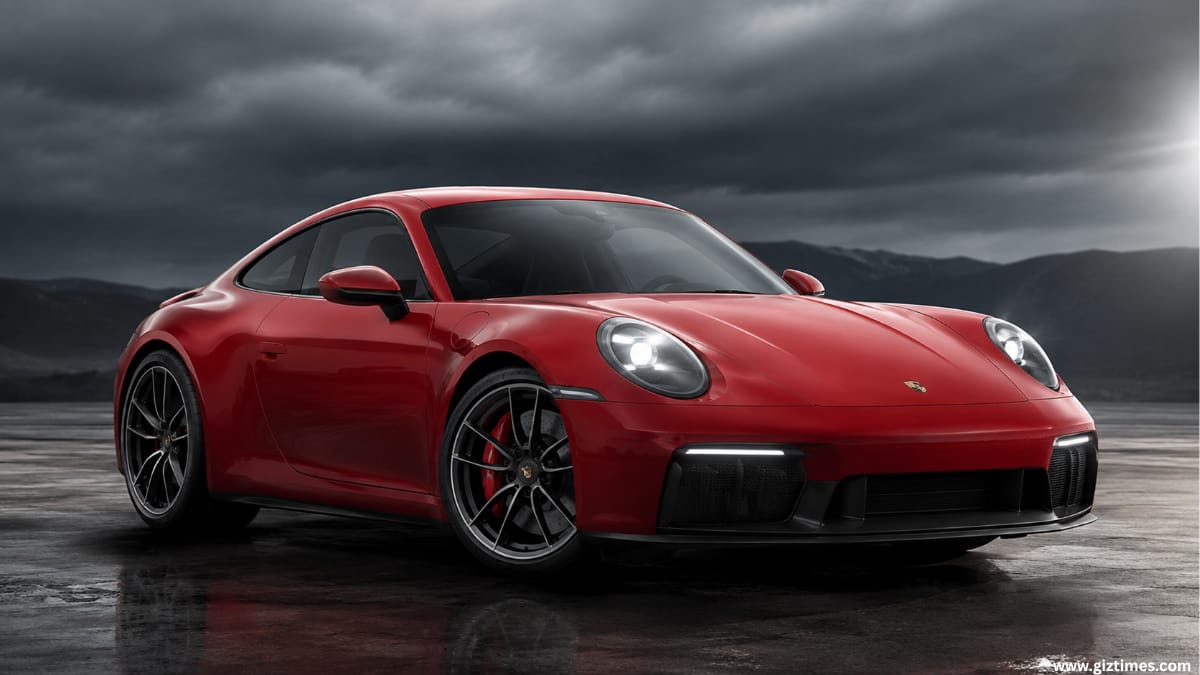
HYDERABAD, India (GizTimes) — The arrival of the Porsche 911 Carrera 4 GTS marks one of the most important technical shifts in the history of the 911. For the first time, Porsche has integrated a hybrid system into its iconic sports car, but the objective is not fuel economy. Instead, the new T-Hybrid architecture is designed to improve performance, responsiveness, and driving dynamics. That decision creates an interesting tension: how do you introduce electrification into one of the world’s most recognizable sports cars without changing the character that made it successful?
Why This Vehicle Exists
The engineering strategy behind the Carrera 4 GTS reveals Porsche’s priorities. Rather than following the industry trend of large battery packs and extensive electric assistance, the company developed a compact hybrid system centered around a new 3.6-liter flat-six engine, an electrically assisted turbocharger, and an electric motor integrated into the transmission.
Together, the system produces 532 horsepower and 449 lb-ft of torque. More importantly, every component serves a performance purpose. The electric turbocharger eliminates traditional turbo lag by reaching operating speed almost instantly, while the transmission-mounted motor contributes additional power during acceleration.
This approach suggests that Porsche sees electrification as a tool to improve the driving experience rather than replace it. The hybrid system is not the headline feature because it is electric; it is the headline feature because it makes the car respond faster and deliver power more consistently across the rev range.
A less clear insight emerges from this philosophy. By using a lightweight battery and recovering energy from exhaust gases through the turbocharger-generator system, Porsche is effectively targeting the weaknesses of turbocharged engines rather than simply adding electric power. The technology is being used to solve a performance problem instead of creating a new power source. That is a fundamentally different hybrid strategy from many modern performance cars.
Framework Integration
The Carrera 4 GTS combines advanced automotive engineering with integrated performance technology.
The centerpiece is the electrically assisted turbocharger. Classical turbocharged engines often experience lag because exhaust flow must build before the turbocharger reaches operating speed. Porsche’s electric motor accelerates the turbo almost immediately, creating faster throttle response while also functioning as a generator that recovers otherwise wasted exhaust energy.
The technology advances beyond the powertrain. Rear-axle steering is standard, improving maneuverability at lower speeds while enhancing stability at higher speeds. Porsche’s active suspension continuously adjusts damping characteristics based on driving conditions, helping the chassis remain composed despite changing road surfaces and driving styles.
Inside the cabin, the fully digital instrument cluster and updated infotainment system bring software deeper into the driving experience. Drivers can monitor hybrid-system information, energy flow, and performance data in real time. Rather than existing as isolated technologies, these systems work together to support the vehicle’s primary mission: delivering more performance while preserving the traditional 911 character.
The result is a sports car in which software, electrification, chassis systems, and aerodynamics all contribute to a single performance objective.
Comparison
The comparison between the Carrera 4 GTS and the Aston Martin DB12 highlights two very different engineering philosophies. Porsche uses lightweight hybrid technology and energy recovery to enhance responsiveness, while Aston Martin extracts maximum performance from a traditional twin-turbocharged V8 and combines it with advanced chassis systems.
| Category | Porsche 911 Carrera 4 GTS | Aston Martin DB12 |
|---|---|---|
| Powertrain | 3.6-liter flat-six T-Hybrid | 4.0-liter twin-turbocharged V8 |
| Hybrid System | Yes, performance-focused T-Hybrid | No |
| Horsepower | 532 hp | 671 hp |
| Torque | 449 lb-ft | 800 Nm |
| Transmission | 8-speed PDK dual-clutch | Not specified |
| Drivetrain | All-wheel drive | Not specified |
| Turbo Technology | Electric exhaust-gas turbocharger | Twin-turbocharged V8 |
| Rear Steering | Standard | Electronic Rear Differential |
| Suspension | Active suspension system | Adaptive dampers |
| Digital Instrumentation | Fully digital cluster | 10.25-inch touchscreen infotainment |
| Key Engineering Focus | Lightweight hybrid performance | Traditional combustion performance |
| Top Speed | Not specified | 202 mph (325 km/h) |
| 0–100 km/h | Not specified | Approximately 3.6 seconds |
Public Reaction Analysis
The public reactions reveal an interesting pattern. The criticism regarding the front cameras and sensors indicates that enthusiasts continue to evaluate the 911 not only as a performance machine but also as a design icon. Even small visual integrations can become discussion points because the 911 sets unusually high aesthetic standards.

The second reaction highlights another theme. Initial confusion about design details quickly gave way to appreciation once the overall execution became clear. This suggests that Porsche’s evolutionary design strategy remains effective. The company introduced significant technological changes beneath the surface while maintaining a familiar visual identity, allowing the engineering story to take center stage.

Together, these reactions show that consumers appear more concerned about how new technology is integrated than the fact that technology exists at all. The acceptance of the hybrid system itself is notable because electrification often generates resistance among sports-car enthusiasts.
Why It Matters
The Carrera 4 GTS demonstrates a potential future path for high-performance vehicles as stricter emissions requirements take effect. Instead of treating electrification as a separate layer added to a sports car, Porsche has embedded it directly into the vehicle’s performance architecture.
This matters because it reframes the role of hybrid systems. The technology improves throttle response, energy utilization, and overall driving dynamics without relying on large batteries or extensive electric-only operation. That makes the vehicle an important example of how software-defined performance and intelligent energy management can coexist with traditional enthusiast expectations.
The model also serves as a real-world demonstration of motorsport-derived technology moving into production vehicles. The electric turbocharger and energy-recovery systems demonstrate how racing innovations can deliver measurable performance benefits on public roads.
Final Takeaways
The removal of traditional front auxiliary lights to create larger cooling openings illustrates how packaging priorities are changing in modern performance cars. Aerodynamics, cooling requirements, and system integration increasingly influence exterior design decisions.
The active cooling flaps represent another subtle but important trend. Components that once performed a single function now adapt dynamically to operating conditions, improving performance and efficiency without requiring driver intervention.
The lightweight battery strategy is as significant as the hybrid system itself. Future performance vehicles may focus more on intelligent energy deployment than on maximizing battery size.
Much of the discussion now centers on how electrification can enhance rather than dilute driving engagement, a factor that could define the future evolution of high-performance sports cars.
