


ANUPPUR, India (GizTimes) — ERNIE Image Turbo, released by Baidu on April 15, 2026, is shifting the positioning of image generation in the generative AI ecosystem. Rather than trying to achieve maximum visual fidelity or artistic value, the model prioritizes speed, controllability, and ease of deployment.
This changes the nature of the competition. The question is no longer “Which model generates better-looking images?” but “Which model can create usable images quickly enough and reliably enough to integrate into production pipelines?”
In this article, we will explore how Baidu’s ERNIE Image Turbo will transform automation systems and affect large-scale production
Why ERNIE Image Turbo is Focusing on Speed
At first glance, the main problem with earlier generations of image generation models was quality. But this was only a superficial issue. Generating usable outputs involved several attempts, prompt adjustments, and post-production corrections. In essence, they remained tools for creative support rather than production infrastructure.
ERNIE-Image-Turbo tackles this issue through three major advances. First, it eliminates three common failure points: poor text rendering, unreliable layout control, and lack of prompt adherence. Second, it introduces a novel Diffusion Transformer architecture that processes text and image in parallel, enabling it to treat typography and layout as fundamental elements rather than post-production additions.
Third, according to data published on Huggingface, it offers an 8-step inference process with the same level of fidelity as ~50-step inference in previous models. Together, these improvements enable continuous, uninterrupted image generation.
Cost and deployment considerations complete the equation. According to the Huggingface data, the model runs on consumer-grade GPUs with 24GB VRAM and can be purchased for about $0.56 per execution via cloud APIs.
With an Apache-2.0 license, this removes both hardware limitations and legal barriers to integration. Finally, the Prompt Enhancer module converts brief prompts into structured instructions. This shifts some of the cognitive work from the user to the system, streamlining the process even further.
The result is clear: image generation ceases to be an interactive activity. It becomes an automated background task.
Hallucination Horizon of ERNIE Image Turbo
ERNIE-Image-Turbo decreases the scope of one type of hallucination and exposes another.
In structured tasks, the hallucination horizon narrows significantly. According to GitHub Repository Benchmark Reports, In LongTextBench benchmarks, it achieves scores of 0.9655 on average. In GENEval tests, the overall score is 0.8667. This indicates that in tasks involving precise text placement, object count, and spatial composition, the model operates reliably.
It is precisely this reliability that makes it suitable for automation. A pipeline generating hundreds of ad creatives cannot afford inconsistency in text rendering or incorrect layouts. ERNIE-Image-Turbo’s architecture is tailored to meet this requirement.
However, the hallucination boundary shifts rather than vanishing entirely. The distillation process embeds guidance, eliminating the need for high CFG scales but reducing controllability via negative prompts. Therefore, users cannot apply fine-tuned corrections during inference.
The user experience confirms this shift. While prompt adherence issues arise only in complex cases, unusual compositions, or non-standard human poses, this is no accident. The model fails precisely when it needs to generalize beyond pre-defined constraints.
Thus, a two-tier reliability model emerges:
- Reliable performance on structured tasks
- Reliability drop on open-ended tasks
This trade-off is acceptable in production environments but problematic for creative exploration.
ERNIE Image Turbo Comparison with Other Models
Unlike previous models, ERNIE-Image-Turbo does not compete with others but complements them by specializing for different production roles.
| Model | Parameter Scale | Key Strength | Speed Profile | Deployment Focus |
|---|---|---|---|---|
| ERNIE-Image-Turbo | 8B | Typography, layout, bilingual prompts | ~8 steps (high speed) | Production pipelines, structured visuals |
| Z-Image-Turbo | 6B | Dynamic compositions, artistic flexibility | Sub-second (enterprise hardware) | Creative generation, abstract prompts |
| Flux / Qwen (12B–20B+) | 12B–20B+ | High-detail textures, resolution | Slower | High-fidelity rendering |
| GPT Image 1.5 | Not specified | Deterministic editing, region control | Optimized | Enterprise workflows, editing precision |
ERNIE-Image-Turbo occupies a unique place on the Pareto frontier, sacrificing flexibility for speed and reliability.
Public Reactions on ERNIE Image Turbo
User responses reveal a dichotomy between quality perception and operational characteristics on different social media platforms.
First, users note the exceptionally clean visuals and high-quality illustrations generated by the model. This confirms benchmark data, proving that ERNIE-Image-Turbo is reliable in controlled aesthetic domains.
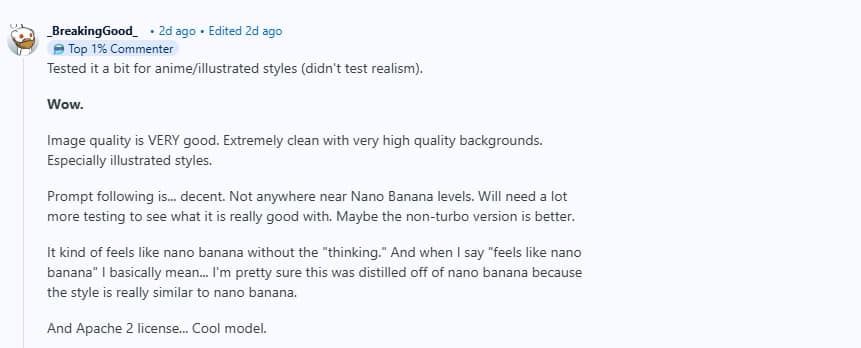
Second, many users mention prompt adherence problems, primarily in complex human scenarios and unusual compositions. This problem is not about image quality but control failures when the task exceeds the boundaries of structured operations.

Third, some users comment on benchmarks, particularly whether the 8-step distillation affects text-based tasks’ performance. This concern reflects the core issue of the model: while it is highly efficient, it may lack controllability in the specific area of application.
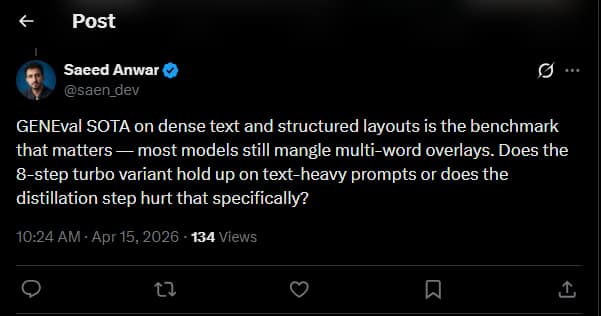
Thus, users evaluate ERNIE-Image-Turbo not as a creative tool but as a production asset. They assess it based on the question: “Does it work reliably under load?”
Why This Market Positioning Matters
ERNIE-Image-Turbo heralds the transition from generative AI as an add-on to generative AI as an infrastructure component.
In advertising and e-commerce, the limiting factor is not creativity but the volume of variations necessary. Businesses need thousands of different creatives across multiple languages, layouts, formats, and contexts. Human-led workflows cannot accommodate such volume.
With ERNIE-Image-Turbo, however, this problem becomes solvable. Simultaneously addressing text rendering, layout, and speed, it allows these assets to be generated automatically. Thus, image generation transitions to the status of a background function feeding other production processes, such as recommendation engines, advertising platforms, and storefronts.
The Apache-2.0 license enhances this shift, allowing companies to self-host and seamlessly integrate the model into their production pipelines. This is crucial for large-scale automation.
Thus this transition reflects the general trend of treating generative models as production systems’ components rather than standalone tools.
Extra Takeaways
A non-obvious implication emerges when analyzing the interaction between the Prompt Enhancer and the DiT architecture.
The Prompt Enhancer normalizes input data by standardizing prompts’ quality, effectively centralizing the creative interpretation process in the system itself. This reduces output variability, making it more appropriate for automation. However, it also implies a gradual shift towards homogenization of generated content due to centralized creative interpretation.
Another subtle shift concerns the parameter scale. ERNIE-Image-Turbo competes with models double its size by optimizing architecture and distillation rather than increasing parameter scales. This suggests that efficiency, rather than sheer power, will become the key lever in some segments of the market.
While ERNIE-Image-Turbo enables fast and reliable image production with high structural reliability, future challenges will involve maintaining control and consistency in unpredictable, human-centric creative environments.
